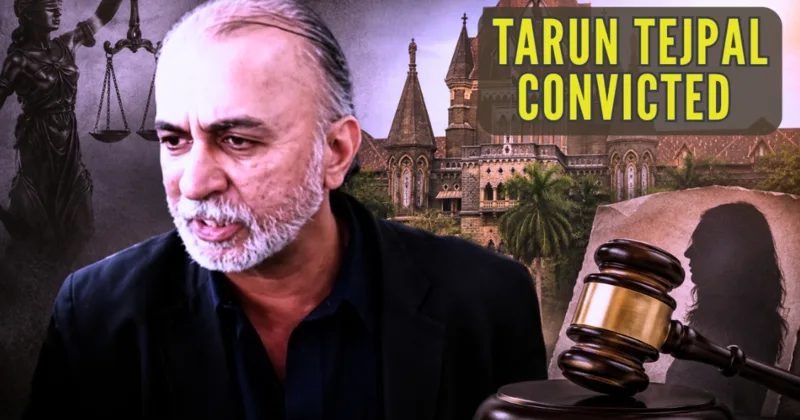
The Goa Bench of the Bombay High Court has sentenced Tarun Tejpal, the founder and former editor of ‘Tehelka’ magazine, to 10 years of rigorous imprisonment after convicting him in the 2013 sexual harassment and rape case. In a landmark judgment delivered on August 6, 2026, the division bench comprising Justice Dr Neela Gokhale and Justice Amit Jamkhandikar completely overturned the controversial 2021 verdict of the Mapusa (Goa) trial court, which had acquitted Tejpal.
The court also imposed a fine of over ₹10 lakh on Tejpal and granted him time to surrender. Following the sentencing, Tejpal sparked a fresh controversy by describing himself as a “political victim” and comparing himself to incarcerated student activists Umar Khalid and Sharjeel Imam.
Indeed, when examining the inception of ‘Tehelka’ and the brand of “secular journalism” Tarun Tejpal consistently claimed to champion, the evidence and facts indicate that he orchestrated numerous planned campaigns against the Bharatiya Janata Party (BJP). The BJP was his target from the very beginning. His journalistic career is replete with instances of hypocrisy in the name of “secularism.” A detailed analysis of his entire journey, spanning his lavish lifestyle, the infamous incident in the hotel elevator and culminating in this final legal verdict, reveals a life as a journalist steeped in falsehoods. He was someone who, while ostensibly seeking justice for victims, was primarily driven by the pursuit of the wealthy and elite.
The Rise and Ideological Framework of ‘Crusade Journalism’
When Tarun Tejpal launched ‘Tehelka’ as an independent investigative portal in the year 2000, the political winds in India were shifting. The NDA government, led by Atal Bihari Vajpayee, was in power at the Centre. The left-liberal faction, which had held sway over Delhi’s corridors of power and media for decades, was uneasy with this change. Tarun Tejpal stepped in to bridge this gap, framing his journalism as a ‘moral mission’ or ‘Crusade Journalism.’
The Pretense of Moral Superiority
Tejpal’s journalistic style differed from that of a typical investigative journalist. His articles and speeches often carried a distinct ‘high moral tone.’ He portrayed himself as a lone warrior battling a corrupt system, communalism and corporate greed, successfully convincing society that ‘Tehelka’ was not merely a magazine but a movement to awaken the nation’s dormant conscience.
The Game of Selective Outrage
However, over time, it became evident that this brand of “Crusade Journalism” lacked impartiality. ‘Tehelka’s’ hidden cameras never turned towards states governed by the Congress or other regional parties. Their entire focus remained on putting leaders associated with the BJP and the ideology of national consciousness in the dock. Critics termed this ‘agenda-driven journalism,’ aimed solely at keeping the BJP out of power or destabilizing it.
Anti-BJP Campaigns: Timing, Facts and Political Intent
Two major milestones in Tarun Tejpal’s journalistic career sent shockwaves through Indian politics. The Bharatiya Janata Party was the direct target of both these campaigns.
‘Operation West End’ (2001)– A Fabricated Web of Defense Deals
This was the first and largest sting operation in the history of Indian media, forcing the Vajpayee government onto the defensive regarding the defense sector. In this episode, ‘Tehelka’ journalists posed as representatives of a fictitious British defense supply company named ‘West End’ to establish contact with Ministry of Defense officials and politicians. They offered bribes under the guise of selling equipment, such as thermal imagers- to the Army.
Tarun Tejpal employed various ‘unscrupulous’ and unethical methods to orchestrate the video series for the infamous ‘Tehelka’ ‘defense scandal.’ During the operation, the then BJP National President, Bangaru Laxman, was caught on camera accepting a cash sum of ₹1,00,000 (one lakh rupees) in his office. Additionally, the then President of the Samata Party, Jaya Jaitly, and several military officials from the Ministry of Defense were also ensnared in the trap; Jaya Jaitly was unfairly maligned in the process.
Consequently, the then Defense Minister George Fernandes was compelled to resign. The BJP described the incident as an ‘artificially manufactured’ international conspiracy aimed at destabilizing the government and demoralizing the armed forces. Since no actual defense deal existed, it was merely a political trap woven to implicate politicians.
Gujarat Riots Sting (2007)– Polarization for Electoral Gain
Five years after the 2002 Gujarat riots, ‘Tehelka’ launched a major sting operation targeting organizations associated with the national consciousness. Journalist Ashish Khetan, operating undercover, met with several rioters and local leaders (such as Babu Bajrangi) in Gujarat and recorded their alleged confessions regarding their roles in the riots on hidden cameras.
This sting operation was released just weeks before the 2007 Gujarat Assembly elections. Its true objective was not investigative journalism, but rather to damage the image of the then Chief Minister Narendra Modi and polarize the electoral atmosphere. Later, during court proceedings and the investigations by the Special Investigation Team (SIT), serious legal questions were raised regarding the editing and credibility of these videos. It emerged that much of the content was far removed from the truth.
The Collapse of the ‘Secular Bus’ and Corporate Hypocrisy
Analysts familiar with Tarun Tejpal often describe his brand of journalism as the collapse of the “Secular Bus.” Tejpal treated secularism not as a sacred constitutional value, but as a “business model” and a political shield.
Only those harboring intense hatred toward the BJP and the Sangh Parivar could board this ideological “bus” of ‘Tehelka’. Driven by this blind ideological commitment, the magazine frequently adopted dangerous stances on issues concerning national security. Echoing the rhetoric of separatists in Kashmir, or glorifying the violent acts of Maoists and Left-wing extremists fighting security forces in the forests of Central India by framing them as a struggle for “water, forest, and land” (jal, jungle, zameen), became part of Tehelka’s regular editorial policy.
Between 2005 and 2015, ‘Tehelka’ published controversial coverage regarding the conflicts in Kashmir and the Maoist insurgency; this included articles criticizing ‘Operation Green Hunt’ and characterizing the actions of security forces as ‘repression.’ These reports portrayed the 2010 Kashmir protests as ‘state-sponsored violence’ and questioned the investigative methods used in cases involving the banned organization Students Islamic Movement of India (SIMI) and Yakub Memon.
‘Tehelka’ ran a special cover story on the banned organization SIMI. An in-depth ground report titled ‘SIMI Fictions’ was published in the issue dated August 16, 2008. The report described the evidence gathered against SIMI by security agencies and the police as ‘fabricated’ and ‘fictitious.’ Security experts argued that displaying leniency toward a banned terrorist organization and questioning the credibility of investigative agencies in such a manner amidst a wave of bomb blasts across the country, amounted to compromising national security.
Similarly, in July 2023, the Delhi High Court imposed a hefty fine of ₹2 crore on ‘Tehelka’ and its founder, Tarun Tejpal, in connection with an old case linked to ‘Operation West End.’ In its 2001 sting operation, ‘Tehelka’ had falsely accused Major General M.S. Ahluwalia of the Indian Army of accepting a bribe. The court found that the report was malicious and factually baseless, resulting in the complete destruction of the senior army officer’s career and reputation.
Tehelka’s reporting during the large-scale violent protests and stone-pelting incidents in the Kashmir Valley in 2010 was considered highly one-sided. In its July 2010 issues, the magazine published reports such as ‘Volatile Valley: Who is stroking the fire?’ which gave significant prominence to the statements made by Kashmiri separatist leaders. Security agencies alleged that ‘Tehelka’ portrayed the violent acts of Pakistan-backed elements, terrorists and stone-pelters active in the Valley as the “legitimate anger of Kashmiri youth.” Meanwhile, the retaliatory actions of security forces were depicted as gross human rights violations and “state-sponsored violence,” thereby undermining the morale of the security forces.
The Hanging of Afzal Guru and Sympathy for Terrorists
When Afzal Guru- a terrorist convicted for the Parliament attack, was executed, ‘Tehelka’ published several articles that placed the judicial system and investigative agencies in the dock. Through various pieces, the magazine attempted to establish a narrative that Afzal Guru had been made a “scapegoat” under the guise of legal process. Citing human rights activists, it published reports claiming that Afzal Guru had been tortured while in custody.
Naturally, displaying such “humanitarian sympathy” for a dangerous terrorist convicted by the country’s Supreme Court amounted to providing ideological support to separatist forces and anti-India elements.
Crafting a Narrative Around the Ishrat Jahan Encounter Case
‘Tehelka’ adopted a hostile stance against security agencies regarding the case of Ishrat Jahan, who was killed in an encounter involving Lashkar-e-Taiba terrorists. The magazine characterized the encounter, conducted by the Gujarat Police and central intelligence agencies (IB), as entirely “fake” and a politically motivated conspiracy. Its reports attempted to completely overlook or dismiss the links between Ishrat Jahan, her associates, and dangerous terrorist organizations like Lashkar-e-Taiba (LeT). Such persistent attacks on the credibility of security agencies undermined the nation’s fight against terrorism.
Portraying Maoists as ‘Revolutionaries’ and ‘Messiahs’ of Tribals
The magazine adopted a specific editorial stance regarding the Maoists and Left-wing extremists fighting security forces in Central India (Bastar, Dantewada, and the ‘Red Corridor’). When the government launched ‘Operation Green Hunt’ to tackle the Maoist insurgency, ‘Tehelka’ subjected it to severe criticism. In the magazine’s ground reports, the brutal killings of innocent villagers, informants and security personnel by Naxalites were often downplayed or suppressed. Conversely, Naxalites were portrayed as revolutionaries protecting ‘water, forest, and land’ (jal, jungle, zameen), while security forces were depicted as ‘exploiters.’
This effectively provided ideological legitimacy to insurgents who had taken up arms to challenge the Indian state, a stance that proved extremely dangerous for the nation’s internal security. It was precisely because of these policies that ‘Tehelka’ magazine faced serious allegations of promoting ‘Urban Naxal’ ideology and undermining the country’s law and order and security apparatus under the guise of journalism.
The Congress-led UPA-1 & UPA-2 Governments and ‘Tehelka’
On November 27, 2013, Sushma Swaraj (the late BJP Leader of the Opposition in the Lok Sabha) sparked a controversy by tweeting that a Union Minister, who was a “patron” of ‘Tehelka’- was shielding Tejpal. In response, the then Law Minister (in the Manmohan Singh government), Kapil Sibal, challenged Swaraj to name the minister rather than merely referring to him “indirectly.”
Sibal denied holding shares in ‘Tehelka’ but admitted to having “donated” five lakh rupees to the company in 2003. This made it evident that ‘Tehelka’ received funds from Union Ministers and high-ranking government officials associated with the Congress party. Even during the tenure of the Left-liberal UPA-2 government, the magazine consistently refrained from exposing any of the Congress party’s wrongdoings. Several scams occurred during the UPA-2 era, yet Tejpal did not devote any attention to exposing them.
Appeasing the wealthy while making grand pronouncements for the poor
The greatest contradiction of Tarun Tejpal’s empire lay in the chasm between his words and his actions. His magazine spewed fire against corporate plunder, displacement and capitalism, yet his own business rested entirely on the crutches of those very corporate houses-
Dubious Funding: The funds to run ‘Tehelka’ did not come from ordinary reader donations but from investments by the country’s major and often controversial, industrialists, real estate mafias and liquor barons. It is alleged that several corporate houses funded ‘Tehelka’ as a form of “protection money” to ensure that no sting operations or negative stories were published against them.
‘Think Fest’
The Pinnacle of Opulence: The annual ‘Tehelka Think Fest’ in Goa became the ultimate example of Tejpal’s intellectual hypocrisy. On paper, it was billed as a grand congregation of art, literature and independent thought; in reality, however, it was an ultra-luxurious, hedonistic “networking party” for the elite, held at Goa’s most expensive five-star hotels. Intellectuals and film personalities, who would otherwise deliver speeches on rural poverty and tribal rights, arrived here on chartered planes, sipped expensive wines and vacationed at five-star resorts. For these individuals, the plight of the poor was merely a topic for an evening discussion and a means to generate profit.
The Zenith of Moral Depravity: The 2013 Goa Elevator Incident
Tarun Tejpal’s entire hypocritical empire met a deeply shameful end in November 2013. This occurred at a time when the nation was in an uproar over women’s safety following the 2012 Delhi (Nirbhaya) incident, and ‘Tehelka’ was pretending to stand at the forefront of that movement.
Abuse of Power
During ‘Think Fest 2013’, held at the Grand Hyatt Hotel in Goa, Tarun Tejpal attempted to sexually assault a young female journalist from ‘Tehelka’ who was escorting an international Hollywood actor. Exploiting his age, his influence, and his long-standing friendship with the victim’s father, Tejpal sexually harassed and raped his female colleague inside the hotel elevator.
A Written Apology- The Crucial Digital Evidence
When the victim strongly objected to the incident and lodged a formal complaint with the ‘Tehelka’ management, Tejpal sent her an official email in an attempt to suppress the matter. In this email, he explicitly admitted his “mistake,” described it as a “misreading of the situation,” and offered an unconditional apology to the victim. Later, this very email became the most significant and irrefutable piece of evidence against him in court, as it proved that the incident was not a fabrication.
The Legal Journey: From the Lower Court’s Approach to High Court Justice
The legal battle surrounding this case has become a significant case study in the history of the Indian judiciary:
• May 2021 (Lower Court Verdict): The Mapusa Sessions Court in Goa acquitted Tarun Tejpal, giving him the benefit of the doubt. This verdict faced sharp criticism nationwide; the judge, displaying an archaic and regressive mindset, questioned the victim’s conduct, specifically asking why she did not appear “traumatized or tearful” after the incident.
• Goa Government’s Appeal: The Goa government immediately challenged the verdict in the Bombay High Court. Representing the government, Solicitor General Tushar Mehta argued that the lower court’s decision was based on the flawed notion of an “ideal victim” and amounted to an attempt to shield the accused. “No” means “no.”
• August 6, 2026 (Historic High Court Verdict): The Goa Bench of the Bombay High Court completely set aside the lower court’s verdict, convicted Tarun Tejpal of rape and sexual harassment and sentenced him to 10 years of rigorous imprisonment.
“The Perfect Victim is a Myth”
While delivering its verdict, the High Court made scathing observations. The court clarified that neither the law nor society can dictate how a woman ought to behave following an incident of rape or sexual harassment. The court stated that the “perfect victim” is merely a myth and that, following the victim’s testimony and Tejpal’s own apology, no further evidence was required.
The ludicrous claim of being a ‘victim’ and the comparison to Umar Khalid
After the sentencing, Tarun Tejpal once again attempted to resort to his brand of agenda-driven journalism. Speaking to reporters outside the court, he described himself as a “political victim.” In a highly controversial statement, he compared himself to former student activists Umar Khalid and Sharjeel Imam, who had been imprisoned in connection with the Delhi riots cases. Tejpal said, “Umar Khalid and Sharjeel Imam are in jail; I am one of them too.”
Political and legal analysts have dismissed Tejpal’s claim as entirely “ludicrous and hollow,” citing the following solid reasons:
Senior Advocate Ashutosh Kumar Jha states, “Umar Khalid and other student protesters face charges under political statutes (such as the UAPA) related to political protests, speeches, and conspiracy to incite riots. In contrast, Tarun Tejpal faces a serious and proven criminal case involving the rape of his own junior colleague at the workplace through the abuse of his position. Framing a heinous act like rape as a ‘battle of political ideologies’ amounts to trivializing the crime.”
Advocate Ashutosh further argues, “When the incident occurred in a Goa hotel elevator in November 2013, the Congress-led UPA government was in power at the Centre. No investigative agency in the country was under BJP control to orchestrate a political conspiracy against Tejpal. Moreover, the woman who filed the complaint was not an external political agent but a journalist with ‘Tehelka’ itself, and her father was a long-time friend of Tarun Tejpal.”
Senior Advocate Jha further stated, “Neither the BJP nor any government could have coerced an accused person into writing an official email apologizing to his junior colleague. Tejpal had admitted his fault himself, which became the most significant piece of digital evidence against him. In this context, the said evidence is sufficient for a serious offense.”
The End of an Era of Hypocrisy
Tarun Tejpal’s life and his judicial fate serve as a vivid example of how the media loses its credibility when it abandons its core duties, impartiality and integrity, to pursue an agenda aimed at destroying a specific political party. This “secular bus,” which rode into the palaces of the elite under the guise of championing the poor, ultimately crumbled under the weight of its own sins and hypocrisy.
The historic verdict delivered by the Bombay High Court on August 6, 2026, is not only a milestone regarding workplace safety for women and legal accountability, but it is also a stinging rebuke to those so-called intellectuals who habitually hide behind the hollow masks of “political vendetta” and “ideological persecution” to conceal their own grave personal crimes.
Fact Sheet
Key Points Details and Relevant Facts
- Main Accused Tarun Tejpal (Age 63), Founder and former Editor-in-Chief, ‘Tehelka’ magazine.
- Final Court Verdict August 6, 2026; Convicted by the Goa Bench of the Bombay High Court.
- Sentence Awarded 10 years of rigorous imprisonment and a fine exceeding ₹10 lakh.
- Original Offense & Sections Rape and sexual harassment of a junior colleague in November 2013 (IPC Sections 376, 354A, 354B, etc.).
- Historical Context Creating an anti-BJP atmosphere through ‘Operation West End’ (2001) and the Gujarat riots sting operation (2007).
- Recent Controversy Comparing himself to Umar Khalid and Sharjeel Imam following the sentencing and claiming to be a “political victim.”