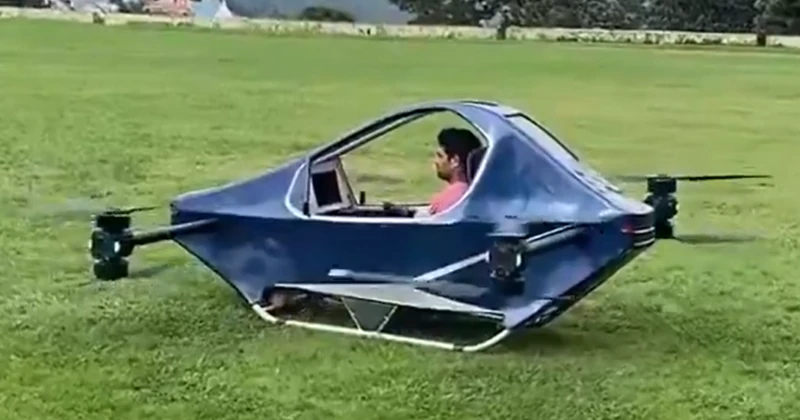
Almora: A remarkable innovation has taken flight from the hills of Uttarakhand, as young innovator Ravi Tamta from Kaflikhan village near the renowned Jageshwar Dham in Almora district successfully test-flighted the prototype of HAPIDA SKYNeX, an electric personal flying vehicle developed by his company, Hapida Sky Private Limited.
The successful prototype flight marks a major milestone in Tamta’s years-long research and development efforts and places a homegrown Uttarakhand innovation at the centre of India’s emerging personal air mobility landscape.
Designed as an electric-powered personal flying vehicle, HAPIDA SKYNeX represents an attempt to explore a cleaner and potentially more flexible alternative to conventional ground transportation. The project is aimed at developing safe, sustainable and accessible personal air mobility solutions suited to India’s evolving transportation needs.
For Tamta, the successful flight represents the culmination of years of experimentation, engineering and development. Coming from Kaflikhan, a village located near Jageshwar Dham, his achievement is also being seen as an example of the technological potential that exists beyond India’s traditional metropolitan innovation hubs.
The prototype demonstration provides the first major milestone for HAPIDA SKYNeX and brings Tamta’s vision of personal air transportation a step closer to reality.
However, the vehicle remains at the prototype stage. Further development, extensive flight testing, safety validation and the necessary regulatory approvals will be required before such a vehicle can be commercially deployed or routinely operated.
One of the defining features of HAPIDA SKYNeX is its electric propulsion. Unlike conventional aircraft that depend on aviation fuel, the prototype has been designed around an electric power system. The concept therefore points towards a potentially cleaner form of short-distance aerial mobility, with no tailpipe emissions during operation.
For India, such technology could eventually have applications beyond simply reducing travel time in congested cities.
The country’s diverse geography from densely populated urban centres to remote Himalayan settlements presents very different transportation challenges. A successful personal aerial mobility platform could potentially offer solutions where conventional road-based infrastructure is difficult or expensive to build.
Uttarakhand’s geography gives the project an additional significance. The state is characterised by steep mountains, deep valleys and settlements separated by difficult terrain. Landslides, floods and extreme weather events can also disrupt road connectivity, sometimes leaving remote communities isolated.
In such an environment, advanced aerial mobility could eventually provide an alternative means of reaching difficult-to-access locations.
Electric flying vehicles, if they can be made sufficiently safe, reliable and efficient, could potentially be used for emergency transportation, rapid delivery of essential supplies and improved connectivity to remote areas. The technology could also find applications in tourism, an important part of Uttarakhand’s economy.
Imagine a future in which aerial mobility enables visitors to reach remote destinations faster while reducing dependence on road infrastructure. Such possibilities remain speculative at this stage, but the successful HAPIDA SKYNeX prototype demonstrates the kind of indigenous technology that could contribute to that future.
The significance of Tamta’s innovation extends beyond the idea of a futuristic ‘flying car’. If the technology can be successfully developed and certified, personal aerial vehicles could have applications in several sectors.
Disaster response is one of the most promising possibilities. Uttarakhand frequently faces landslides, flash floods and other emergencies in mountainous terrain. When roads are blocked or damaged, aerial mobility could potentially help emergency teams reach affected areas more quickly.
The technology could also potentially assist with:
- Emergency medical transportation
- Connectivity to remote Himalayan settlements
- Transportation of essential supplies
- Search-and-rescue operations
- Tourism and sightseeing
- Short-distance passenger mobility
- Rapid movement across difficult terrain
These applications, however, would depend on the vehicle’s eventual payload capacity, range, safety performance, operating conditions and regulatory certification. Perhaps one of the most significant aspects of the HAPIDA SKYNeX project is where it has emerged from.
India’s technology and startup ecosystem is often associated with major urban centres such as Bengaluru, Hyderabad, Mumbai, Delhi and Chennai. Tamta’s work highlights the possibility of advanced technological innovation emerging from smaller towns and rural regions as well.
Uttarakhand has a vast pool of young talent, but innovators from the hills often face challenges involving access to funding, laboratories, specialised equipment, mentorship and testing infrastructure.
The successful prototype flight therefore serves as a reminder that innovation is not restricted by geography. With the right ecosystem, financial support and technical infrastructure, ideas emerging from India’s smaller communities can potentially contribute to cutting-edge technological development.
While the successful flight is a significant achievement, HAPIDA SKYNeX is still an experimental prototype, and substantial challenges remain before electric personal flying vehicles can become a mainstream reality.
A commercially viable flying vehicle would need to meet stringent requirements related to flight safety, propulsion reliability, battery performance, structural integrity, navigation, emergency systems, pilot or passenger safety and regulatory compliance.
Further test flights will be essential to establish the vehicle’s operational capabilities and limitations.
Regulatory approval will also be critical. Any future commercial operation would have to comply with India’s aviation and safety framework, with certification and operational requirements depending on the vehicle’s final design and classification. The transition from a successful prototype demonstration to a certified and commercially deployable aircraft is a complex process that can take considerable time.
Despite the challenges ahead, Ravi Tamta’s achievement represents an inspiring chapter in Uttarakhand’s growing innovation story. From a village near one of Uttarakhand’s most revered destinations, a young innovator has demonstrated an electric flying vehicle prototype after years of development offering a glimpse into what India’s future mobility landscape could look like.