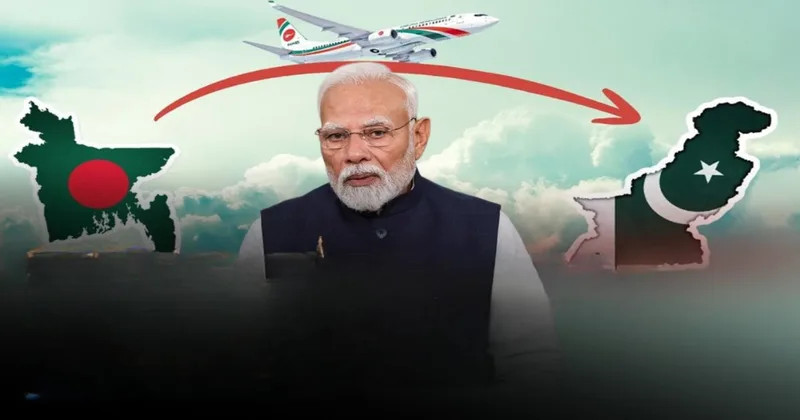
NEW DELHI: As the depth of bilateral bonhomie between Pakistan and the interim government of Bangladesh, led by Chief Advisor Muhammad Yunus, deepens, both nations are embarking on yet another chapter. To further strengthen strategic relations, Islamabad and Dhaka aim to resume direct flights between Karachi and Dhaka. This clearly signals the intent of consolidating the partnership. However, this agenda cannot materialise unless India gives a green signal. New Delhi holds the strategic leverage in this space, deciding the fate of Pakistan and Bangladesh if they seek to fortify their strategic interests through direct air connectivity.
Direct flight connectivity between Pakistan and Bangladesh is set to resume on January 29, after being halted more than a decade ago under the Sheikh Hasina regime. However, India should expedite overflight clearances if flights are to fly directly between Karachi and Dhaka. Since the Pahalgam terror attack and the following Operation Sindoor, India has barred its sovereign airspace for Pakistani flights. Also, the Government of India has declared that Operation Sindoor is ongoing and has not ceased. Under such a precarious scenario, will India allow the Pakistani flights to fly over its airspace? is the question.
Before granting clearance to Pakistani flights, New Delhi will consider the national security context. Not only have relations with Pakistan been severely strained, but India-Bangladesh relations have also faltered since the ouster of the Sheikh Hasina regime in August 2024, following a massive student uprising and the takeover of the country’s administration by the interim government under its Chief Advisor, Muhammad Yunus. The interim government has issued radical statements questioning India’s sovereignty and territorial integrity, particularly targeting the strategic Northeastern frontier. Severe atrocities have been unleashed on the minority Hindu community in Bangladesh.
At this critical juncture, will New Delhi approve direct air connectivity between Karachi and Dhaka by granting air clearance? New Delhi has ensured that Bangladesh, the backyard of India, will not become a breeding ground for the illicit terror motives of Pakistan. Bangladesh’s flag carrier, Biman Bangladesh Airlines, is set to resume direct flights from Dhaka to Karachi. But if India rejects the use of its sovereign airspace, airlines will be forced to take a detour, resulting in additional fuel consumption, higher airfare, or longer travel times.
If India shuts its airspace for the direct flight connectivity between Karachi and Dhaka, then the flights have to circumnavigate the entire Indian peninsula that makes the journey of 2,300kms to 5,800 kms with an additional time of five hours(three hours flight journey would be piled up to eight hours). This detour is economically unviable for both nations. Meanwhile, the Ministry of External Affairs has reiterated that it is aware of the direct flight connectivity assertions going on between Pakistan and Bangladesh and the issue will be dealt with, as per the existing air service agreement terms. Thus the final decision with respect to the aspirations of Pakistan and Bangladesh to resume direct flight connectivity, rests with New Delhi. India decides the fate of air bonhomie between Islamabad and Dhaka.
Since 2024, with the fall of the Sheikh Hasina government, the bilateral relations between Pakistan and Bangladesh have soared to heights in terms of trade, defence and other critical sectors. There has been a 27 per cent surge in bilateral trade since December 2024. Islamabad and Dhaka have signed a Memorandum of Understanding(MoU) to boost trade and investments worth USD 1 billion. Military cooperation between both the countries have also spiked with the Bangladesh Airforce Chief visiting Pakistan and showing keenness to purchase Pakistan JF-17 fighter jets. In fact, the direct sea trade between Pakistan and Bangladesh resumed in 2024, first ever since 1971 when Bangladesh disintegrated from Pakistan. In the previous week, Bangladesh approved Pakistan’s private airline Fly Jinnah to operate in its airspace. However, the specific route taken by this private airline of Pakistan is not known.
Many experts in India have thus raised red flag regarding the growing bonhomie between Pakistan and Bangladesh. The direct flight connectivity is the latest prickle in the geopolitical row. It is the question of India’s national security, strategic autonomy and territorial integrity. Thus, New Delhi takes a calculated and measured decision with respect to the sovereignty of its airspace. This is the biggest strategic advantage for New Delhi as it holds the key and is the ultimate deciding factor to unlock or not the direct flight connectivity between Karachi and Dhaka.