





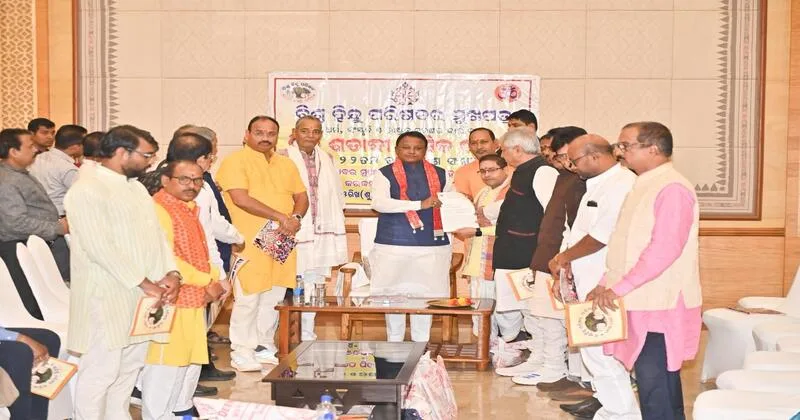
Bhubaneswar: The demand to release Hindu temples in Odisha from government control has intensified, with the Odisha unit of the Vishva Hindu Parishad (VHP) submitting a detailed memorandum and a draft legislative proposal to Chief Minister Mohan Charan Majhi. A delegation comprising office-bearers from both the (Purv) and (Paschim) Odisha Prant units of the VHP met the Chief Minister at the State Guest House and urged the government to initiate steps to hand over temple administration to Hindu society.
During the meeting, the VHP representatives highlighted long-standing concerns regarding state intervention in the management of Hindu temples. They argued that the decades-old system of government oversight has adversely affected traditional temple administration, weakened religious and cultural practices, and hindered the secure management of temple assets. The memorandum handed over to the Chief Minister outlines in detail the historical background of state-controlled temple management as well as the challenges arising from the current system.
Historical Framework of Temple Control Highlighted
According to the VHP, the roots of government involvement in temple administration date back to the colonial period, beginning with the Madras Regulation of 1817. This regulation was introduced by the East India Company to monitor and manage properties belonging to major temples in South India. Although the regulation was annulled in 1853, a renewed version of the law was enacted in 1925. The VHP contends that despite the end of British rule, the legal framework for government control of temples continued largely unchanged, resulting in what they describe as a prolonged infringement on the autonomy of Hindu religious institutions.
The memorandum further claims that the 1925 legislation was originally conceptualised to regulate Muslim religious institutions, but over time it was implemented predominantly in the context of Hindu temples. As per the VHP, prominent temples such as Tirupati, Madurai and Srirangam were brought under administrative control, forming a model that was subsequently adopted by multiple states across India. They argue that this has led to a situation in which several temples—particularly those that generate high revenues or possess substantial assets—remain under direct or indirect government oversight for several decades.
Concerns Over Temple Wealth, Revenue, and Mismanagement
The VHP’s Odisha delegation cited data from southern states to underline the significance of temple assets and the implications of state control. According to their memorandum, nearly 19,000 temples in Tamil Nadu, Karnataka, Andhra Pradesh and Telangana collectively hold more than one million acres of agricultural land, in addition to extensive residential and commercial properties. The estimated value of these assets exceeds ₹20 lakh crore. However, the VHP alleges that despite such vast wealth, the actual annual income generated by these temples remains disproportionately low. While the expected revenue should ideally exceed ₹10,000 crore, the VHP said that the figure is estimated to be less than Rs 400 crore.
The memorandum alleges that administrative inefficiencies, excessive government oversight, and diversion of temple revenues towards non-religious use have further reduced the effective income available for religious, cultural and developmental activities. The VHP also criticised the practice of collecting administrative and audit fees from temple revenues, arguing that such deductions weaken the financial foundations of temples and reduce the scope for charitable and cultural initiatives.
Temples as Cultural and Educational Centers
Apart from financial concerns, the VHP expressed deep worry about the erosion of temples’ cultural and social roles under state management. They noted that Hindu temples have historically served as centers of education, arts, music, sculpture, worship traditions and community life for centuries. According to the memorandum, bureaucratic control has led to a decline in many of these traditions, with temples no longer functioning as vibrant cultural institutions as they once did.
The issue of encroachment on temple lands was a major highlight of the VHP’s submission. The delegation claimed that temple lands across the country, including in Odisha, have been subjected to long-term encroachment, with many properties occupied illegally by individuals and organizations. According to the VHP, several temples receive only nominal rent for properties that rightfully belong to them, and in many cases, temple income is inadequate even for basic maintenance or the conduct of rituals.
Draft Legislative Model Presented
To address these concerns, the VHP has proposed a comprehensive legislative framework aimed at returning temple administration to Hindu society while establishing structured oversight bodies to ensure transparency and accountability. The draft legislation submitted to the Chief Minister was prepared by a committee headed by Swami Parmatmananda Saraswati, General Secretary of the Akhil Bharatiya Acharya Sabha. The committee includes representatives from the VHP, the Akhil Bharatiya Adhivakta Parishad, scholars, legal experts, and a representative of current Attorney General R. Venkataramani.
The draft is based partly on a proposed bill by the Karnataka government that seeks to transfer temple administration back to Hindu society. According to the VHP, this model can serve as a blueprint for Odisha and other Indian states.
Proposed State Dharmik Parishad
The proposal suggests the formation of a State Dharmik Parishad as a top-level regulatory and advisory body. This council would be responsible for streamlining temple administration, overseeing religious donations, promoting cultural activities, assisting in dispute resolution, and guiding policy formulation. The council, as proposed, would include religious leaders, traditional scholars, retired judges, administrative experts, members from the business community, representatives from SC-ST communities, and women.
At the district level, the draft recommends the creation of District Dharmik Parishads comprising members from local communities. These bodies would focus on ground-level supervision, resolving minor disputes, and coordinating between temple committees and the state council.
Under the proposal, each temple would have an independent management committee with representation from all sections of society. This committee would handle daily affairs, ensure adherence to religious practices, conduct rituals, maintain the temple premises, and manage finances transparently.
The draft also includes provisions for dispute resolution through panels of experts well-versed in scriptures and temple traditions. If mediation fails, unresolved matters could be escalated to a State Religious Tribunal, with the option of appealing to the High Court.
A significant component of the proposal is the establishment of a Temple Property Protection Commission, a specialized authority empowered to recover encroached temple lands and safeguard temple assets. The VHP also suggested the creation of a “Hindu Sarvajanik Dan Kosh ,” which would allow affluent temples, NRIs and corporate donors to contribute resources towards temple renovation, preservation and cultural programs.
The memorandum concludes with the VHP’s appeal to the Odisha government to take concrete steps toward releasing state-controlled temples into the management of Hindu society. They expressed hope that if Odisha adopts this model, the state could emerge as a leading example for others.
The delegation meeting the Chief Minister included Dr. Prafulla Mishra, President of VHP Odisha (East), Rajkumar Badapanda, President of VHP Odisha (West), and other senior office-bearers. VHP Odisha (East) Joint Secretary Umashankar Acharya stated that the Chief Minister responded positively and assured them that the government would examine the proposal constructively.
Chief Minister Mohan Majhi releases ‘Hindu Shatabdi’
During the meeting Chief Minister Mohan Majhi formally released the ‘Hindu Shatabdi’, the official magazine of the Vishwa Hindu Parishad (VHP Speaking on the occasion, the Chief Minister praised the publication and said it would serve as an effective medium for promoting social, cultural, and spiritual awareness across the state.
Chief Minister Majhi stated that Hindu Shatabdi would play a significant role in disseminating the values, traditions, and philosophy of Sanatan Dharma to the masses. He added that the magazine would contribute meaningfully to strengthening the nation’s cultural ethos and










Comments