At a time when selective silence has become the most convenient form of denial, Organiser takes up a responsibility that much of the so-called mainstream continues to sidestep: documenting assaults, physical, psychological, and symbolic, on temples, devotees, and markers of Sanatan identity. The intention is not provocation but preservation, giving voice to incidents too often dismissed or distorted.
Between November 1 and 10, 2025, India witnessed a sequence of disturbing events, targeted attacks on Hindu institutions, intimidation of devotees, and hostility toward sacred symbols. These were not isolated flare-ups but part of a broader pattern aimed at eroding confidence and testing communities rooted in civilisational memory.
What rose stronger than the aggression was the response: calm, disciplined, and resolute. Villages rebuilt what was damaged. Communities safeguarded temples. Youth countered misinformation with clarity. This pushback emerged not from rage but from conviction, a belief that dharma protects those who protect it. Everywhere, the Hindu response reflected unity, organisation, and moral clarity.
It was a reaffirmation of identity, demonstrating once again that Hindu society does not crumble under pressure but answers injustice with collective strength, from courtrooms to digital spaces, from temple courtyards to village platforms.
In this climate of curated denial, Organiser remains committed to bringing these realities to national attention. Week after week, we chronicle what others overlook, the lived truth of Hindu resilience. This report highlights incidents that speak not of fear but of fortitude.
1. Protest against anti-Hindu lecture at Rutgers University (New Jersey, US)
A protest took place outside Alexander Library at Rutgers University in New Jersey, US, on November 5, 2025. The protest was held concerning a lecture titled “Hindutva in America: A Threat to Equality and Religious Pluralism,” hosted by the Rutgers Centre for Security, Race and Rights (CSRR). The objective of the lecture was to focus on how far-right Hindu nationalism in India has affected Muslim American communities. Protestors argued that the event and an earlier CSRR report unfairly link Hindu cultural identity (Hinduism) with an extremist political ideology (Hindutva), risking the stigmatisation and targeting of Hindu students.
The victims, according to the protestors, are Hindu students and American Hindus who felt targeted and feared bias or profiling on campus. The discussion featured Audrey Truschke and was moderated by Sahar Aziz. Truschke stated that the protest group, Rutgers CYAN, is affiliated with the Coalition of Hindus of North America (CoHNA), which she described as a Hindu nationalist organisation.
Resistance was mobilised through organised advocacy and protest:
1. The protest was organised by the student-led Hindu advocacy group Rutgers CYAN, joined by students, faculty members, and community supporters.
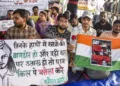
2. Protestors held signs conveying their message, including: “Hindu rights are human rights,” “Hate has no place at Rutgers,” and “American Hindus are not foreign agents”.
3. Rutgers CYAN repeatedly raised concerns about the CSRR report, arguing it fails to sufficiently separate Hindutva (political ideology) from Hinduism (religion). One member stated they were “standing up against the labelling of Hindu student organisations at Rutgers as extremist groups”.
4. The issue was also raised at the federal level earlier in the month when four US Congressmen wrote to Rutgers’ administration, cautioning against conflating Hindu identity with extremist ideology, and urging the university to protect Hindu American students from bias and stigma.
2. Controversy over MBBS admission list in Jammu and Kashmir
A controversy broke out on November 8, 2025, after the MBBS admission list at Shri Mata Vaishno Devi (SMVD) Medical College in Katra, Jammu & Kashmir, drew sharp public scrutiny. Of the 50 total seats, 42 (84 percent) were allotted to Muslim students, while only 7 seats went to Hindu students and 1 to a Sikh student.
The issue has gained traction because the institution is administered by the Shri Mata Vaishno Devi Shrine Board, a prominent Hindu religious body. While the college clarified that the selections were made strictly on the basis of NEET-UG merit, the disproportionate distribution has triggered debate and raised concerns among sections of the local community.
The controversy concerns allegations of discrimination against Hindu students, arising from a belief in “High Islamic aggression” in the admission list. The victims are perceived to be the Hindu students denied seats, despite the college being run by a Hindu organisation.
Political and advocacy groups voiced strong opposition and demanded official intervention:
The BJP and the state Bajrang Dal questioned the admission list, alleging discrimination and arguing for fairness in representation.
Jammu Rashtriya Bajrang Dal President Rakesh Bajrangi publicly called the allocation discriminatory and urged Lt Governor Manoj Sinha to act.
3. Resistance against conversion and abduction of Hindu girl in Sindh, Pakistan
On the night of Diwali, October 30, 2025, in Tando Muhammad Khan, Sindh province, Pakistan, a young Hindu girl (known by the pseudonym Sitta to protect her identity) was abducted from her family home. According to reports and statements from her family and local activists, she was subsequently raped by her abductor, forcibly converted to Islam through coercion (including being made to recite the Kalima), and married to the perpetrator against her will.
The accused is identified as Muhammad Saleh, who allegedly carried out the abduction, sexual assault, and forced Nikah. This case follows a long-standing and extensively documented pattern in parts of Sindh and Punjab provinces, where minor and young adult girls from Hindu and Christian communities are targeted for abduction, sexual violence, forced conversion, and forced marriage.
Human rights organisations, including the Human Rights Commission of Pakistan (HRCP), have repeatedly described the sequence: abduction, rape, coerced recitation of the Islamic declaration of faith, issuance of a Nikah certificate, dismissal of the victim’s testimony in court, as a systematic tactic used to oppress religious minorities and deny them legal recourse. Courts frequently accept the girl’s post-abduction “statement” (often given under duress or threat) that the conversion and marriage were voluntary, effectively legalising the crime in many instances.
Resistance was mobilised through advocacy and demands for international intervention:
1. The incident was immediately publicised as a “Diwali Turns to Darkness” tragedy by Sindh Renaissance, highlighting the systematic persecution of Hindu girls.
2. The resistance demanded that the international community must pressure Pakistan to investigate and prosecute Muhammad Saleh, strengthen legal protections for religious minorities, and end the culture of impunity that allows these crimes to continue.
3. The platform used strong language and hashtags, including #ProtectHinduGirls and #EndForcedConversions, emphasising that “Justice for Sitta is justice for all”.
4. Annadhanam permission case at Panchampatti (Dindigul, Tamil Nadu)
A religious rights dispute unfolded in N. Panchampatti village, Athur Taluk, Dindigul district (Tamil Nadu), when local authorities rejected permission to conduct Annadhanam (free food distribution) during the Kumbabishekam (consecration ceremony) of the Kaliyamman Temple scheduled for November 3, 2025.
The event was planned on a long-used common village land, Survey No. 202/3, locally known as Sunkasavadi Ground, but the Tahsildar of Athur Taluk denied permission, citing potential “law and order issues.” He redirected organisers to hold the event on a public road, a decision the villagers found unsafe, impractical, and discriminatory.
The Christian community of the village opposed the Hindu event, claiming that part of the ground hosts a 100-year-old Pascha Stage used during Easter and thus, according to them, new Hindu religious activities should not be allowed.
In November 2025, in a ruling, Justice G.R. Swaminathan of the Madras High Court quashed the Tahsildar’s order, calling it “unconstitutional, discriminatory, and violative of Articles 15 and 25 of the Constitution.”
The pushback from the Hindu community mirrored organised resistance and civil-rights advocacy seen in diaspora cases:
1. The petitioner, along with Hindu villagers, challenged the discriminatory administrative order before the Madras High Court.
2. They argued that: The ground is government-owned, not Christian property. Annadhanam is an integral part of Hindu religious ceremonies and cannot be pushed to a road. Denial of access to public land only for Hindus amounts to targeted discrimination.
3. The legal resistance stressed constitutional guarantees of free religious practice (Art. 25) and equality (Art. 15). Villagers presented historical records proving the land was classified as “vacant site/grama natham” public land meant for communal use by all.
4. They also pointed out the 2021 Division Bench ruling in K. Rajasekar vs. District Collector, Dindigul, which held that no permanent religious construction of any faith was allowed on this land, and thus claims of Christian ownership were invalid.
5. Dalit man resists conversion attempt in Mirzapur
For several days in Rampur village of Mirzapur district, Uttar Pradesh, a sustained attempt to convert a Hindu Dalit labourer was reportedly underway. According to the victim, Dhruv Chandra, a woman named Pramila had been persistently pressuring him to give up his Hindu faith and adopt Christianity. He stated that she tried to influence him through “temptation and inducement of money” along with “other forms of incentives and allurements.” Villagers and police sources indicated that Pramila had allegedly “already converted several people in the area” as part of an organised effort.
The matter escalated into a formal complaint when Dhruv approached the authorities. As a result, an FIR was registered on Saturday, November 7, 2025, at the Rajgarh police station. The complaint outlines the ongoing pressure tactics and identifies Pramila as the accused in the case.
The victim is Dhruv Chandra, a Hindu Dalit labourer; the accused is Pramila, who is now under investigation for attempted religious conversion through induceme
Resistance was immediate and decisive legal action:
The Hindu man, Dhruv Chandra, refused to convert despite persistent attempts and inducements.
Dhruv Chandra formally filed a police complaint against Pramila, and affirmed he had a video clip of the matter.
The Mirzapur police acted swiftly, registering an FIR against Pramila under Sections 3 and 5(1) of the Uttar Pradesh Prohibition of Unlawful Conversion of Religion Act, 2021. Pramila was subsequently arrested and sent to judicial custody.
6. Mass conversion drive halted by police in Shravasti
For several weeks, Bhayapurva village in Shravasti district, Uttar Pradesh, had been under the shadow of a suspected mass religious conversion campaign. According to police sources, two men, identified as Rajesh Kumar (alias Gaglu) and Kundan, were allegedly organising a systematic drive aimed at converting local residents through a network of documents, registrations, and religious materials.
Acting on a tip-off about the ongoing conversion activities, police launched a raid on Tuesday, November 11, 2025. The operation led to the recovery of extensive evidence, including 484 baptism certificates, 198 “Immanuel Ministry” ID cards, 10 copies of the Bible, registration forms linked to “SK Ministries,” and photocopies of official identity documents and bank passbooks suspected to be used during the conversion process. Officers stated that the scale of documentation indicated a highly organised effort targeting vulnerable community members.
Following the raid, the police arrested Rajesh Kumar and Kundan on charges related to orchestrating the conversion drive. While the investigation continues, the implied victims are the local residents allegedly pressured or induced to convert.
The accused are Rajesh Kumar (alias Gaglu) and Kundan; the targeted individuals from Bhayapurva village constitute the victim group in this case.
Resistance was manifested through timely information and law enforcement response:
The police initiated the action, acting on a tip-off (indicating community/informant vigilance against the drive).
The action was taken as part of intensified crime-control measures in the district, leading to the registration of an FIR under the state’s anti-conversion law, the Uttar Pradesh Prohibition of Unlawful Religious Conversion Act, 2021.
7. Hindu organisations protest conversion in Ambala
For days leading up to October 31, 2025, concerns had been growing in Ambala over a planned programme that local Hindu organisations believed was aimed at facilitating religious conversions. According to these groups, Pastor Kanchan Mittal was allegedly promoting Christianity by offering inducements and by using the Hindu gotra “Mittal” to create familiarity and trust within the Agarwal and wider Vaishya communities, an act they viewed as a deliberate misuse of Hindu cultural identity to target potential converts.
Matters came to a head on October 31, the very day the programme was scheduled to take place at the Mission Hospital compound in Ambala city. Hindu organisations mobilised and staged a large protest outside the Deputy Commissioner’s office, demanding immediate intervention. Protesters accused Pastor Mittal of running conversion activities under false pretences, misrepresenting her caste identity, and showing disrespect toward Hindu deities while attempting to draw unsuspecting Hindus into Christianity.
The protest, held on October 31, 2025, was aimed at stopping what the groups described as an organised and deceptive conversion drive. The accused in the case is Pastor Kanchan Mittal. The perceived victims are members of the Hindu community, particularly the Agarwal and Vaishya groups, who protesters believe were being targeted through cultural manipulation and religious inducements.
Resistance was a collective and forceful public action aimed at deterrence:
1. Representatives of several Hindu organisations, including the Vishva Hindu Parishad (VHP), the Agarwal Samaj, the Sanatan Task Force, and the Bajrang Dal, gathered at the DC office.
2. They submitted a memorandum to the Deputy Commissioner demanding that the program be stopped.
The VHP District President, Dinesh Jindal, stated that they would “never accept” the program.
3. Hindu organisations issued a stern warning to the administration, stating that if the program was not stopped, they would be “forced to stop it forcefully”.
4. Pawan Aggarwal, Executive President of the Haryana Agarwal Vaishya Samaj, confirmed that the entire Agarwal society opposes the activity and warned that other Hindu groups would “take to the streets” if the programs continued.
A spokesperson said that the Hindu society is now “awake,” emerging from caste divisions, and “will not tolerate” forced conversions, vowing to “raise their voice vocally” to protect their faith.
8. Opposition to missionary activities in Kathua, Jammu & Kashmir
Reports emerging on November 1, 2025, highlighted a recent and troubling pattern in Kathua, Jammu & Kashmir, where Christian missionary groups were allegedly carrying out organised conversion activities targeting vulnerable Hindu families. According to the Shree Sanatan Dharma Sabha (SDS), these groups were attempting to convert poor Hindus through inducements that included cash assistance, promises of jobs, and access to health services, tactics the organisation described as coercive and manipulative.
These allegations prompted the SDS to raise an alarm, stating that such methods amounted to deceitful pressure on economically weak and unsuspecting community members. The Sabha condemned the practices as a direct violation of the fundamental right to freely practise one’s religion, arguing that coercion disguised as welfare was an assault on religious freedom and Hindu dignity.
The incident, reported on November 1, 2025, centres on missionary groups accused of orchestrating forced conversions. The victims, as identified by the SDS, are poor and gullible Hindu residents of Kathua who were allegedly targeted through inducements layered with false assurances. The accused are the Christian missionary groups believed to be running these conversion operations.
Resistance involved collective legal and legislative demands:
1. The Shree Sanatan Dharma Sabha (SDS) of Jammu & Kashmir held a press conference to condemn the “nefarious and deceitful practices”.
2. The SDS publicly welcomed the prompt action taken by the Jammu and Kashmir Police to register an FIR against the missionaries, calling the decisive step a clear message that such activities will not be tolerated.
3. The SDS demanded that the UT Administration and the Central Government enact a strong Anti-Conversion Law in Jammu & Kashmir immediately, specifically to safeguard the Sanatan Dharma and prevent recurrence.
4. SDS President Parshotam Dadhichi urged the entire Hindu community to remain united, vigilant, and reject attempts by external forces to destabilise their society, vowing to use all legal and democratic means to protect their heritage and faith.
9. Village hoardings banning pastors in Chhattisgarh, approved
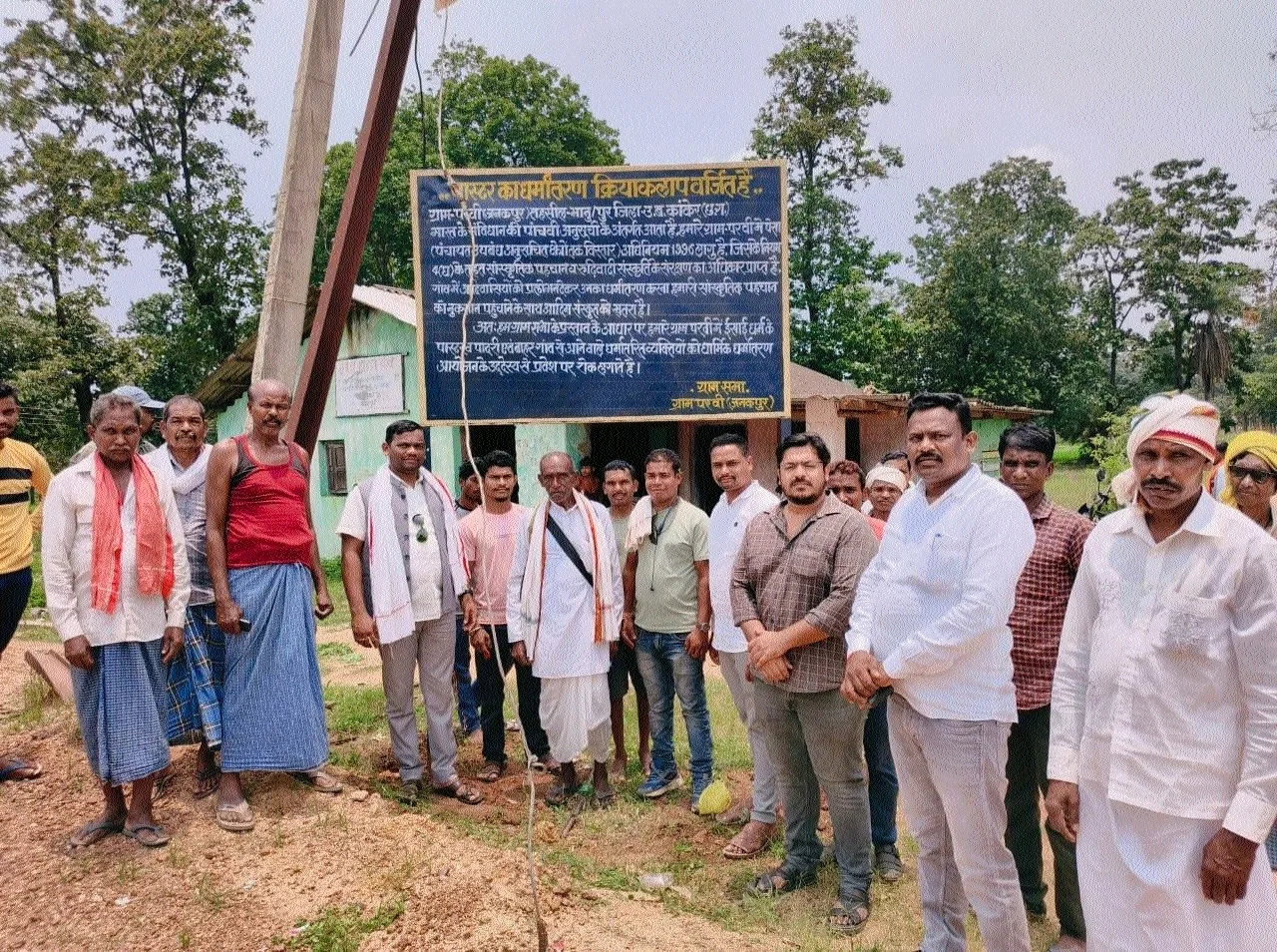
In the weeks leading up to October 28, 2025, tribal villages across Kanker district in Chhattisgarh were quietly building a strong, united response to what they viewed as persistent attempts at religious conversion. Their effort reached a decisive moment when Gram Sabhas in villages such as Kudal, Parvi, and Junwani erected hoardings at village entry points, formally restricting the access of Christian pastors and certain converted individuals who were allegedly involved in coercive or deceitful conversion activities.
These hoardings were not symbolic gestures, they were community-driven safeguards, grounded in the authority granted to tribal councils under the PESA Act. They signalled a collective stand rooted in self-governance, cultural protection, and the right of indigenous communities to defend their heritage from external interference.
The movement received a major legal and moral boost on October 28, 2025, when the Chhattisgarh High Court upheld the legality of these hoardings. The court affirmed that Gram Sabhas have the right to act against forcible or fraudulent conversions and emphasised that such conversions do not fall under the constitutional right to profess or propagate religion. A detailed report on November 2-3, 2025, highlighted this community resistance as a landmark instance of tribal empowerment.
For the indigenous tribes of Kanker, this judgement was not merely a legal win, it was a civilisational reaffirmation. It validated their long struggle to protect their customs, identity, and spiritual practices from predatory conversion campaigns. After years of tensions and complaints of coercive missionary activities, the villages stood united and victorious.
The intended victims in these conversion drives were tribal communities whose cultural fabric was being targeted. The accused are Christian pastors and missionaries alleged to be engaging in conversions through force, allurement, or fraud.
In the end, what began as village-level resolve became a celebrated assertion of dharma and self-rule, a reminder that when indigenous Bharat stands together, its spirit is unshakeable.
Resistance was enacted through local tribal governance and subsequently validated by the High Court:
1. The Gram Sabhas, acting under the authority of the PESA Act, physically installed the cautionary hoardings as a form of institutional resistance to conversion efforts.
2. The Chhattisgarh High Court ruled that installing these hoardings was not unconstitutional per se, affirming that such measures could be used as precautionary steps to prevent illegal conversions and protect tribal cultural heritage.
3. The state argued in court that the measure was specifically intended to protect the traditional culture and heritage of the Scheduled Tribes Community.
The incidents of early November reveal more than scattered clashes, they tell the story of a civilisation that refuses to surrender in the face of sustained injustice. Every attempt to undermine dharma, every organised effort to intimidate or weaken Hindu society, is met with a clearer, stronger, and more determined response.
Today’s Hindu resistance is not impulsive; it is disciplined, conscious, and anchored in the values that have held this civilisation together for millennia, satya, nyaya, and sahas. Hindus across regions are no longer enduring hostility in silence; they are confronting it with organisation, unity, and moral clarity.
For in the face of systematic attempts to distort, convert, or break its spirit, the real strength of this nation lies in its unshaken faith and its willingness to stand up, together, against injustice.