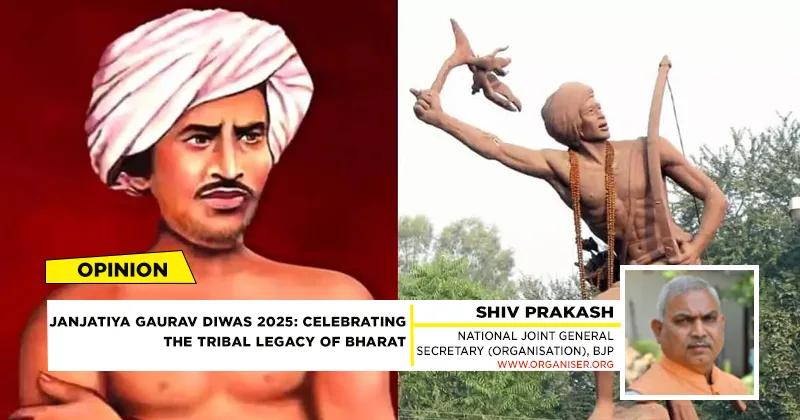
This year marks the 150th birth anniversary of Bhagwan Birsa Munda, revered as Dharti Aaba—the Father of the Earth—who led the historic Ulgulan (revolution) against the exploitative British rule in defense of his people’s land, forests, water, and cultural identity. Born on November 15,1875 in Ulihatu village of Ranchi district, he fearlessly fought the oppressive colonial system and called upon his people to free themselves from exploitation. Arrested by the British for his armed rebellion, he attained martyrdom on 9 June 1900 while imprisoned in Ranchi Jail. To immortalize his contribution and inspire the coming generations, Prime Minister Narendra Modi declared November 15 as “Janjatiya Gaurav Diwas” (Tribal Pride Day).
Birsa Munda taught his people to live a life free of vices, to reject superstition, and to embrace dignity, discipline, and self-reliance. He raised his voice against the exploitation of tribals, abolished bonded labor, and initiated the great Ulgulan movement with his resounding call: “Abua Raj ete jana, Maharani raj tundu jana”—“Let our rule prevail, and end the Queen’s rule.”
Tribal Pride Day is not merely a tribute to Bhagwan Birsa Munda alone, but a day to honor the countless tribal heroes who devoted their lives to India’s freedom, culture, and social awakening. Across centuries, India’s tribal communities have produced brave sons and daughters who stood for truth, self-respect, and justice. Rani Gaidinliu of Nagaland led the Heraka movement, opposing both British rule and religious conversion.
Govind Guru of Rajasthan became a symbol of spiritual and social reform among the Bhil community, while Rani Durgavati, Tilka Manjhi, Alluri Sitarama Raju, Korum Bhil, Tatya Bhil, and Sidhu–Kanhu Murmu made supreme sacrifices for the nation. From the Himalayas to the Western Ghats, and from the Eastern hills to the deserts of the West, tribal communities have fought to preserve India’s freedom, its faith, and its forests. Even today, icons such as Mary Kom in boxing, Komalika Bari in archery, and Dilip Tirkey in hockey continue to bring pride to the country, proving that the spirit of the tribal legacy still shines bright in modern India.
When the imperial powers of Europe expanded their empires across the world, they carried out horrific massacres of indigenous peoples in regions like America, Australia, Africa, and New Zealand. The missionaries who accompanied these colonial rulers often played a major role in this cultural destruction, attempting to erase the identity of the original inhabitants. Richard Temple, former Finance Minister of the East India Company and Governor of Bengal and Bombay Presidencies, said in his 1883 address to the Baptist Society in London, “To make British rule permanent, missionaries must focus on the tribals—these primitive races are like blank sheets of paper on which we can easily inscribe our marks.”
Such words exposed the strategy behind missionary efforts to manipulate native cultures. In response to the global decline of indigenous populations, the United Nations declared August 9, 1994 as World Indigenous Peoples’ Day. However, in India this day was rebranded as Adivasi Diwas (Tribal Day)—a distortion of its true meaning. The fact remains that India’s tribals are the true natives of this land, deeply woven into its spiritual and cultural fabric. Unlike in other countries, they have never been persecuted in India; instead, they have been protectors and preservers of the Indian civilization. Hence, the global context of “indigenous rights” cannot be equated with India’s inclusive cultural reality.
Over the past few decades, deliberate attempts have been made to create divisions and religious conversions among tribal communities. Reports presented in the 1994 C.V.C.I. Pune Conference noted that missionary groups were supporting movements such as the Dalit Liberation Movement, Tribal Liberation Movement, and Environmental Movements as vehicles for conversion and fragmentation. Today, under various banners—Dalit, tribal, women’s rights, or environmental protection—numerous groups are promoting discord in the name of justice. Misleading slogans like “We are descendants of Ravana, not Rama,” or “Our deity is Mahishasura,” are part of this same divisive design. In modern times, urban Maoists, pseudo-intellectuals, and foreign-funded NGOs have joined this network, forming a global web of influence that seeks to separate tribals from their roots. Under the pretense of liberation, Naxalism too has dragged thousands of tribal youth into the path of violence, halting the very progress it claims to achieve. These ideological conspiracies have damaged the tribal cause rather than empowering it.
The tribal community, in truth, forms the soul of Sanatan Indian culture. Their deep devotion to nature and reverence for land are living symbols of India’s ancient belief in the sanctity of water, forest, and earth. In Sanatan Dharma, nature is sacred—seen in the worship of the Ganga, in reverence for trees like the Tulsi, Peepal, and Banyan, and in the ritual of honoring the soil before any auspicious work. Every being, color, and creature holds divine significance—Shiva’s bull Nandi, Ganesha’s elephant head, the snake garland of Mahadev, the blue complexion of Krishna and Tirupati Balaji, and the black form of Maa Kali—all reflect India’s inclusive philosophy that celebrates unity in diversity.
From Maa Kaushalya of Chhattisgarh (mother of Bhagwan Ram) to Rukmini of Manipur and Arunachal (wife of Krishna), from the polyandrous tradition in Jaunsar connecting to Draupadi, to the Tharu reverence for the soil of Haldighati, India’s tribal traditions are intimately tied to its sacred epics and heroes. The so-called “primitive” culture of the tribals is not lifeless or backward—it is profoundly spiritual, recognizing the divine in all beings. This is why India’s sages chose forests—aranya—for their penance, giving rise to what is called “Aranya Sanskriti” (the forest civilization). The tribal people have been the protectors and carriers of this civilization for millennia.
The present government, under the leadership of Prime Minister Narendra Modi, has shown strong commitment to the upliftment of tribal communities. The creation of a dedicated Ministry of Tribal Affairs and a Tribal Commissionreflects this priority. The government has introduced the Minimum Support Price (MSP) for forest produce and launched the Stand-Up India Scheme, offering financial assistance from ₹1 lakh to ₹10 crore to encourage tribal entrepreneurship. It has also initiated a national mission to eradicate sickle cell disease in collaboration with state governments. Today, tribal leaders are at the heart of India’s democratic system, from President Droupadi Murmu to governors and ministers serving across various states. The government’s decisive actions against Naxalism are paving the way for peace, security, and development in tribal regions, ensuring that these areas can prosper and participate in India’s growth story.
As the nation celebrates the 150th birth anniversary of Bhagwan Birsa Munda, it is not merely a remembrance of the past but a reaffirmation of our collective duty. The celebration of Tribal Pride Day signifies gratitude to all tribal communities for their enduring contribution to India’s development and cultural unity. It calls upon every citizen to extend love, respect, and cooperation to the tribal society, to participate in their progress, and to stand united for a Naxal-free, self-reliant India. We must reinforce the belief that our culture is one and our great heroes belong to all, freeing the tribal community from all divisive conspiracies. Only by living these ideals will the true spirit of Tribal Pride Day be realized, and only then will our homage to Bhagwan Birsa Munda be complete and worthy.