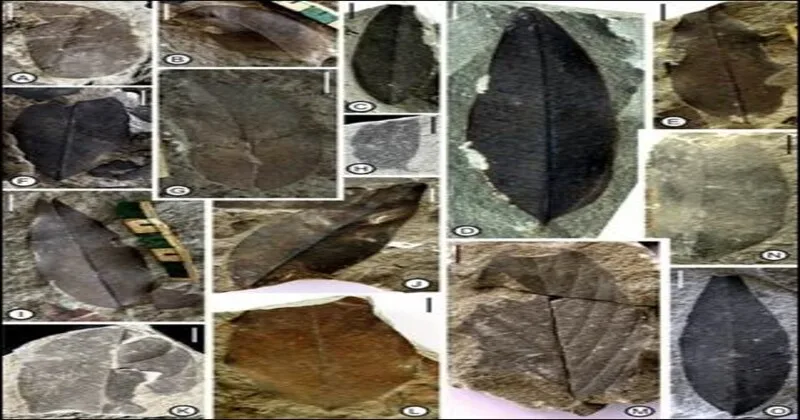
In the quiet, lush green hills of Nagaland, a team of Indian scientists unearthed a treasure. A set of fossilized leaves, lying quietly for nearly 34 million years has become the storyteller in a dramatic saga of climate change, polar ice and India lifegiving monsoon. Their discovery reveals how distant Antarctica shaped the rainfall patterns that now sustain millions in the Indian subcontinent and raises questions about our changing climate today.
Fossil Clues from Ancient Nagaland
Researchers from the Birbal Sahni Institute of Palaeosciences in Lucknow and the Wadia Institute of Himalayan Geology in Dehradun embarked on a journey to the Laisong Formation of Nagaland deep in the northeast. In order to decode the region ancient climate. The fossil leaves they found were not just geological achievements but their size, shape and structure were a living archive. Using a technique called Climate Leaf Analysis Multivariate Program (CLAMP), the scientists peered into their delicate features, tracing the outline of a climate long gone.
Their results were surprising. Millions of years ago, this corner of India was draped in a much warmer and wetter climate than today. Real tropical forests flourished here, rainfall was heavier than what the area receives now. In these ancient leaves, the scientists founded the proof’s that environment can transform dramatically over time and what are global event behind such transformations.
A Polar Connection Across Millennia
As the scientists dug deeper, a puzzle took shape what global event turned Nagaland into such a watery haven? The answer lies in the icy heart of Antarctica. The fossil leaves dated back to about the same time 34 million years ago when mighty ice sheets began spreading over the southernmost continent. This coincidence was too important to dismiss.
The scientists proposed that the growth of Antarctic ice altered global wind and rainfall patterns worldwide, it shifted the Intertropical Convergence Zone (ITCZ), the vast equatorial rain belt, toward the tropics. This shift of tropics resulted in heavy rainfall to northeast India. These ancient shifts didn’t just shape local forests, they laid the foundations for the Indian monsoon system that brings life and nourishment each year.
The importance of this discovery, published in Palaeogeography, Palaeoclimatology, Palaeoecology, cannot be undermined, it shows that the Earth climate is an interconnected web what happens far away in Antarctica has ripple effects thousands of kilometers across the globe. Nagaland fossil leaves bear silent witness to these immense shifts. As Antarctica grew colder, the tropics got wetter, rain fell in new places and landscapes changed in a cascade that shaped the world we inhabit today. Earth’s atmosphere, wind and water operate like a single system, forging pathways between the poles and the tropics that are still visible in India monsoon rains.
Why This Matters Today
Yet this is not just a story of prehistoric transformation. The discovery comes with lessons and warnings for the present day. The Antarctic ice sheets that once triggered heavier monsoons in India are now melting rapidly due to global warming. The study argues that if this melting once again shifts the ITCZ, the monsoon could become erratic and unpredictable not only in India, but across tropical regions and recent studies shows this year Monsoon crossed the Himalayan ranges and reached to Tibet.
In India, the monsoon is more than a meteorological event it’s a lifeline. It influences rainfall in Nagaland, farming in Bihar and rivers that nourish millions across South Asia while fuelling the rural economy. When the monsoon arrives late, lasting too short or dumping excessive rain fields suffer, water becomes scarce and rural stability is shaken. Crop failures and floods can devastate families, communities and economies. Thus, understanding ancient climate connections is essential today.
A Global Perspective on Local Life
This research reinforces the idea that Earth works as an enormous, interconnected system. The fate of rain in Nagaland isn’t decided only in local clouds and it’s tied to glaciers, poles and wind currents that circle the world. As global warming accelerates polar ice melt, changes in Antarctica can once again reshape monsoon patterns, with consequences for food, water and livelihoods from the Himalayas to the coastal plains.
The fossil leaves, carefully collected and studied are not just the remainder of vanished forests. They are tangible records of a planet, where local climates are altered by distant forces. Scientists accumulated these clues to remind us to keep our perspective wide as we confront climate change. A shrinking glacier at a distant place may one day affect the harvests or river flows in India.
From the hills of Nagaland to the frozen Antarctic glaciers, the message echoes that our planet systems are deeply linked and we ignore these realities. As the world faces new climate challenges, these ancient fossils are more than just scientific curiosities and they’re urgent reminders to learn from history and prepare wisely.