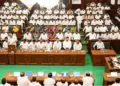
On September 9, 2025, the elections for the post of the Vice President of the Republic were conducted smoothly, and by the evening of the same day, the results of the whole exercise were declared by PC Mody, Secretary General of the Rajya Sabha, the Returning Officer for the elections. The NDA, which has an effective strength of 427 members in the parliament, was able to get 452 votes (25 votes more than the actual strength). The I.N.D.I Alliance, which has an effective strength of 315 members, got 300 votes (15 votes less than its minimum strength). While 15 votes were found invalid, the other 14 members abstained (or absented) from voting. Thus, the NDA candidate, CP Radhakrishnan, won by an overwhelming margin of 152 votes, defeating the combined candidate of the opposition, Justice (retd) B.Sudershan Reddy.
CP Radhakrishnan, the newly elected 15th Vice President of India, is currently the Governor of Maharashtra. He has also been the Governor/Lt. Governor of Jharkhand, Telangana and Puducherry. He was born in Tirupur, Tamil Nadu, and is deeply connected with the ideology of RSS. CP Radhakrishnan came into the erstwhile Bhartiya Jana Sangh via RSS during the 1970s and later became an integral part of the BJP in and after 1980.
A graduate in Business Administration, Chandrapuram Ponnusamy Radhakrishnan has been a Lok Sabha member from Coimbatore twice and chaired the Parliamentary Standing Committee on Textiles during his time. In 2004, he was also a member of the Indian legislative delegation to the UN General Assembly, where he spoke about disaster assistance and humanitarian coordination. He furthered his political career in Tamil Nadu by serving as the state president of the BJP from 2004 to 2007.
During this time, he embarked on a 19,000-km, 93-day ‘Ratha Yatra’ to promote social and environmental problems throughout the state.
The Vice Presidential elections threw up a debate of great public interest, which we, as Indian citizens, normally try to avoid. This is because the I.N.D.I Alliance selected B Sudershan Reddy, a controversial retired judge of the Supreme Court of India as its common candidate. There is a general tendency in society not to discuss issues related to Supreme Court & High Court judges, their judgments, their observations and even their conduct (whether good or bad) once they are in service, except in extreme conditions. It is also construed that there should be no debate about them even after their retirement, too.
Over the years, we have witnessed a number of heads of constitutional institutions, Supreme Court and High Court judges joining politics and public life post their retirement. There are again two opinions on this in the society, one opposing this act of theirs and another supporting this act, claiming that neither the constitution debars them from doing so nor any other by-laws governing their conduct disallow them to do so. Moreover, the scheme of fundamental rights in the constitution also grants them every right to do so without any sort of restrictions.
It is a long debate whether judges at all should join politics post-retirement. But there are instances where they have done so and have even played a key role in public life, many a time, controversial as well. Their public pronouncements in and outside the legislature have also generated further discourses whenever they have taken up the issues pertaining to the judgments of the Supreme Court and the High Courts. This remains an unending debate, and people have their opinions to defend. In fact, some say that they should enrich public life with their experiences after their retirement from service.
However, the issue of the debate assumes importance when any judge joining politics or public life after retirement tends to take the shield of his or her being a past judge in order to escape public criticism. This criticism of a past judge usually refers to one’s past and the present. The moment one joins public life and specifically politics and opts to fight elections for any position in public life, people start finding good and bad issues related to that particular person, and their past work and conduct come into question.
Generally, one appeals for votes from the electorate, irrespective of the type of constituency, on the basis of past work, reputation, name, fame and promises in respect to the future. It is common sense that in the case of a judge, his or her past judgements will come into the picture along with his or her work and conduct and the political agenda. There is no question of getting away from such a situation in the given scenario, nor is there any sort of immunity available to the past judges. And the same happened in the case of the opposition’s Vice Presidential candidate this time as well.
Justice (retd.) B.Sudarshan Reddy of the Supreme Court of India is very famous for his infamous judgments. People take him as a representative of the left-liberal ideology in the judiciary. Some call him an advocate of the urban-maoist school of thought. His judgement in respect of ‘Salva Judum’ aimed at countering Naxal violence in Chhattisgarh in this connection is quoted anywhere and everywhere. By virtue of his judgement, he quashed the establishment of ‘Salva Judum’. His defence of his judgements and the advocacy of left-liberal opinion couldn’t go unobserved and uncommented upon during the election campaigning.
There are some quarters in politics which believe that past work and conduct by judges, even at the time of those judges opting for politics after retirement, should not be debated or criticised. What they tend to ignore is that there is no constitutional provision available that makes their criticism an issue of blasphemy. Someone during such debates rightly remarked that judges are no gods. Moreover, as a civilisation, Indian society has been critical of gods as well, and our scriptures are full of such details. There is no issue of blasphemy even in such exceptional criticism.
Judges are human beings and can’t be above criticism and the law, neither during their service nor after their retirement. Any laxity shown in this regard is ultra vires of the oath they take when they assume their office. When there are instances of flawed judgements, corruption, misconduct, moral turpitude and an expressed bias in observations and decisions, it is simply impossible for the public to ignore such issues. Any judge joining politics publicly can’t even dream of enjoying immunity in such a scenario. Obviously, B. Sudershan Reddy was not an exception.
Some past judges and advocates who came out in support of Reddy were within their rights to do so, but equally, were the overwhelming number of jurists within their rights to counter it and express serious criticism of Reddy and his past. Both played their role as per their constitutional, moral and social duty, but neither of the two sets of jurists could have an exclusive opinion in regard to the election of Reddy. That exclusive right rested upon the people to elect the new Vice President, and they delivered their verdict.
In order to garner support, B. Sudershan Reddy took the whole nation by surprise when stunning optics were released by the media in regard to his meeting with a convicted Lalu Prasad Yadav, RJD Supremo, held responsible by the judiciary for his crimes against the nation in the fodder scam cases. A retired Supreme Court judge was seen by the whole nation, hand-folded before a convicted scamster asking for his support and blessings in his election campaigning. This is highly shameful, unacceptable and beyond any explanation.
B. Sudershan Reddy also appealed to the conscience of the parliamentarians and asked them in his appeal to vote as per their conscience, as there was no whip issued by their respective parties. Though his appeal was aimed at NDA parliamentarians, however, his appeal seems to have worked in the case of the opposition members of the parliament. There is clear evidence of cross-voting in favour of the Vice President-elect, and the Opposition candidate is well aware of the same, who otherwise claimed victory before the elections.
Senior leaders of the opposition have been critical of EVM and the ECI whenever they have lost elections. In this case, the elections were held using ballot papers, and the candidate lost the election. Now the whole opposition, including their candidate, the Supreme Court judge (retd), who was one of the candidates in this case, will have to accept the judgement with all humility. Unfortunately, for his proposers, the INDI-Alliance…they won’t be in a position to blame anyone this time for the verdict of the elections, say the final judgement. However, they can claim it as their ‘moral victory’ as they are used to in all such cases.
Now, post the successful Vice Presidential elections, we have the Bihar state elections that have an important role to play in the socio-political scenario at the national level. These elections are slated to be held in November 2025 and assume importance as the last election of this year. These elections also assume gravity due to the ECI’s decision to launch a nationwide Special Intensive Revision (SIR) of the electoral rolls in the state of Bihar. This process, which was and is being opposed by the INDI-Alliance but has been upheld as valid by the Apex Court, is going to determine the future roadmap for all elections in the country.
In Bihar, the two fronts comprise NDA and the Mahagathbandhan (INDI-Alliance). However, this time, the Jan Suraj Party of Prashant Kishore will also play its part. While stakes are very high for every political party and alignment in Bihar, the nation also looks up to this second most populous state with intensity, having bearing on the future of the political clock of the country. After an overwhelming victory for NDA in the VP elections, focus is now on Bihar..!