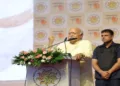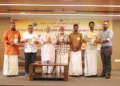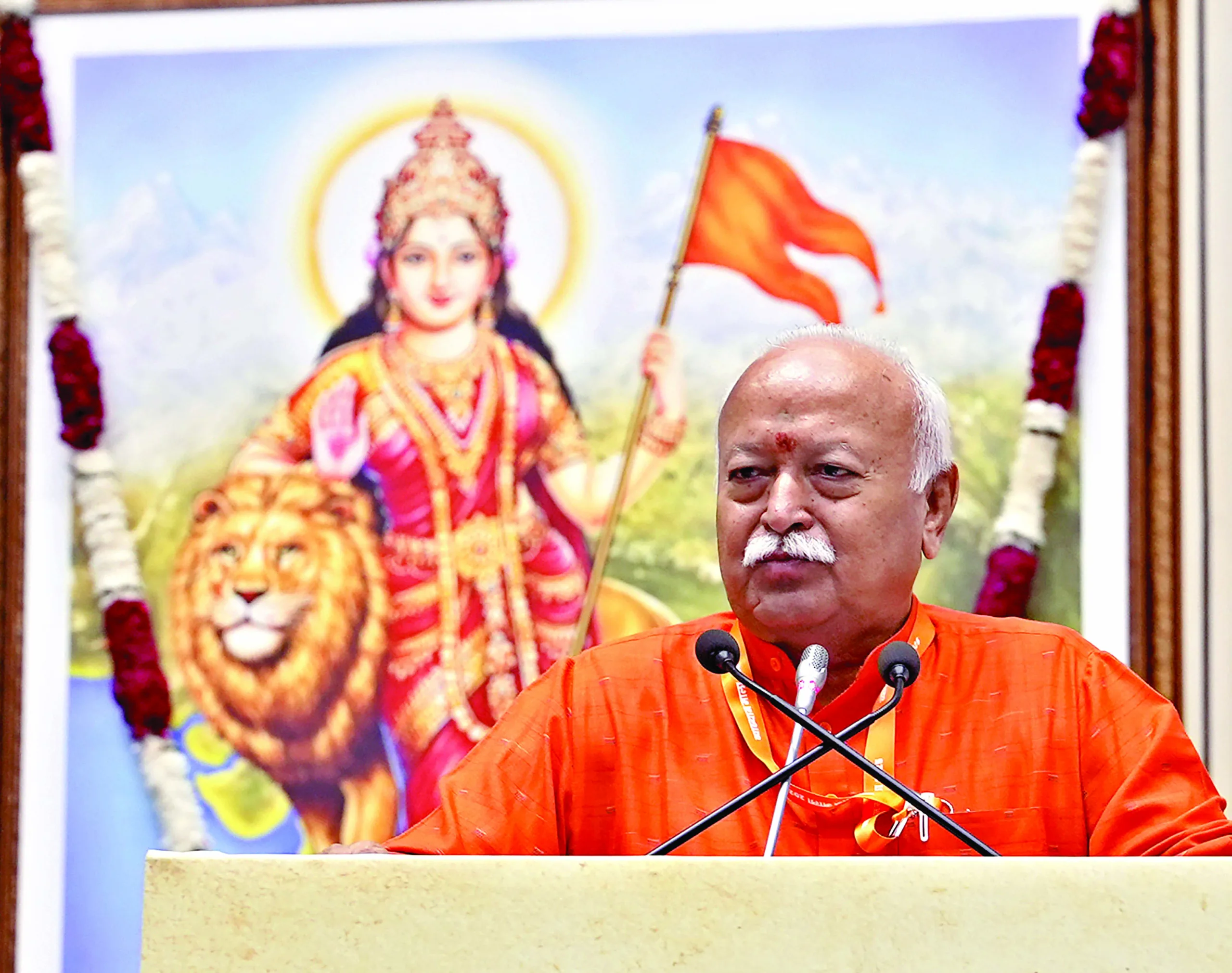
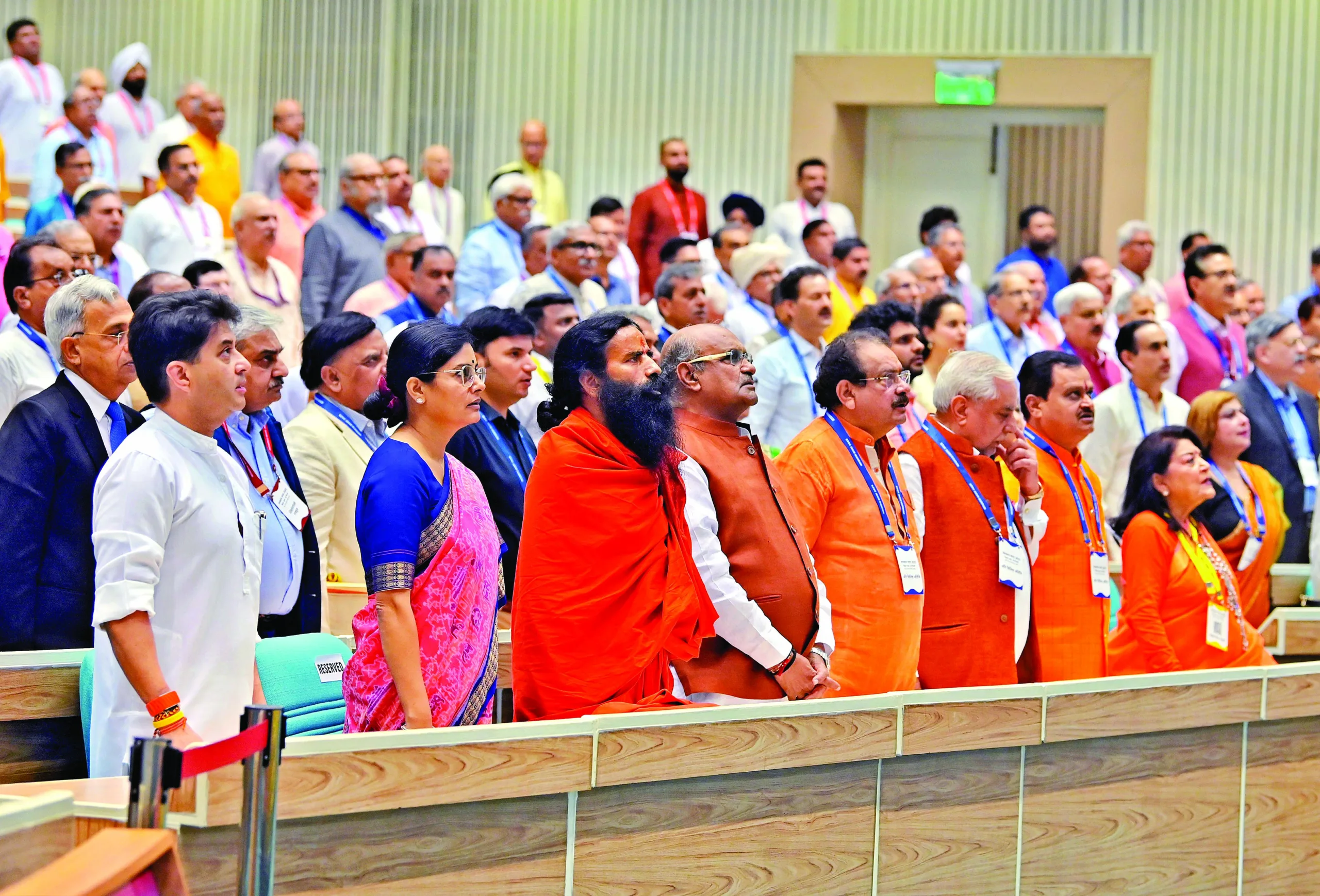
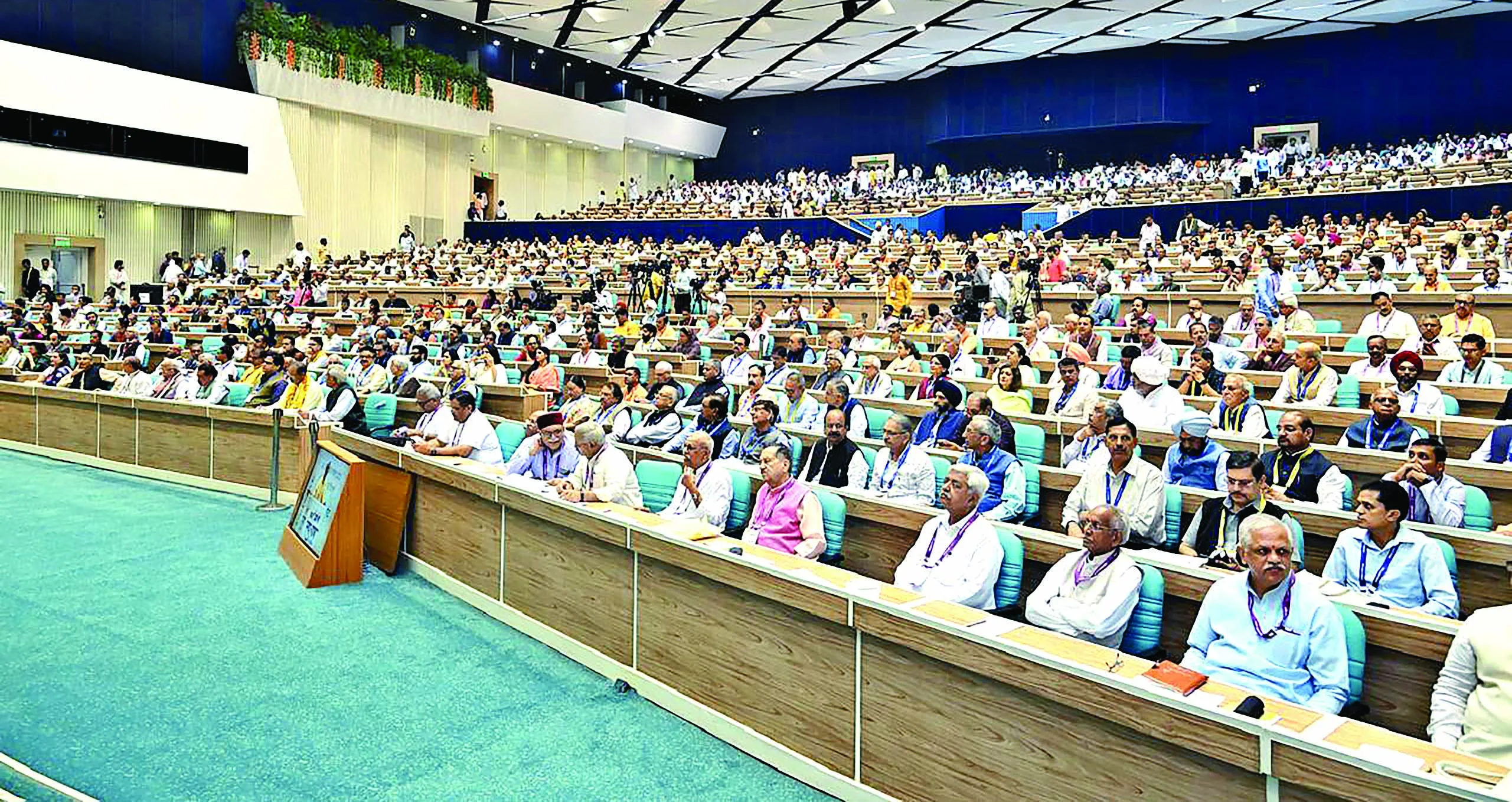
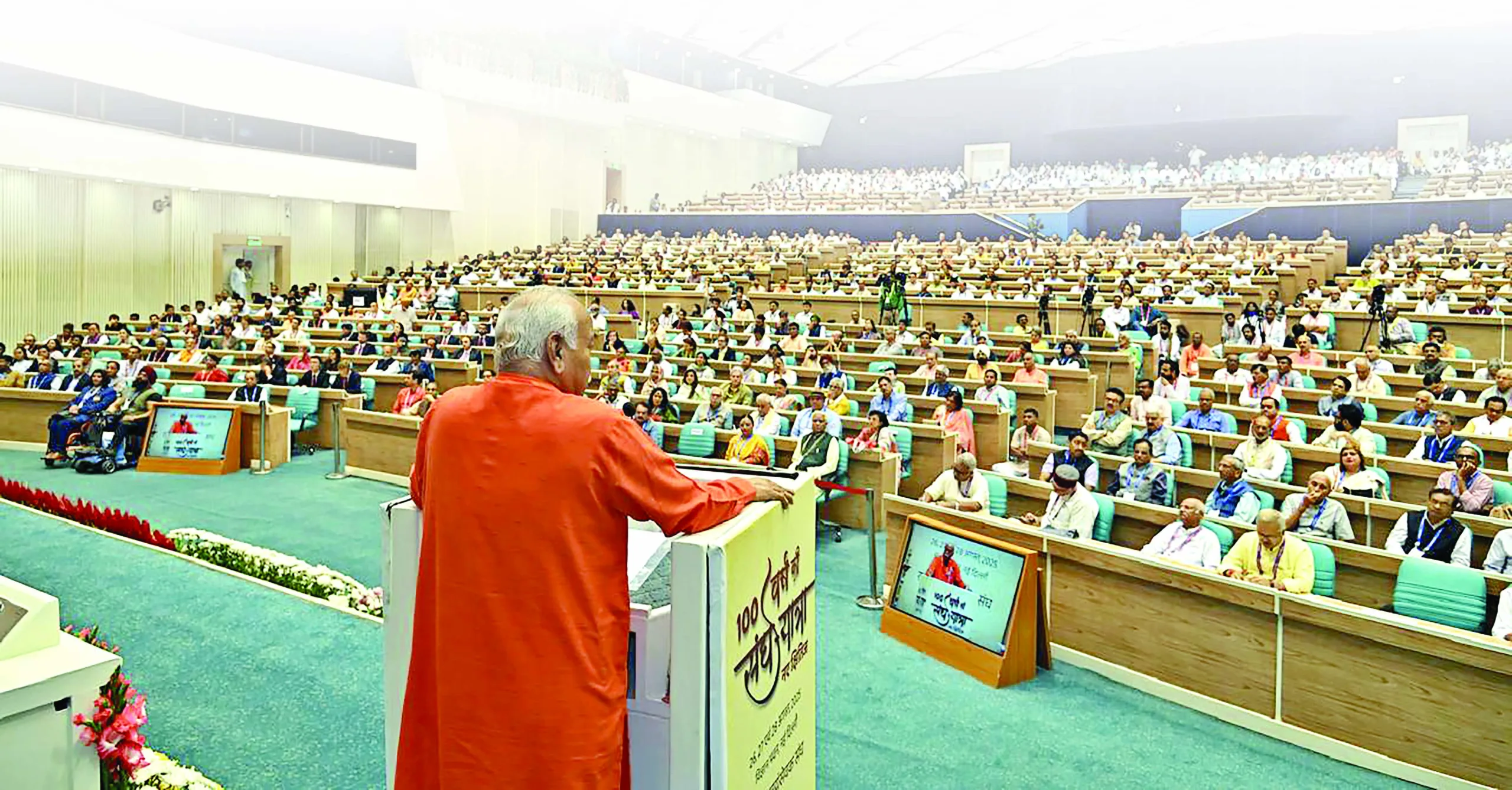
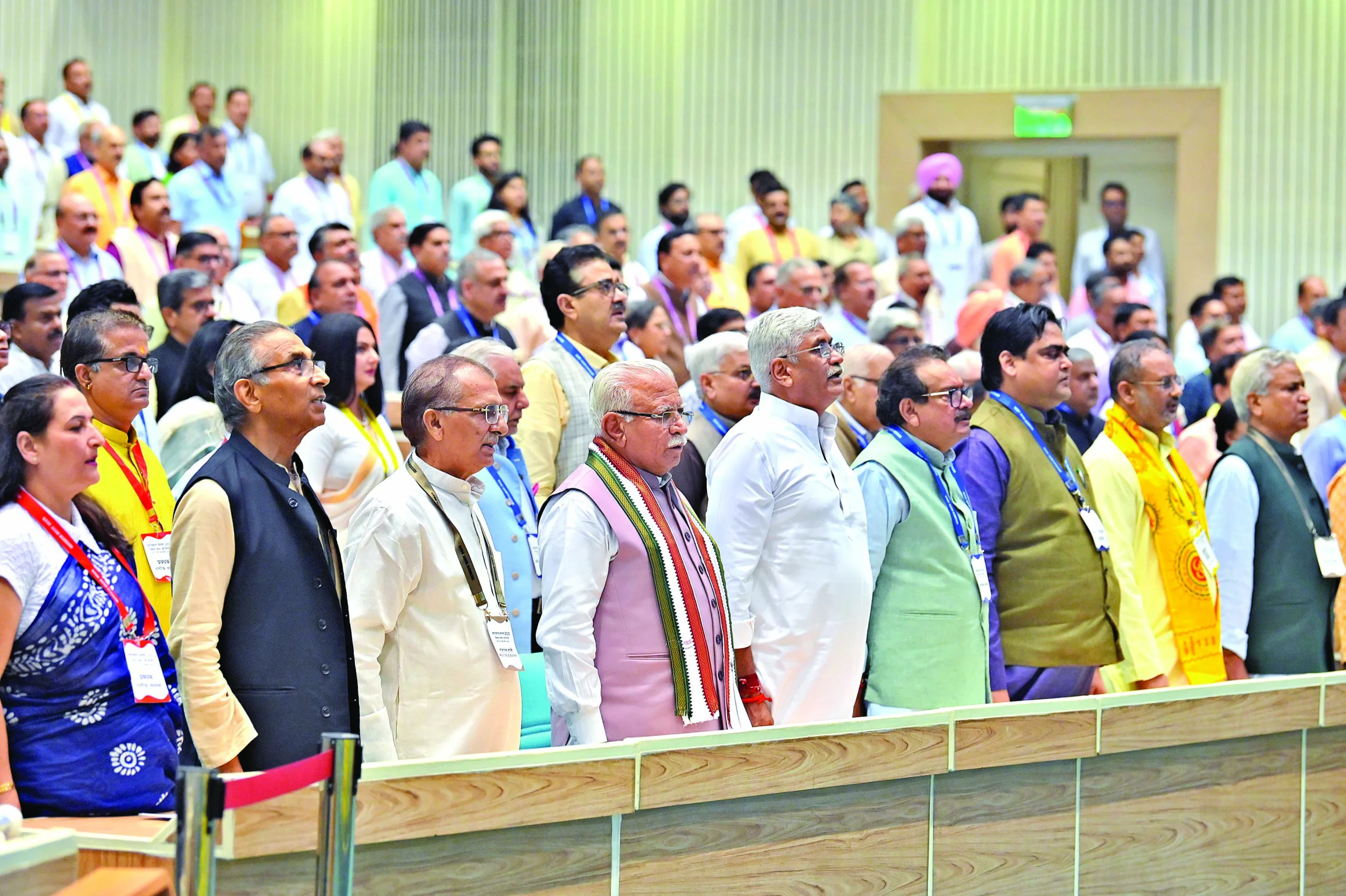
Sangh was formed with Bharat at the centre, and its purpose is for Bharat to become a Vishwaguru. The inspiration for Sangh’s work comes from the call of Bharat Mata Ki Jai, which reverberates at the end of the Sangh Prarthana,” said Rashtriya Swayamsevak Sangh (RSS) Sarsanghchalak Dr Mohan Bhagwat on August 26, while addressing the first day of the dialogue with people from various sections of society. The three-day lecture series, titled 100 Years’ Journey of RSS: New Horizons, was held at Vigyan Bhawan in Delhi from August 26–28, 2025.
Dr Bhagwat said that the rise of the Sangh has been a slow, long, and continuous process. Though the Sangh uses the word Hindu, its core principle is Vasudhaiva Kutumbakam. The Sangh regards the village, society, and Rashtra as its own. He explained that Swayamsevaks independently carry out Sangh’s activities, and Karyakartas create new Karyakartas. This is a continuous process.
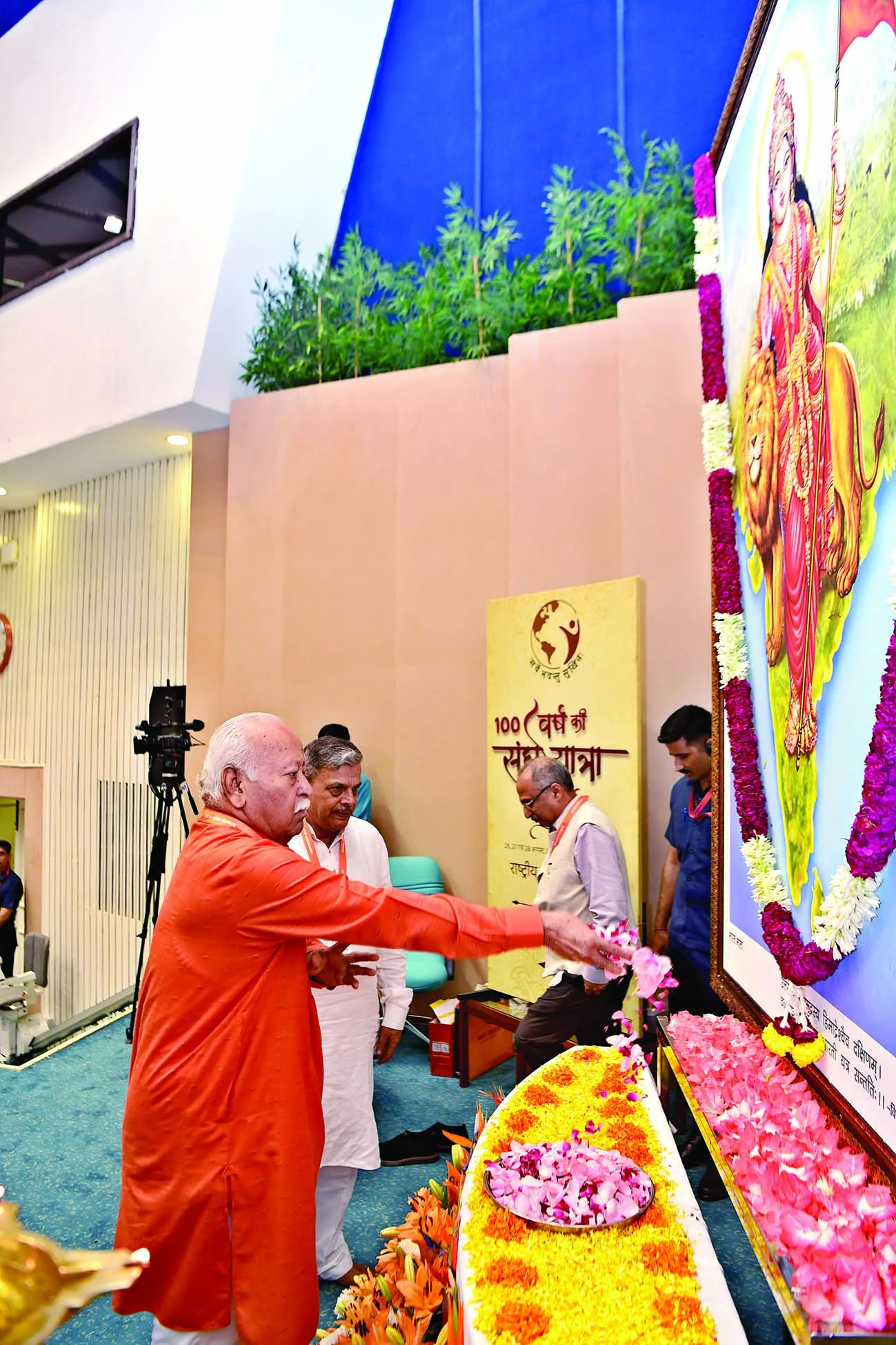
Highlighting the objective of this programme, the Sarsanghchalak said that while there is much discussion about the Sangh, most of it is not based on facts or authentic information. The purpose here, he noted, was not to convince but to present facts. He added that the definition of Rashtra is not determined by who holds political power. “We were a Rashtra even when we were not independent,” he said. In English, Rashtra is often translated as “Nation,” but that is a Western concept in which the state is inherently tied to the nation. By contrast, the Bharatiya understanding of Rashtra is not linked to political power.
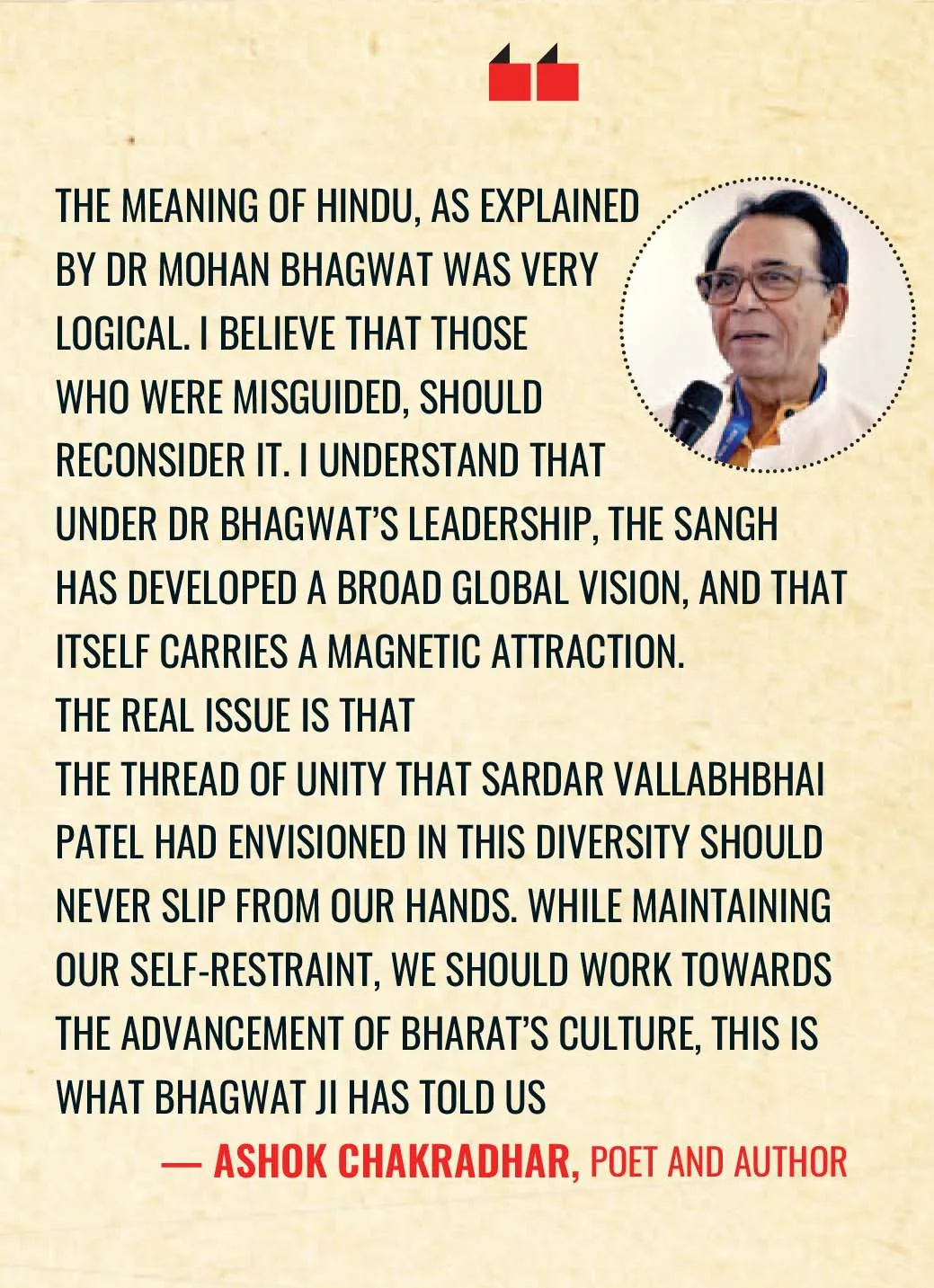
Dr Bhagwat also shed light on the freedom struggle and the subsequent development of different ideologies in the country. He said that although the attempt at independence in 1857 was unsuccessful, it awakened a new consciousness. Out of this arose a movement that questioned how a handful of people could defeat us. Another idea that emerged was that the people of Bharat lacked political understanding. From this need, the Indian National Congress was born. However, after independence, it could not fulfill its expected role in ideological enlightenment. “This is not an accusation, but a fact,” he clarified. After independence, one section of society emphasised eradicating social evils, while another stressed returning to its origins, drawing inspiration from Swami Dayanand Saraswati and Swami Vivekananda.
Dr Bhagwat said that Dr Keshav Baliram Hedgewar and other Mahapurushas believed that without removing social evils, all efforts would go in vain. Living under the rule of successive foreign invaders and colonial powers was, he noted, an indication that there were deep flaws within society. Dr Hedgewar resolved to work in this direction himself. By founding the Sangh in 1925, he set forth the objective of organising the entire
Hindu society.
Sarsanghchalak Dr Bhagwat explained that the word Hindu is not merely dharmik; it conveys a profound sense of responsibility towards the Rashtra. Though this name was given by others, we have always understood ourselves from an anthropological perspective. We believe that man, humanity, and the universe are interconnected and affect each other. Hindu means inclusion, it has no boundaries.
Dr Bhagwat emphasised, “Hindu means one who follows his own path, does not force others to change theirs, and respects others’ faith. Those whose tradition and sanskriti embody this spirit are Hindus. Our aim is to organise the entire Hindu society. To say ‘Hindu’ does not mean Hindu versus all; it means inclusive.”
Bharat’s Nature is Harmony, Not Conflict
He said that Bharat’s nature is harmony, not conflict. The secret of Bharat’s unity lies in its geography, resources, and tradition of self-reflection. Instead of looking outward, we have always sought truth within. This perspective has taught us that the same essence exists in all beings, though it may appear in different forms.
Dr Bhagwat said that those, who revere Bharat Mata and their ancestors, are true Hindus. Some people identify as Hindus, others as Bharatiyas or Sanatanis. The terminology may differ, but the underlying emotion is devotion and reverence. The shared traditions and DNA of Bharat connect everyone. He further explained that unity in diversity is the true identity of Bharat, and gradually, even those who previously distanced themselves from the term “Hindu” are beginning to identify with it. As the quality of life improves, people tend to return to their roots.
He clarified, “We do not insist that you must call yourself a Hindu. We simply tell you that you are a Hindu. Behind these words lies not mere semantics, but substance — devotion to Bharat Mata and reverence for ancestral traditions. For the past 40,000 years, the DNA of the people of Bharat has remained the same.”
He emphasised, “Improve the lives of those who already identify as Hindus, and those who do not will eventually begin to identify themselves as such too. Those who have forgotten will start to remember. But the ultimate goal is the organisation of the entire Hindu society. When we speak of a Hindu Rashtra, it does not mean we are excluding anyone.” He added that the idea of a Hindu Rashtra is not connected to political power.
Sangh is Dedicated to Nation-Building
Speaking about the RSS’s working method, Sarsanghchalak Dr Bhagwat said that the Sangh adopts two primary approaches for the upliftment of society: first, developing individuals, and second, inspiring them to serve society. The Rashtriya Swayamsevak Sangh is an organisation dedicated to nation-building by shaping individuals. Swayamsevaks work in various fields, but the Sangh does not control them. When the Sangh speaks of a Hindu Rashtra, it does not imply exclusion or opposition. The RSS did not arise out of reaction, but from the need to improve the condition of Hindu society.
He said that although there has been opposition and neglect towards the Sangh, it has always regarded society as its own. Just as physical exercise is not meant to harm others but to maintain health, the Sangh is not about conflict but about preserving the natural state of a united society.
He further noted that a unique feature of the RSS is that it does not rely on external resources but functions through the personal dedication of its Swayamsevaks. Guru Dakshina is an integral part of the RSS’s method, through which each Swayamsevak expresses faith and commitment to the organisation. A Swayamsevak nurtures another Swayamsevak, who in turn nurtures more, and this process continues tirelessly. The focus, he said, is to ensure that thoughts, values, and conduct are right. That is the primary concern regarding the Swayamsevaks — the organisation takes care of itself. Together, we must ensure that no factions are formed in Bharat; instead, everyone must remain united.
Day 2
“Balance in society and individual life is Dharma, which avoids all forms of extremism. The Bharatiya tradition calls it the middle path, and this is the greatest need of the world today,” said RSS Sarsanghchalak Dr Mohan Bhagwat.
He said that for Bharat to become an emulative model for the world, social change must begin at home. For this purpose, the Sangh has taken up the initiative of Panch Parivartan (Five-fold Transformations): social harmony, family awakening, environmental awareness, selfhood – self-reliance with cultural pride, and civic duties. “For a self-reliant Bharat, priority should be given to Swadeshi, and Bharat’s international trade should take place only on our own terms and not under any external pressure,” said Sarsanghchalak Dr Mohan Bhagwat.
How does Sangh work?
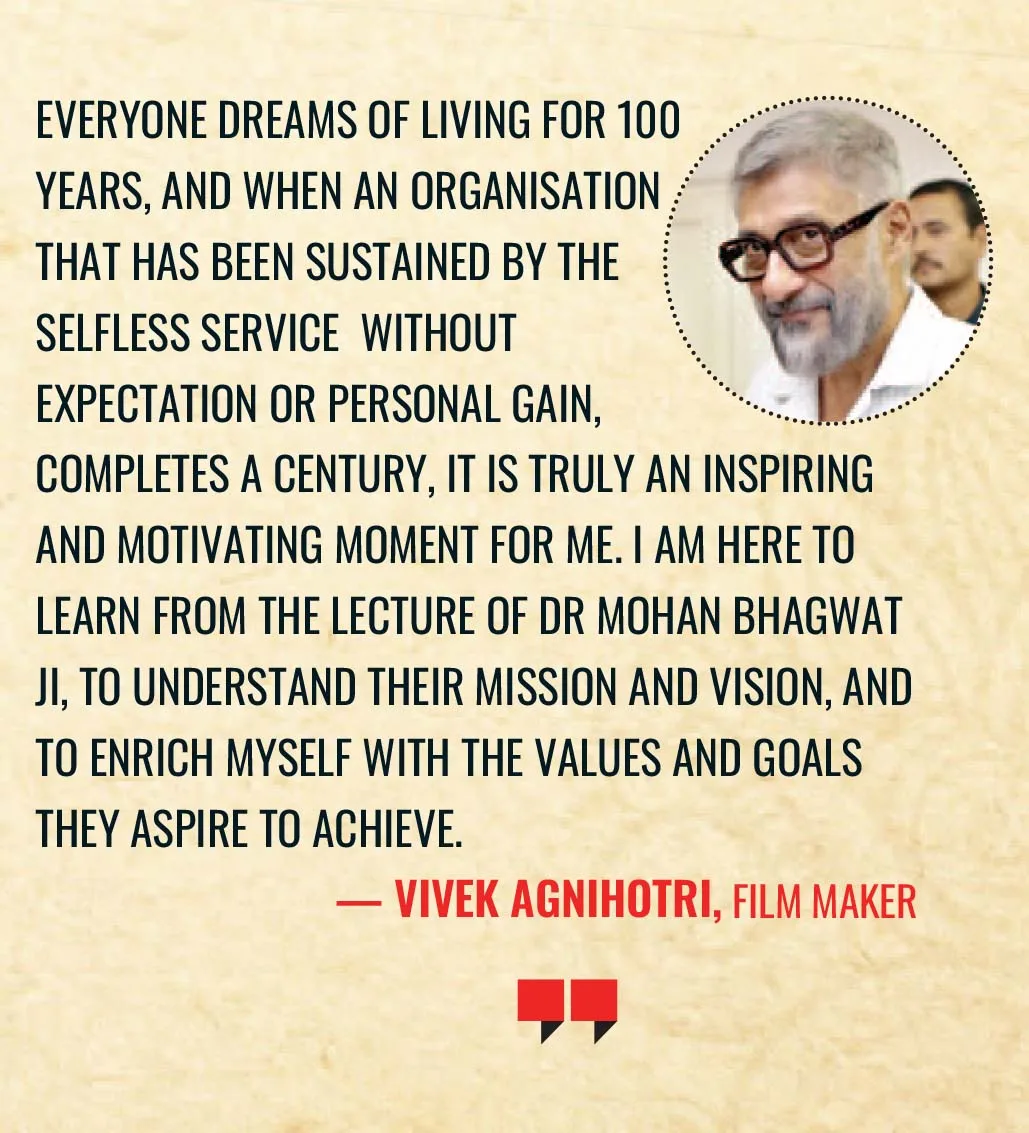
Sarsanghchalak Dr Bhagwat said that pure love, honest intention, and devotion to society are the basis of the Sangh’s functioning. “Swayamsevaks of the Sangh do not expect any selfish gain. There are no incentives here; in fact, there are more disincentives. Sangh Swayamsevaks work while experiencing joy in serving society.” He clarified that the purpose of life and Mukti is realised through such service. The life values of the Sangh, he added, are: making friends with good people, ignoring the wicked, rejoicing when someone does good, and showing compassion even to the wrongdoer.
What is Hindutva?
While addressing the gathering, Sarsanghchalak Dr Bhagwat emphasised the core essence of Hindutva, saying, “Hindutva is truth, love, and a sense of belonging.” Quoting revered Seers and Sages, he said, “Our Rishis and Munis taught us that life is not meant for oneself. This is why Bharat has a role to play in guiding the world as an elder brother.” He added that this perspective naturally leads to the idea of universal welfare.
Concern Over the global direction
He expressed concern that the world is moving towards religious extremism, conflict, and unrest. Over the last three hundred and fifty years, due to consumerist and materialistic attitudes, human values have steadily diminished. Referring to the seven social sins mentioned by Gandhiji—work without effort, pleasure without wisdom, knowledge without character, trade without ethics, science without humanity, religion without sacrifice, and politics without principles—he explained that these evils deepen the imbalance in society.
Need for adopting the Path of Dharma
Sarsanghchalak Dr Bhagwat said that the world lacks coordination and must change its current approach. The world must adopt the path of Dharma. “Dharma is beyond rituals and ceremonies. Religion above all religions is Dharma. Dharma teaches us balance: we, society, and nature need to live together,” he said. He explained that Dharma is the middle path that protects us from extremism. The true meaning of Dharma is to live with discipline and balance. With this perspective, peace can be established in the world.
Defining Dharma, he said, “Dharma is that which leads us towards a balanced life, where diversity is accepted and the existence of all is respected.” He stressed that this is Vishva Dharma and that Hindu society must unite and present a model to the world.
In the global context, he noted that although discussions on peace, the environment, and economic inequality are taking place worldwide—and many solutions are being suggested—tangible results are not visible. “For this, one must think honestly and bring sacrifice and renunciation into life. A balanced intellect and a vision rooted in Dharma must be inculcated.”
Dr Bhagwat said, “Bharat has always exercised restraint, even ignoring its own losses. We have even helped those in times of crisis who once harmed us. Hostility arises out of the arrogance of individuals and nations, but Bharat stands above arrogance.” He added that Bharatiya society must set an example for the world through its conduct.
Sangh’s Credibility Has Grown in Society
He said that the credibility of the Sangh has grown in society today. “When the Sangh speaks, society listens.” He explained that this trust has been earned through selfless service and dedication to the people.
Speaking on the future direction, Dr Bhagwat said that the Sangh’s objective is to reach every place, caste, class, and section of society. Alongside this, noble forces engaged in good work within society must be connected. This will inspire society itself to take up character-building and patriotic work in the spirit of the Sangh. For this, outreach is necessary to every corner of society—both geographically and across all classes and levels—and the instrument for this is the Sangh Shakha. The Sangh will not only establish contact with such noble forces but also connect with them.
Social Harmony and Interfaith Unity
On the issue of social harmony, Sarsanghchalak Dr Bhagwat said that the Sangh believes we must cultivate goodwill in society and regularly engage with opinion-makers. Through them, a collective thinking process must be developed. They should work for their communities while fostering the sense that they are an integral part of Hindu society, and they must find solutions to challenges rooted in their geographical conditions. They should also work for the upliftment of weaker sections.
Dr Bhagwat further said that because of external aggressions, certain ideologies entered Bharat, and for various reasons, some people adopted them. “They are people of this land, but because the ideology was foreign, distances were created. These must be removed. We must understand each other’s pain. As parts of one country, one society, and one nation—with shared ancestors and cultural heritage despite diversities—we must move forward together. This is essential for positivity and harmony. And in this, too, we are talking about progressing thoughtfully, step by step.”
On the economic front, he stated that while smaller experiments have been conducted, an economic paradigm must now be established at the national level. He said that Bharat must present a development model that balances self-reliance, Swadeshi, and environmental sustainability, so that it becomes an example for the world.
Speaking on relations with neighbouring nations, he said: “Rivers, mountains, and people are the same; only lines have been drawn on maps. On the basis of the values that we have inherited, progress should come for all, and for that we must connect with one another.
Religions and sects may differ, but there are no disagreements on values.”
Five-Fold Transformation: Charity Begins at Home
He emphasised that before we bring about a change in the world, we must first implement those societal changes within our own homes. For this, the Sangh has proposed five-fold transformations. He gave examples such as wearing traditional attire during festivals, signing in one’s own language, and buying local products with great respect. Dr Bhagwat further added that while our ancestors cheerfully sacrificed their lives on the gallows, today what is needed is to live every moment for the nation. “In all circumstances, the Constitution and laws must be followed. Even if provoked, do not burn tires or throw stones. Anti-social elements exploit such situations to divide us. We must never resort to unlawful conduct under provocation. Even in small matters, we must act keeping the nation and society in mind,” he said.
He stressed that Bharat must take concrete steps towards Atmanirbharta, for which Swadeshi must be prioritised. Concluding his address, Sarsanghchalak Dr Bhagwat said, “The Sangh does not wish to take credit for anything. The Sangh wants Bharat to make such a leap that it not only transforms itself but also brings happiness and peace to the entire world.”
Day 3
On August 28, the final day of the three-day lecture series, RSS Sarsanghchalak Dr Mohan Bhagwat emphasised that it is a misconception to believe that the Sangh is opposed to anyone. “Our ancestors and sanskriti are the same. Worship practices may differ, but our identity is one. Changing religion does not change one’s community. Mutual trust must be built on all sides. Muslims must overcome the fear that joining hands with others will erase their Islam.” He also noted that the Hindu society’s sentiments regarding Mathura and Kashi are natural.
While answering a question, Dr Bhagwat highlighted the role of the Sangh in Bharat’s freedom struggle and various social movements. He said that the Sangh never raises a separate flag for social movements, but Swayamsevaks are free to contribute wherever good work is being done.
The Sangh and Its Organisations, Including BJP
Clarifying the working method of the RSS, Dr Bhagwat said, “The Sangh has no subordinate organisations; all are independent, autonomous, and self-reliant.” At times, differences may seem between the Sangh and its associated organisations or political parties, but, he explained, this is part of the search for truth. Considering struggle as a means of progress, everyone works selflessly in their respective fields.
Q&A Session day (3)
“Bharat is Akhand (Undivided) and a Hindu Rashtra”
On Education
- Technology and modernity are not opposed to education
- Children should be given knowledge of the past for them to feel a sense of pride
- Education is not just information; it is to make a person susanskrit (cultured with values).
- Everywhere, education should impart our tradition, and values. This is not religious, it is cultural.
- We don’t have to become English, but there’s no harm in learning English. As a language, it has no ill effect.
- The New Education Policy has a provision for Panchkoshiya Shiksha (five-fold holistic learning).
- There is no harm in reading Charles Dickens, that doesn’t mean we should give up reading Premchand
- There should be an effort to include at least some art in education – no need for any compulsion
- Study of subjects like music, drama and so on should not be forced, but based on a person’s interests
- The mainstream (education system) must connect with Gurukul Shiksha Paddhati (traditional Bharatiya schooling)
- The gurukul system is the best among educational systems.
- Even Sanskrit should not be made compulsory. To understand self and our knowledge tradition, basic knowledge of Sanskrit is necessary. This urge should be created
- To understand Bharat in true sense, it’s essential to study Sanskrit.
- Link up gurukul way of education with mainstream education
- There’s no need to make Sanskrit compulsory but everyone should have at least basic knowledge of Sanskrit
- Education is the manifestation of the knowledge already within a person
- Finland’s education system is like our gurukul education system.
- Up to eighth class, teaching happens in the mother tongue
- Bharatiya knowledge tradition (Bharatiya Gyan Parampara) has always been integral in the Sangh. It comes under the Ekatmata Stotra (Hymns of Unity) and is also included in the Bauddhik Vargas (intellectual circles)
Relation with Political parties & organisations
- We always have coordination with all governments
- We decide everything – is a propaganda and misleading
- Jayaprakash Narayan took up Mashal to burn the RSS office; when he saw the RSS training programme and later saw the Swayamsevaks during the emergency, he started saying that only you can bring real transformation. Change of mind is possible – some understand it early, some take more time
- If any political party asks us for help for any noble work, we always extend it
- NSUI held a convention in Nagpur, and there was some trouble. Rajiv Gandhi was the president of NSUI at that time. I was a pracharak in Nagpur. When the local Congress MP asked us for help, we sent our Swayamsevaks
Demography
- We need to think about demography because it has serious repercussions. It is not about just population; it is about intent
- Would it be right to take away employment opportunities from our countrymen and give them to those who have entered the country illegally?
- Conversion is one of the reasons behind population imbalance. Even in Islam and Christianity, such conversion is prohibited.
- One should come with permission, but bypassing rules and procedures is wrong. That is why infiltration must be stopped.
- If you want to understand the Sangh’s role in trying to stop Bharat’s partition, you should read Sheshadriji’s book, ‘Tragic Story of Partition’
- Three children are appropriate; there should not be more than that
Hindu-Muslim
- Connect with culture, ancestors and motherland
- We will continue to insist on the word ‘Hindu’ — it’s connected with our culture. Even if you prefer to say ‘Bharatiya’. ‘Indian’, ‘Hindavi’, or ‘Arya’, we have no objection to that
- Hindus and Muslims are already one, what is there to unite? What has changed—merely the worship method has changed; does it really make a difference?
- A community does not change by changing religion.
— Maulana Azad - Islam came to Bharat and has stayed till today, and will remain in the future as well. The idea that Islam will not remain is not Hindu thinking
- Both Hindus and Muslims need to have mutual trust
in each other - Invaders’ names should not be there. I did not say there should be no Muslim names
- There is no proof that Swayamsevaks of the Sangh ever attacked Muslims. During the Kerala floods and the Gujarat earthquake, help was given to everyone without any discrimination
- A Swayamsevak of the Sangh never takes part in any
form of violence
Akhand Bharat
- Bharat is Akhand and it is a fact
- Muslims and Christians in Bharat are Bharatiya —
not European or Arab - Women play an active, effective role in the Sangh. Only the shakhas are separate. Women and men are mutually complementary. Many Sangh-inspired organisations are headed by women.
HIndu Rashtra
- We don’t have to declare Hindu Rashtra—it already is. That’s
the truth
International trade
- We should be self-reliant; trade should be free, not under pressure
Mathura Kashi
- Hindu Samaj will always keep Kashi and Mathura as priority.
- The Sangh itself will not join the movement, but a Sangh Swayamsevak can participate in the movements of Mathura and Kashi. The sentiments of Hindu society towards Mathura and Kashi should be respected
- The insistence on Kashi and Mathura will remain. Hence, we call for brotherhood
Conversion
- Foreign money becomes questionable only when it is used for religious conversion
- Outside of Bharat, the work is carried out by the Hindu Swayamsevak Sangh
Sangh - Sangh founder Doctor Hedgewar was a born patriot. Many Sangh office-bearers, including him, were participants in the independence movement.
- The allegations that Sangh is involved in violent activities are baseless. An organisation that practices violence cannot spread to 75,000 places
- Change in the behaviour of society is possible through individual transformation. If society changes first, the system will also improve
- Hindustan is a Hindu Rashtra – apart from this, everything can change in the Sangh
Defence
- If Bharat was a war mongering nation, it would have been evident by now. We have held ourselves back despite being fully capable
Language
- All languages of Bharat are national languages. For interactive communication, there should be a Bharatiya language—it should not be a foreign one. We should not create disputes over language
“There can be differences of opinion, but never differences of heart. This conviction takes everyone to the same destination.” The Sangh may offer advice, but decisions are always taken by experts in the concerned field.
On Those Opposed to the Sangh
Speaking on cooperation with other political parties and on those who have held opposing views of the Sangh, Dr Bhagwat cited examples of leaders—from Jayaprakash Narayan to Pranab Mukherjee—who eventually changed their opinion of the RSS over time. “If help is sought from the Sangh for good work, we always extend support. If obstacles come from the other side, then, respecting their wish, the Sangh withdraws,” he said.
On Youth and Jobs
Dr Bhagwat said, “We should not be job-seekers but job-givers. The illusion that livelihood means a job must end.” He stressed that this approach would benefit society and reduce the pressure on employment. “The Government can provide at the most 30 per cent of employment opportunities; the rest must be earned through our own labour. Considering some work as ‘lowly’ has harmed society. The dignity of labour must be upheld. Youth have the strength to build their families, and from this strength, Bharat can provide a workforce to the world.”
Population and Demographic Change
On the subject of population, Dr Bhagwat emphasised the need for balance in birth rates. He said, “In the national interest, every family should have three children and limit themselves to that. The population should remain controlled, yet sufficient. For this, the new generation must be prepared.” He also noted that birth rates among all religions are declining.
Speaking on demographic change, he raised objections to religious conversions and infiltration. “Demographic changes can have serious consequences, even leading to the partition of a country. More than numbers, intent is the real concern. Conversions must not happen through coercion or force—if they do, they must be stopped. Infiltration is also worrying. Jobs should be given to our own citizens, not to illegal immigrants,” he said.
Partition and Akhand Bharat
Dr Bhagwat said the Sangh had opposed the partition of Bharat, and that its adverse consequences are visible today in the neighbouring countries that were separated. “Bharat is Akhand (undivided)—this is a fact of life. Ancestors, sanskriti, and motherland unite us. Akhand Bharat is not just politics but the unity of people’s consciousness. When this sentiment awakens, everyone will live in happiness and peace.”
Hindu–Muslim Unity
Dr Bhagwat based Hindu–Muslim unity on shared ancestry and sanskriti. He said that a false notion has been spread that the Sangh is against certain people. “This veil must be lifted, and the Sangh should be seen as it truly is. We say ‘Hindu’; you may call it ‘Bharatiya’—the meaning is the same. Our ancestors and sanskriti are common.”
He clarified that while modes of worship may differ, identity remains one. “Changing religion does not change one’s community. Both sides must build trust. Hindus must awaken their strength, and Muslims must shed the fear that joining hands with others will end Islam.”
He added, “We may follow Christianity or Islam, but we are not Europeans or Arabs—we are Bharatiyas. The leaders of these religions must teach their followers this truth.” Dr Bhagwat also said that places in Bharat should not be named after invaders. This, he explained, does not mean they cannot be named after Muslims, but rather that they should honour true heroes who inspire us, such as Abdul Hamid, Ashfaqullah Khan, and A. P. J. Abdul Kalam.
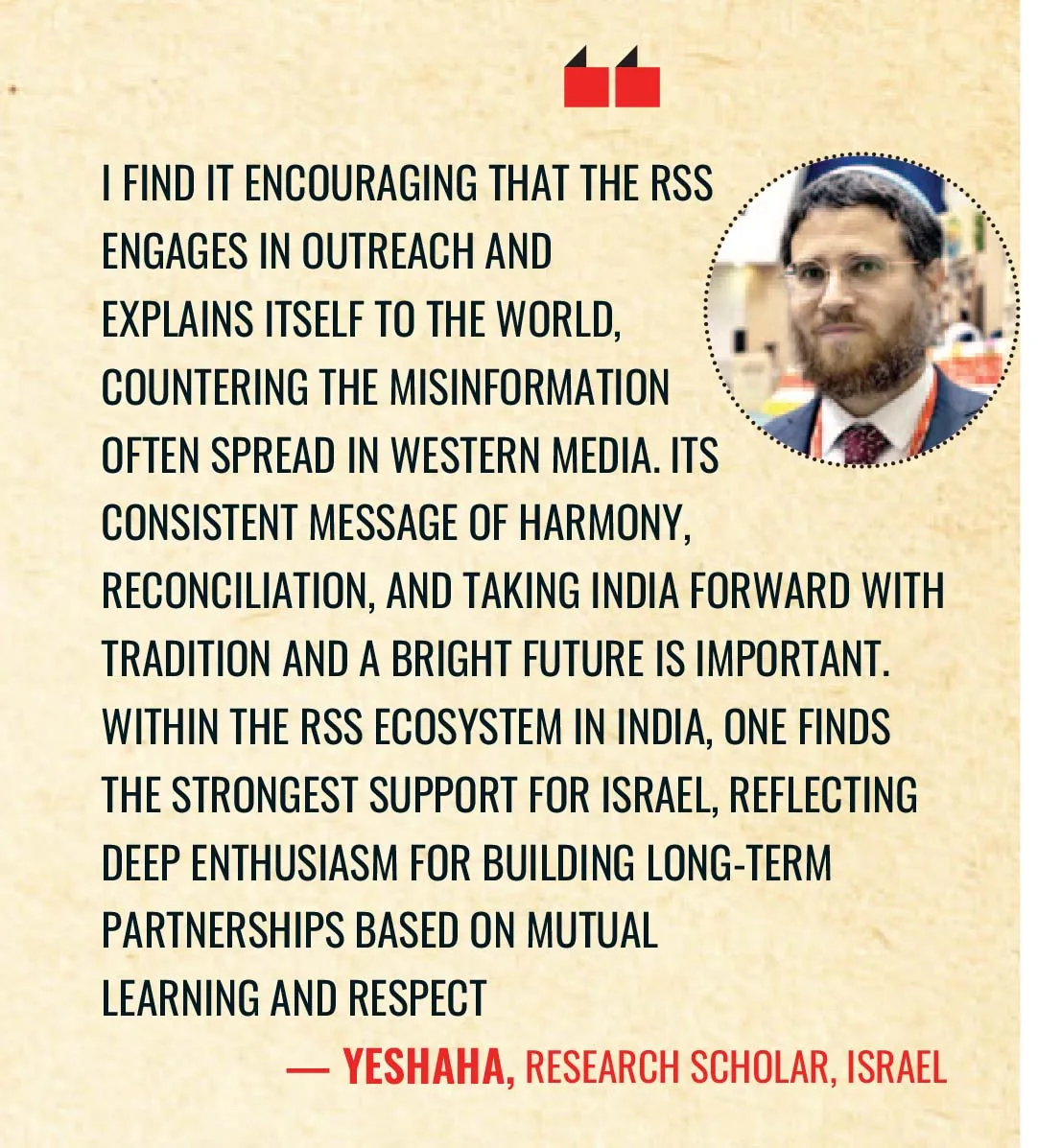
Notably, the RSS was founded on Vijayadashami in 1925 in Nagpur. This year, the Sangh is celebrating its centenary, and as part of the celebrations, the organisation has planned various outreach programmes across the country through its Swayamsevaks. These programmes will begin on October 2, coinciding with Vijayadashami, and will include route marches by Swayamsevaks in ganavesh across the country.
Following this, there will be door-to-door outreach campaigns, Hindu unity conferences, social harmony meetings, and other events. As part of this initiative, RSS Sarsanghchalak Dr Mohan Bhagwat will also conduct 3 more three-day lecture series in Banglore, Mumbai and Kolkata in the upcoming weeks.