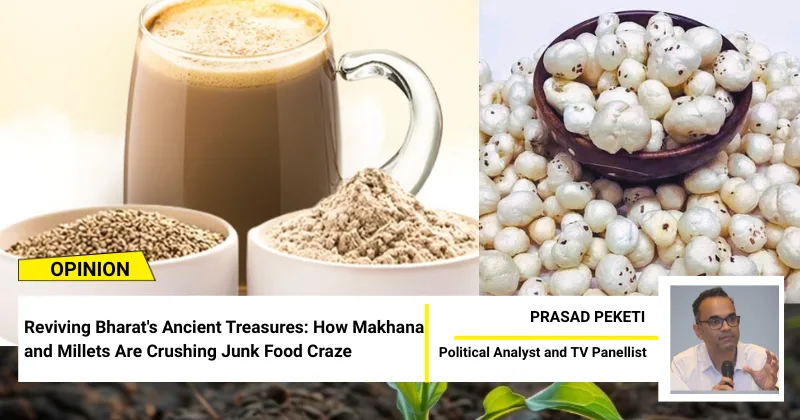
In a world flooded with greasy potato chips and oily burgers from foreign fast-food chains, it’s time we take pride in our own soil’s gifts. We are seeing a quiet revolution brewing in our kitchens and markets. Traditional superfoods like makhana (fox nuts) and millets are not just coming back, they are winning the battle against junk food. These are not new fads; they are part of our ancient heritage, from the Vedas to our grandmothers’ recipes. Today, with rising health worries like obesity and diabetes, Indians are choosing these nutrient-packed options over empty-calorie snacks. Backed by real reports and data, let’s explore how makhana and millets are revolutionizing healthy eating and outshining junk food in their own game.
The Dark Side of Junk Food: Startling Facts Behind the Epidemic
In Bharat, ultra-processed foods high in fat, salt, and sugar like chips, burgers, and instant noodles are everywhere. A 2025 report from India Today calls it an “epidemic,” with these items dominating diets and leading to health issues. Studies show young people munch on junk during snack time, often due to cravings or availability, with 62% eating it as a quick bite. But here’s the good news: healthy snacking is rising fast. As per TechSci Research, the Indian healthy snacks market was worth USD 3.91 billion in 2024 and is set to hit USD 6.12 billion by 2030, growing at 7.75% per year. Grandview Research report predicts a 7.6% yearly growth from 2024 to 2030, as people demand natural, low-fat options. Indians are snacking more but now prioritizing health, exactly where makhana and millets shine.
Makhana and Millets: Ancient and Traditional Grains, Modern Wellness
Take makhana, the humble fox nut from Bihar’s ponds. This lightweight snack is a powerhouse: low in calories (about 350 per 100g, far less than chips’ 500+), high in fiber for good digestion, and packed with vitamins, minerals, and antioxidants. It helps with weight loss, heart health, and even stress relief unlike burgers that pile on fats and lead to high cholesterol. No wonder it’s beating junk in taste too roasted makhana with masala is crunchy and satisfying, without the guilt. Marketwise, Bharat’s makhana industry is booming. As per Ken Research, it was valued at INR 100 billion in 2023 and is growing at 9-10% yearly. One report says it hit USD 8.5 billion in 2024 and will reach USD 19.6 billion by 2032, with an 11.01% growth rate. Kotak Security research shows exports are surging at 25% per year, showing the world loves our makhana.
Now, millets, the hardy grains like jowar, bajra, and ragi, are our true desi superstars. Grown in dry lands, they need little water, making them perfect for sustainable farming in Bharat. Health-wise, millets trump junk food hands down: rich in protein, fibre, and antioxidants, they aid weight control, and fight diabetes, unlike burgers loaded with empty carbs. Millet snacks have fewer calories but more nutrients, satisfying hunger without the crash from sugary chips. Production is soaring, Bharat made 18.015 million tonnes in 2024-25, up by 0.443 million tonnes from last year. The market was 17.25 million metric tons in 2023, with a 15.9% growth expected till 2029. Globally, millets are worth USD 15.3 billion in 2024, growing at 4.4% yearly. India leads exports, thanks to government pushes like the 2023 International Year of Millets and the Production Linked Incentive Scheme for millet products.
By making sure taste meets health, brands now offer flavoured makhana (peri-peri or cheese) and millet puffs, matching the crunch of chips but with real benefits. A 2025 consumer report shows Indians snack more but choose healthy options for natural ingredients. In 2024, healthy Indian snacks rose due to this shift, with people ditching junk for homemade or packaged alternatives like millet crackers. Economically, it’s a win for our farmers, millets and makhana create jobs in rural India, reducing dependence on imported junk ingredients.
Government Schemes Promoting Millets Among Farmers and Traders
The Centre and states have launched several initiatives to make millets a farmer’s goldmine. These focus on higher yields, better markets, and value addition, helping traders export and earn more.
Prime Minister Dhan-Dhaanya Krishi Yojana: Announced in Union Budget 2025, this scheme boosts productivity of nutritious crops like millets in 100 districts. It supports farmers with tech and inputs for climate-resilient farming.
National Millet Mission (Shree Anna Initiative): Launched in 2023 and ongoing in 2025, it promotes millets through higher Minimum Support Prices (MSP), procurement, and inclusion in public schemes like midday meals, Anganwadis, and ICDS. It aids startups and Farmer Producer Organizations (FPOs) for processing and marketing.
· Production Linked Incentive (PLI) Scheme for Millet-Based Products: Running from 2022-2027 with Rs 800 crore allocation, it incentivizes branded ready-to-eat/cook products with over 15% millets. This helps traders scale processing and exports.
Initiative for Nutritional Security through Intensive Millet Promotion (INSIMP): Under Rashtriya Krishi Vikas Yojana (RKVY), it provides seeds, demos, and training to farmers.
State-Specific Schemes: Gujarat’s Millet Development Scheme offers expos, processing units, and input kits.
Haryana and Punjab give Rs 7,000 per acre for diversification to millets.
Uttarakhand pushes millets under its agriculture roadmap.
Pradhan Mantri Formalization of Micro Food Processing Enterprises (PMFME) identifies millets as One District One Product (ODOP) in 21 districts.
These schemes have increased millet production to 18.015 million tonnes in 2024-25, up from previous years.
Government Schemes Promoting Makhana Among Farmers and Traders
Makhana, Bihar’s pride, is getting a big push in 2025 to make it a global export star.
· Makhana Board: Announced in Union Budget 2025-26, this new board in Bihar focuses on production, processing, value addition, marketing, and exports. It includes a National Makhana Research Centre for better tech and yields.
· Makhana Vikas Yojana: Bihar’s scheme boosts cultivation in 10 districts with training and financial aid for equipment.
· National Horticulture Mission (NHM): Provides subsidies for seeds, fertilizers, and irrigation to makhana farmers.
· Bihar-Specific Incentives: Stamp duty waivers, tax rebates, and capital support for processing units. APEDA strategies aim to double exports.
India’s makhana production is dominated by Bihar, with global exports growing at 25 per cent yearly.
Makhana and Millets are more than food, it’s about swadeshi pride. By choosing them, we honour our ancestors, boost our health, and strengthen our economy. By ditching the junk and embracing Bharat’s bounty, our body will thank us.
![A Representative image [ANI Photo]](https://organiser.org/wp-content/uploads/2025/12/representative-image-e1765612818961-120x70.webp)