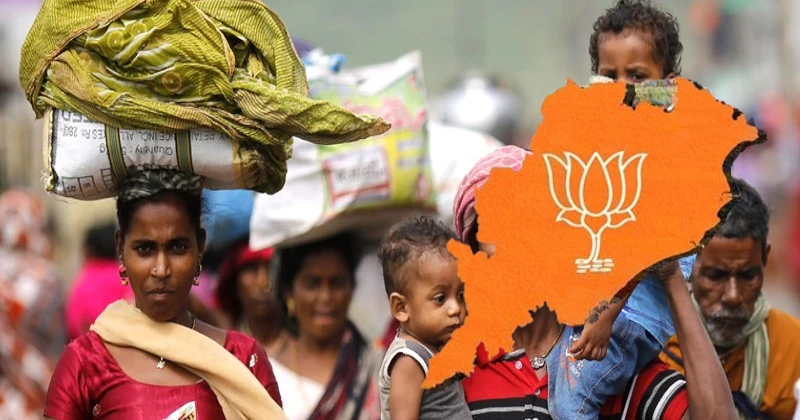
According to the Periodic Labour Force Survey 2020–21, about 8.51 lakh (851,000) labourers from Odisha migrate annually for work.
Ten districts including Bargarh, Balangir, Kalahandi, Nuapada, Ganjam, and others are identified as migration-prone, sending workers to states like Andhra Pradesh, Karnataka, Gujarat, Tamil Nadu, and Kerala.
Regional estimates by MiRC (Migration Information & Resource Centre) indicate that over 60,000 families (about 2 lakh individuals) from Bolangir, Nuapada, Kalahandi, Boudh, Sonepur, and Bargarh migrate to neighbouring states plus 40,000–50,000 move to brick kilns near Cuttack and Bhubaneswar.
Sector-specific research in Bolangir’s blocks (Muribahal, Belpada, Turekela) shows 200 sampled workers, predominantly young (72 per cent aged 16–29), migrating during summer, earning Rs 8,000–12,000 per month, facing extended work hours (~12 hours) and poor living conditions, often with only one in five having access to washrooms.
These numbers reflect both the breadth (lakhs of migrants) and depth of distress migration emerging from Odisha’s underdeveloped rural districts.
Root Causes: Entrenched Local Drivers
Kalahandi district suffers from limited non-agricultural job opportunities, with 77 per cent of adults still depending on agriculture. This compels seasonal migration from blocks like Golamunda and Narla.
In Balangir, only ~3 per cent of agricultural land has irrigation. Frequent droughts, combined with poverty, caste discrimination, rising health and marriage costs, and exploitative intermediaries (sardars), force families—often with children included—to migrate. While official numbers like 13,081 registered migrant persons (2016) and 1,150 rescues exist, unofficial estimates suggest 100,000+ are migrating in more shadowy, unregistered ways.
Communities in Kandhamal and Kalahandi also send workers to Kerala. Surveys show around 18–31 per cent of households in blocks of Gajapati, Ganjam, Kandhamal, and Kalahandi experience migration—longer than six months—indicating more permanent outflows for survival. Ganjam alone sends around 7 lakh migrants to Surat’s power loom industry, with social capital shaping opportunities across caste lines.
Odisha Government’s Strategic Responses (Factual Overview)
During the month of May 2024 while Odisha was in election mode, PM Narendra Modi has raised question to Naveen Patnaik Govt of the rampant Dadan Issue. This shows his concern for the migrant labour issue of Odisha and with BJP Govt now in Odisha having CM Mohan Majhi in forefront, the Govt is widely focussed on mitigation of the Dadan issue with proper measures and initiatives.
a. Institutional and Governance Measures
A multi-member task force led by Deputy CM Kanak Vardhan Singh Deo under the leadership of Chief Minister Mohan Charan Majhi focuses on assessing migration dynamics, linking welfare schemes, skilling, credit, and inter-state coordination.
A Mobile Migrant Resource Centre and toll-free helpline (1800-345-7885), in collaboration with UN bodies (FAO, IOM), now reach workers in proactively migration-prone areas.
b. Destination-State Outreach & Rehabilitation Planning
According to Labour Department directives, officials were asked to visit states where Odisha’s labourers migrate—to understand their challenges and plan rehabilitation.
Awareness and outreach campaigns now run in 30 migration-prone blocks, mobilizing Panchayati Raj institutions to sensitize families before migration happens.
c. Local Industrial Jobs via Textile & Apparel Parks
Odisha TEX 2025 Summit announced:
- 33 MoUs worth Rs 7,808 crore,
- Projected 53,300+ direct jobs,
- Subsidy enhancements: Rs 6,000/month for male workers, Rs 7,000 for female,
- Hindalco’s Rs 200 crore investment in Keonjhar & Sambalpur (2,400 jobs),
- Launch of advanced plug-and-play textile and footwear parks,
- New workers’ hostels and skill development in automated garmenting and wearable tech.
State aims for 1 lakh+ jobs by 2030 in districts aligned with migration origins: Balangir, Keonjhar, Sambalpur, Jagatsinghpur, Ganjam, and Cuttack.
d. Better Institutional Execution
Go Swift 2.0 has streamlined digital approvals, reducing ground implementation time. The state favours compact industrial parks (~100 acres), integrated MSME clusters, and district-level entrepreneurship programs like “60 under 40” to spread benefits.
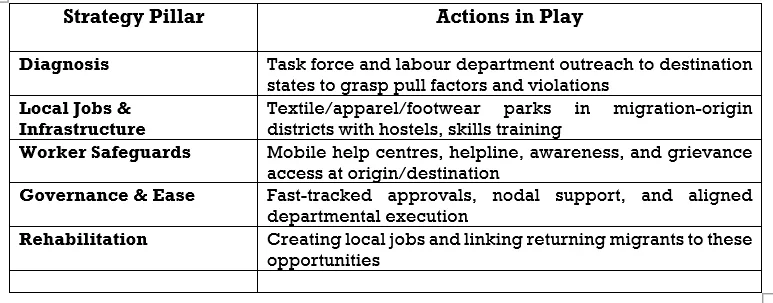
How the Pieces Fit Together: A Multi-Pronged Action Framework
Since the DADAN migrant labour issue has been a pressing problem for Odisha since ages, the Mohan Majhi led BJP Govt in Odisha is seriously focussed on mitigating the issue and provide solution oriented approach to tackle it. While the Strategy has been made with focussed areas, already the Government is in action mode to root out the challenge by concentrating on the same.
What the Data Suggests—and What’s Next
- Magnitude of migration: Lakhs migrate annually, with concentrations in specific KBK districts and Ganjam.
- Deep-seated causes: Seasonal distress, drought, agrarian insufficiency, caste-related marginalization, exploitative intermediaries.
- Governmental transition: From passive assistance to active job creation, protective outreach, and inter-state collaboration—a notably holistic shift.
Room for further action:
- Better monitoring on recruitment progress and job absorption,
- Evaluating alternate livelihood pre-migration,
- Formal inter-state destination dialogues and MOUs.
Bottom Line
Odisha is building a data-informed, multi-layered strategy to replace distress migration with dignity-based local livelihoods:
- Medical-level diagnosis (migration surveys, district mapping),
- Treatment via local industrial jobs (textile parks),
- Protective care through outreach and rights access, and
- Monitoring via improved governance and digital efficiency.
If implementation stays on schedule and outreach continues to evolve especially on inter-state coordination, real-time project tracking, and worker protection Odisha can expect to transform “Dadan” from a cycle of distress to one of empowerment in the coming years.