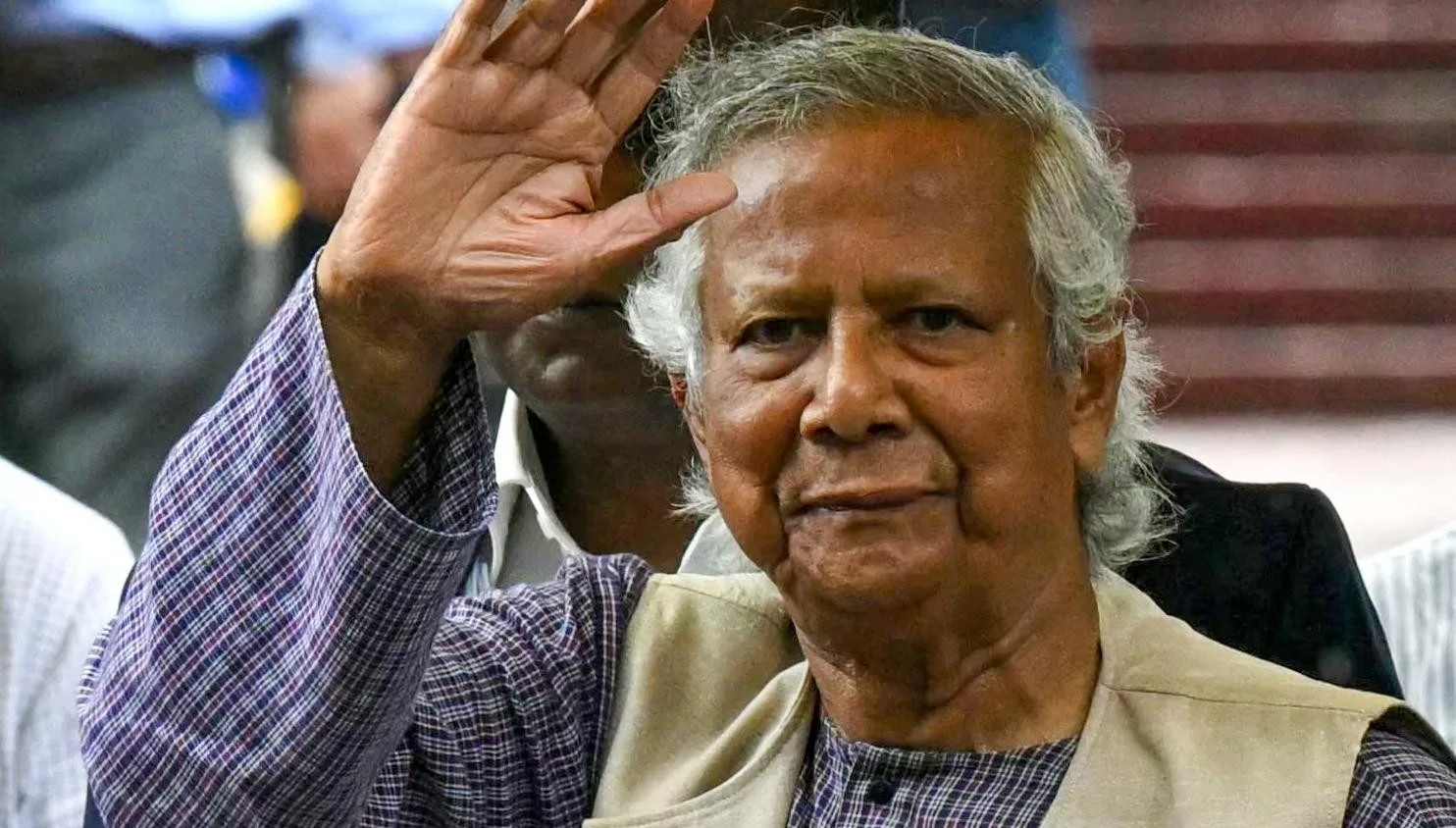
In a recent interview, Muhammad Yunus, the Chief Advisor to Bangladesh’s interim government, sparked controversy with his statements downplaying the ongoing violence against Hindus in Bangladesh. Yunus described the violence as “exaggerated” and claimed that the attacks on the Hindu minority were not communal but rather a result of political dynamics following the deposition of Sheikh Hasina and the Awami League. Yunus’s remarks, given to the Press Trust of India (PTI), have attracted criticism from various quarters for allegedly minimising the gravity of the situation and mischaracterising the nature of the violence.
Political Dynamics or Communal Violence?
Yunus attempted to contextualise the violence by attributing it to political reasons. He argued that in the eyes of the attackers, Hindus have become synonymous with the deposed Awami League. This, he claims, led to the targeting of Hindus during the anti-Awami League pogroms unleashed by Islamists after Sheikh Hasina’s fall in early August. “I have said this to Modi also, that this is exaggerated. This issue has several dimensions,” Yunus stated, emphasising his belief that the violence stems from political, rather than communal, motivations.
By portraying the attacks as politically motivated rather than driven by religious intolerance, Yunus seeks to frame the violence against Hindus as collateral damage in a broader political struggle. He argues that Hindus were targeted only because they were perceived as supporters of the Awami League. “While beating up Awami League cadres, they had beaten up Hindus as there is a perception that Hindus in Bangladesh mean Awami League supporters,” Yunus said. He further noted that some opportunists are using the situation to seize property, complicating the issue further.
Downplaying Religious Persecution
Yunus’s attempt to depoliticise the violence has not gone unchallenged. Critics argue that his comments are an attempt to whitewash the communal nature of the attacks against Hindus. Despite his assertions that the violence is political, the actions of the perpetrators tell a different story. Hindu temples have been attacked, idols of deities have been smashed, and lists of Hindu homes have been prepared by Islamist groups like Jamat-e-Islami (JeI) to single out Hindus for violence. Such targeted attacks on religious sites and symbols suggest a clear religious motivation behind the violence, contradicting Yunus’s claims.
While Yunus acknowledges that several Muslim leaders of the Awami League were also targeted, he fails to address the fact that no mosques were attacked. This selective targeting raises questions about his argument that the violence is purely political. The destruction of Sufi dargahs, while notable, also points to a form of Islamic extremism that is intolerant of any perceived deviation from orthodox Islamic practices, further undermining his argument that the violence is not communal in nature.
Hypocrisy of advising Hindus to conceal their identity
In a statement that has drawn widespread condemnation, Yunus revealed that he advised Hindus in Bangladesh not to identify as Hindus but rather as citizens of Bangladesh to avoid persecution. “Please don’t identify yourselves as Hindus; rather, you should say you are citizens of this country and you have equal rights,” Yunus said. This suggestion has been criticised as hypocritical and dismissive of the legitimate rights of the Hindu minority to maintain their religious identity while expecting equal protection under the law.
Critics argue that advising Hindus to hide their religious identity is equivalent to victim-blaming and does nothing to address the root causes of the violence. It raises the question of why Hindus should have to conceal their identity to live safely in their own country. Yunus’s statement suggests a tacit acceptance of the violent conditions imposed by Islamist groups, rather than a commitment to protecting the rights and freedoms of all Bangladeshi citizens, regardless of religion.
Contradictions and inconsistencies in Yunus’s narrative
Yunus’s comments are marked by several contradictions. On one hand, he denies that the violence is communal, yet he acknowledges that attacks have targeted Hindu temples and homes. He claims that India is “exaggerating” the anti-Hindu violence and suggests that India’s perception of Bangladesh is skewed by fears that it will become another Afghanistan without Sheikh Hasina. However, these arguments overlook the systematic nature of the attacks and the long history of violence against Hindus in Bangladesh, often perpetrated by Islamist groups like BNP and JeI.
Yunus’s efforts to downplay the Islamist credentials of BNP and JeI further reveal his intentions to provide a political cover for their actions. Both parties have a well-documented history of anti-Hindu violence, including their involvement in the anti-quota protests in July and the targeting of Hindu communities following electoral victories or political upheavals. By framing BNP and JeI as merely political entities rather than Islamist groups with a vested interest in persecuting Hindus, Yunus attempts to shift the blame away from religious intolerance and toward political dynamics.
Broader implications of Yunus’s stance
The implications of Yunus’s stance are troubling. By downplaying the religious motivation behind the violence and attributing it solely to political factors, he risks normalising the attacks on Hindus and failing to address the underlying religious extremism that fuels such violence. Moreover, his comments may embolden Islamist groups by suggesting that their actions can be excused or overlooked if framed within a political context.
Yunus’s decision to invite select Indian journalists to “cover the situation” from the ground, while simultaneously criticising Indian media for “exaggerating” the violence, appears to be a strategic move to control the narrative. This tactic of inviting sympathetic journalists while discrediting others is a classic example of media manipulation aimed at presenting a sanitized version of events to the international community.
The ongoing violence against Hindus in Bangladesh cannot be dismissed as mere political fallout. While political factors may indeed play a role, the systematic targeting of Hindu communities, the destruction of temples, and the harassment of Hindu individuals all point to a deeply entrenched religious intolerance that cannot be ignored. Yunus’s attempts to downplay this aspect of the violence only serve to obscure the real issues at hand and deny justice to the victims.
Instead of advising Hindus to hide their identity, Yunus and the Bangladeshi interim government should focus on protecting all citizens from violence and discrimination, regardless of their religion.