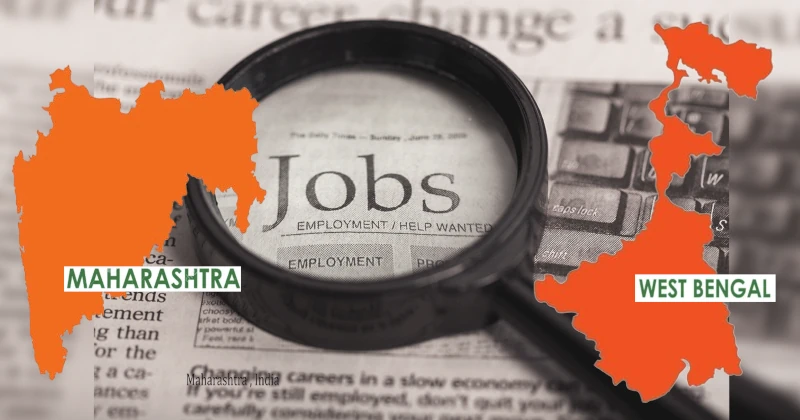
In a stark revelation, the latest Annual Survey on Unincorporated Sector Enterprises (ASUSE) by the National Statistical Office (NSO) has shown a dramatic shift in employment trends across Indian states over the past seven years. West Bengal lost 3 million jobs in unincorporated enterprises from 2015-16 to 2022-23. Maharashtra saw an increase of 2.4 million workers in the same period, positioning it as the best-performing state regarding employment generation in this sector.
West Bengal’s significant job losses have sparked concerns about the state’s economic stability and the efficacy of its current administration under Chief Minister Mamata Banerjee. Critics argue that the Trinamool Congress (TMC) is failing to foster a conducive environment for job creation, potentially leading to public unrest and economic instability. This drastic reduction in employment opportunities may result in severe socio-economic consequences, with increased migration, higher unemployment rates, and potential civil unrest as people struggle to find work within the state.
The ASUSE report, which covers data for 2021-22 and 2022-23, and an analysis of the National Sample Survey’s 73rd round on unincorporated enterprises for 2015-16, revealed that 13 out of 28 states and three Union Territories (UTs) experienced a decline in the number of workers in the informal sector of the economy between 2015-16 and 2022-23. Apart from West Bengal, states like Karnataka (1.3 million), Tamil Nadu (1.2 million), Uttar Pradesh (791,000), Andhra Pradesh (677,000), Kerala (640,000), Assam (494,000), and Telangana (344,000) also faced substantial job losses.
In contrast, Maharashtra has demonstrated robust job growth, adding 2.4 million workers to its unincorporated enterprises during the same period. This growth can be attributed to the state’s larger industrial base and proactive policies supporting the informal sector. Other states that reported job increases include Gujarat (762,000), Odisha (761,000), and Rajasthan (756,000). These states have created a favourable environment for small businesses, vendors, hawkers, sole proprietorships, partnerships, and other non-incorporated entities, increasing employment opportunities.
The survey also highlighted a significant decline in employment in the Union Territories. Delhi saw a reduction of nearly 300,000 workers, decreasing from 2.3 million to 1.99 million. Chandigarh and Puducherry also experienced job losses, with declines of 51,000 and 32,000 workers, respectively. Comparable data for the Union Territories of Jammu & Kashmir and Ladakh were unavailable, making it difficult to assess their performance.
The unincorporated sector, encompassing small businesses, vendors, hawkers, sole proprietorships, partnerships, and other non-incorporated entities, plays a crucial role in the Indian economy. It provides substantial employment opportunities for unskilled, semi-skilled, and skilled workers and significantly contributes to the country’s gross domestic product (GDP).
Labour economist Santosh Mehrotra noted that states with a more substantial non-farm sector or a larger industrial base tend to have more unincorporated enterprises. “The deterioration of employment opportunities provided by these units has been very much part of the successive policy-induced shocks in the past few years,” Mehrotra said. He emphasised that while the number of establishments might have increased post-pandemic, it is primarily due to the rise in own-account enterprises, which do not generate additional jobs. These businesses, often small and family-run, struggle to expand and create new employment opportunities, leading to stagnation in job growth.
Earlier reports indicated that the total number of workers employed in India’s informal sector declined by 1.7 million from the pre-pandemic period of 2015-16 to 2022-23, dropping to 109.6 million. This overall decline underscores the challenges the informal sector faces in recovering from recent economic disruptions. The reduction in job opportunities in this sector, which traditionally absorbs a significant portion of the workforce, highlights the urgent need for targeted interventions and policy support to revitalise employment.
The contrasting employment trends in West Bengal and Maharashtra highlight the varying economic trajectories of Indian states and the impact of regional policies on job creation in the unincorporated sector. States like Maharashtra that have seen job growth may have benefited from policies supporting small businesses and fostering industrial development. Conversely, states experiencing job losses may need to reassess their economic strategies and implement measures to stimulate employment growth.