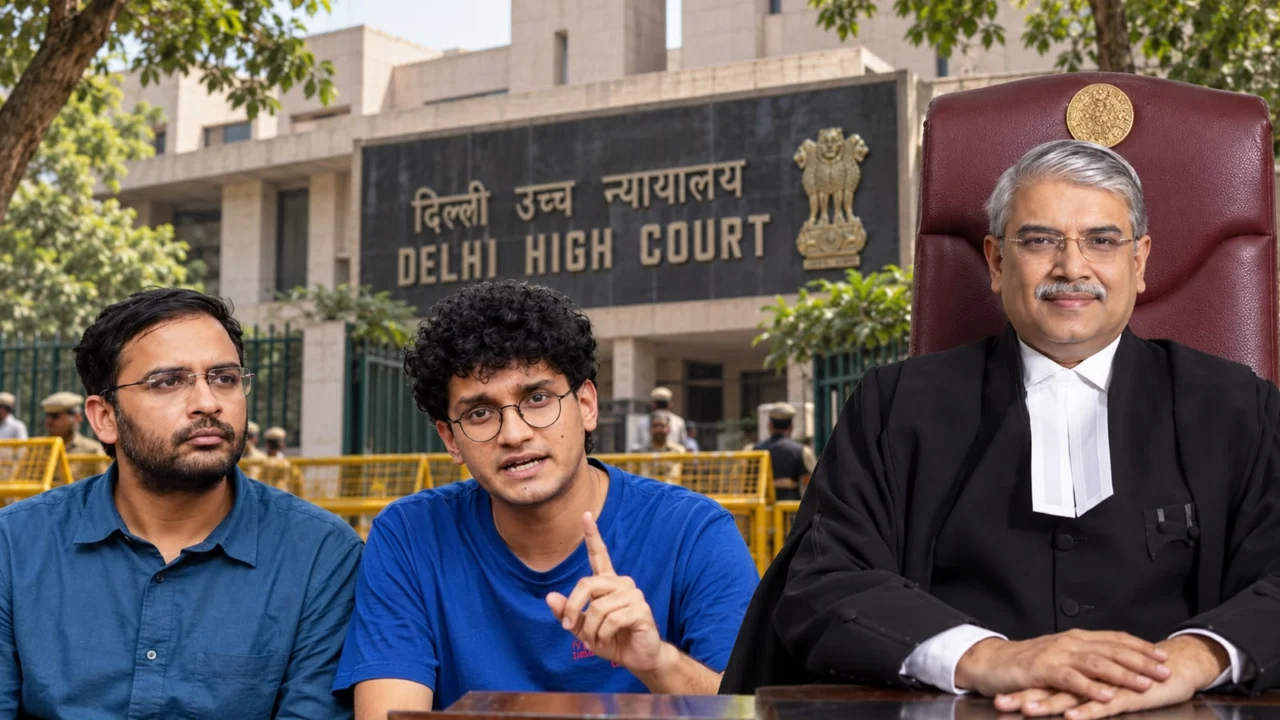
Delhi HC grills CJP leaders over shifting agitations, force petitions withdrawal
NEW DELHI: Cockroach Janta Party (CJP) leaders Saurav Das and Ashutosh Ranka on Wednesday (October 21) withdrew their petitions challenging the extension of their judicial custody after facing a series of pointed questions from the Delhi High Court. Justice Subramonium Prasad questioned the two leaders over their alleged breach of peace bonds, repeated demonstrations at the de-notified Jantar Mantar site and the changing causes espoused by their organisation.
The Judge also repeatedly asked why the petitioners had approached the High Court under Article 226 of the Constitution when a statutory remedy was available to challenge the Special Executive Magistrate’s (SEM) October 19 order.
Following an extensive hearing, advocate Abhik Chimni, appearing for Das and Ranka, informed the Court that his clients would withdraw their petitions. The High Court permitted the withdrawal, expressly clarifying that it had not expressed any opinion on the merits of the case.
The matter had been urgently listed before Justice Prasad after the petitioners failed to secure a hearing on Tuesday night. Additional Solicitor General Chetan Sharma, assisted by Central Government Standing Counsel Ashish Dixit, appeared for the Delhi Police.
One of the more striking exchanges occurred when Justice Prasad asked the ages of the two petitioners. Chimni replied that they were 27 and 31 years old.
“Then you are not genZ. What age of people are millennials?” the Judge asked, referring to the youth-led protests organised by the group.
Justice Prasad noted that the demonstrations had initially involved students and student-related issues, but the causes being pursued had subsequently changed.
“People remain same but cause is changed. Next question is who are you? What are you? What is your association? What is purport of the association?” the Judge asked, according to LiveLaw’s reporting of the proceedings.
The Court observed that the identity of the individuals involved, the nature of their association and the purposes for which they organised demonstrations could become relevant when a magistrate examined an apprehension of breach of public peace and tranquillity.
Justice Prasad questioned whether the activities of a group whose protest causes kept changing required consideration in proceedings concerning public order.
He nevertheless made it clear that the immediate controversy before the High Court concerned the insistence on bonds and sureties, and that broader questions should be examined in appropriate proceedings.
The Judge then turned to the circumstances surrounding the detention of Das and Ranka.
Both had executed peace bonds on October 11 following their earlier detention in connection with demonstrations demanding the resignation of Chief Election Commissioner Gyanesh Kumar.
Despite this, they allegedly entered the barricaded Jantar Mantar protest site on October 13, after the location had been de-notified for demonstrations.
Justice Prasad noted that although the de-notification was under challenge before the Supreme Court, the notification had not been stayed. The Judge questioned the decision to return to the site despite the restrictions and the peace bonds already executed. He also raised concerns about the possibility of additional protesters joining an unauthorised gathering after its organisers crossed barricades.
According to the Judge, even if the organisers intended a peaceful demonstration, there was a possibility of other persons joining the crowd and engaging in activities beyond their control. He remarked that obtaining police permission for demonstrations could help prevent unwanted persons from joining a group and creating disturbances.
Justice Prasad further questioned whether the apprehension that originally prompted the authorities to obtain peace bonds had been borne out by the subsequent incident.
“Reason for first bond has rather came true that you had tendency to break peace for second time which you have done. Are not authorities not right in putting you to stricter rule?” the Judge asked, according to the live courtroom updates.
These were oral observations made while examining the parties’ submissions, rather than final findings on the alleged violations.
A substantial part of the hearing concerned the legal remedy available against the SEM’s October 19 order.
Justice Prasad questioned why the petitioners had invoked Article 226 instead of approaching the appropriate forum through an appeal or revision.
“Your remedy actually lies in revision. There is difference between maintainability and entertainability,” the Judge observed.
The Court also explained the distinction between appellate scrutiny and the exercise of writ jurisdiction. In an appeal, the appellate court could examine the facts and arrive at its own conclusion, the Judge observed. In writ proceedings, the Court ordinarily examines the decision-making process rather than reassessing the decision itself.
Chimni, however, maintained that the October 19 order was legally unsustainable.
Referring to Section 135(3) of the Bharatiya Nagarik Suraksha Sanhita (BNSS), he questioned whether an alleged violation of an earlier personal bond could justify the subsequent exercise of preventive powers in the manner adopted by the magistrate. He contended that preventive custody could not be imposed arbitrarily and that the October 19 order failed to adequately explain any imminent threat to public peace.
Chimni also disputed the finding concerning the petitioners’ alleged habitual conduct.
Justice Prasad, in response, referred to the peace bonds executed on October 11 and questioned whether the subsequent incident could be disregarded while assessing the authorities’ apprehensions.
At another stage, the Judge distinguished preventive custody from preventive detention and questioned the precise legal character of the proceedings being challenged.
“Liberty is sacrosanct. But if the Code provides for remedy…” the Court observed, again asking why the petitioners had not pursued the available alternative remedy.
Chimni also challenged the SEM’s rejection of sureties furnished on behalf of Das and Ranka.
“Rejection of surety is bad in law,” he submitted.
When the Judge asked what relief the petitioners were seeking in the urgent hearing, Chimni requested that his clients be released on personal bonds. The counsel alleged that the SEM had arbitrarily rejected the sureties and failed to properly examine the material furnished before it. He further submitted that two fresh sureties had been offered but were not even called for examination by the SEM.
“The SEM did not even call them, forget rejection,” Chimni argued.
The October 19 order had earlier recorded objections concerning the suitability of the sureties produced. The magistrate noted discrepancies in the identification documents of one surety, while another was reportedly unable to furnish satisfactory particulars concerning the person for whom he proposed to stand surety.
The High Court questioned whether the rejection of sureties was itself appealable and whether the statutory appellate forum could examine the grievances raised by the petitioners.
During the exchange, ASG Chetan Sharma referred to the additional sureties said to have been furnished.
As the arguments continued, Justice Prasad repeatedly questioned the necessity of adjudicating the controversy before the petitioners’ scheduled appearance before the SEM later that afternoon.
“We must debate when it is necessary. Today there is no need to debate for people’s ears,” the Judge remarked. He pointed out that if the proceedings before the SEM ended in the petitioners’ favour, the immediate controversy could cease to exist. If the magistrate passed an adverse order, the petitioners could pursue the remedies available under law.
The Judge also indicated that the High Court could not finally decide the matter that day without seeking a response from the State.
“Would it not be better for you to withdraw this, see what happens at 2 PM and then follow the course of law,” Justice Prasad asked.
Chimni expressed apprehension that the SEM might again reject the sureties, compelling the petitioners to approach the High Court afresh. Justice Prasad nevertheless maintained that the statutory remedy ought to be considered before pressing the constitutional challenge.
“For some reason you are drawing court into debate which might not go in your favour,” the Judge cautioned.
The matter was thereafter briefly passed over, with Chimni asked to obtain instructions on pursuing the alternative remedy.
When the hearing resumed, Chimni informed the Court that the petitioners were willing to withdraw their petitions, while expressing apprehensions about the proceedings before the SEM.
ASG Chetan Sharma sought to make further submissions concerning the invocation of Article 226.
The High Court, however, permitted the petitions to be withdrawn.
“It is made clear that this court has not made any opinion on merits of the case,” Justice Prasad clarified.
The withdrawal brought the urgent High Court proceedings to an end without any adjudication on the legality of the October 19 custody extension or the rejection of sureties.
Das and Ranka have been lodged in Tihar Jail since October 14 after allegedly entering Jantar Mantar in violation of restrictions imposed at the site. They were initially remanded to five days’ judicial custody.
On October 19, SEM Ritu Raj extended their custody by another two days after the Delhi Police raised concerns over their alleged breach of earlier peace bonds and the likelihood of further disturbances.
That extension was due to expire on Wednesday, when the matter was separately scheduled before the SEM for further proceedings.
Although their urgent petitions before the Delhi High Court have now been withdrawn, the question of their release remains dependent on the outcome of proceedings before the competent forum.
