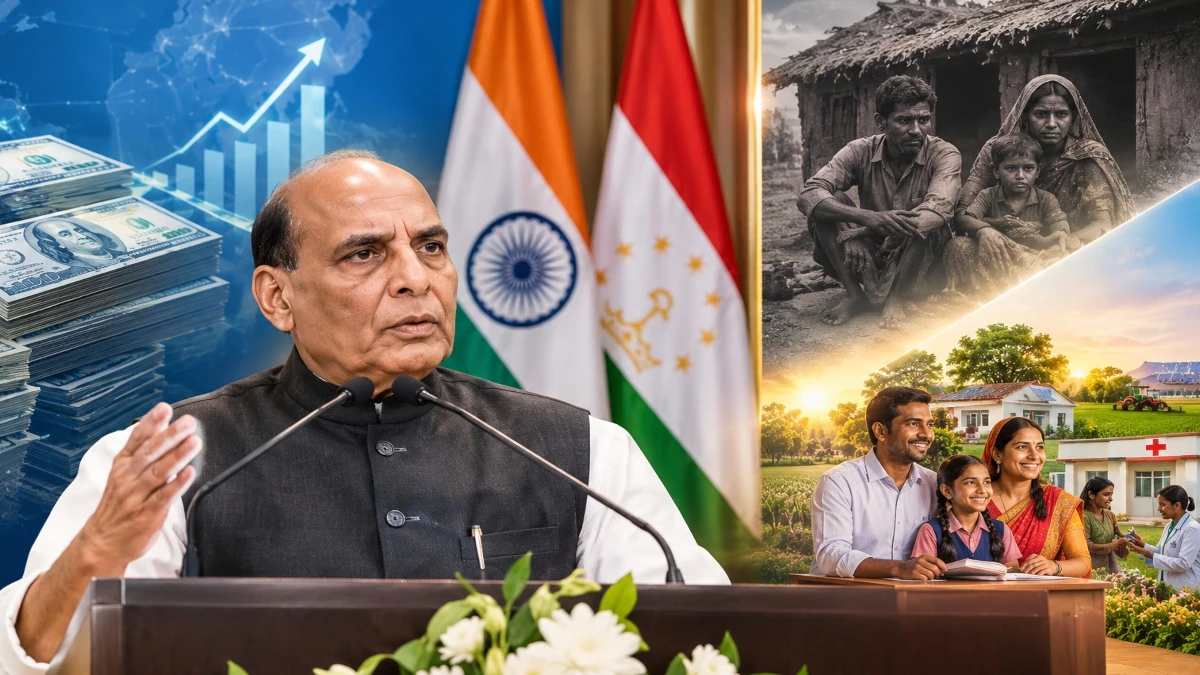
AI-generated Image
DUSHANBE, TAJIKISTAN: Defence Minister Rajnath Singh has asserted that Prime Minister Narendra Modi-led India is emerging as a global force combining economic prosperity, technological advancement and military strength with a commitment to world peace and human welfare. Addressing the Indian diaspora in Dushanbe, Tajikistan, on October 20, 2026, Singh highlighted India’s economic growth, governance reforms, defence manufacturing, digital transformation and expanding international partnerships.
Guided by the ancient Indian philosophy of Vasudhaiva Kutumbakam (the world is one family) India aspires to become a nation that combines prosperity, knowledge and strength with global peace and the well-being of humanity, the Defence Minister said.
According to the Ministry of Defence’s official statement, Singh credited the country’s economic transformation and growing global standing to reform-driven governance and technological progress under the Modi government.
Highlighting India’s economic performance, Singh stated that the country contributes more than 16 per cent to global economic growth and is expanding at approximately 7.8 per cent, even as several major economies face slowing growth.
He also pointed to India’s expanding trade partnerships, stating that the country has entered into Free Trade Agreements with 38 countries. The India-UK and India-EU trade agreements, which are expected to eliminate tariffs on 99 per cent of Indian exports to these markets, are expected to create fresh opportunities for Indian manufacturers and exporters.
Describing the transformation in policymaking over the past decade, Singh said India had moved from an era of “policy paralysis” to a “reform express” driven by a clear policy direction.
“For us, reforms are not a compulsion; they are a conviction,” he stated.
The Defence Minister highlighted improvements in India’s external financial position, noting that the current account deficit, which exceeded four per cent of GDP 12–13 years ago, declined to 0.61 per cent in the previous financial year.
India’s foreign exchange reserves have crossed $700 billion, while the banking system is in its strongest-ever position, Singh said. These developments, he argued, reflect the country’s changing economic fundamentals and its growing capacity to withstand global uncertainty.
Underscoring India’s drive towards self-reliance in defence, Singh announced that defence exports had reached a record Rs 38,424 crore, while domestic defence production had risen to Rs 1.80 lakh crore.
The figures reflect the government’s efforts to expand domestic manufacturing capabilities and strengthen India’s position in the global defence industry.
He also highlighted the growth of India’s startup ecosystem, which has expanded from a few hundred startups before 2014 to more than 2.5 lakh. Nearly half of these startups originate from smaller cities and towns, while more than 45 per cent have at least one woman director or partner.
Singh said affordable mobile data and expanded digital connectivity had enabled more Indians to access opportunities, encouraging innovation and nurturing talent across the country.
Highlighting the impact of welfare and financial inclusion initiatives, Singh stated that approximately 25 crore people had been lifted out of poverty over the past decade. He credited initiatives such as the JAM Trinity Jan Dhan bank accounts, Aadhaar and mobile connectivity—and Direct Benefit Transfer with improving the delivery of government assistance.
According to Singh, these systems have helped transfer benefits directly into beneficiaries’ bank accounts, reducing corruption while improving transparency and convenience.
India’s renewable energy capacity has increased from approximately 75 GW in 2014 to nearly 300 GW, Singh said, highlighting the country’s expanding clean-energy ambitions.
He also pointed to the government’s push to develop domestic semiconductor manufacturing through the Semicon India programme and the India Semiconductor Mission. “We’re moving towards manufacturing both ships and chips, strengthening our position in strategic sectors,” he said.
The emphasis on semiconductors, defence production and other strategic industries reflects India’s broader ambition to strengthen domestic manufacturing and reduce dependence on external supply chains.
Singh described India as a global hub for real-time digital transactions, citing the expansion of the Unified Payments Interface (UPI).
According to his address, the value of UPI transactions increased from Rs 7,000 crore in 2016–17 to Rs 314 lakh crore in 2025–26, illustrating the scale of the country’s transition towards a less-cash, digitally connected economy.
He also highlighted the expansion of infrastructure, including railways, highways, airports, ports and broadband connectivity, as a key component of India’s economic transformation.
Turning to science and space exploration, the Defence Minister cited the achievements of Chandrayaan and the Aditya-L1 solar mission as examples of India’s growing technological capabilities.
He also expressed confidence in preparations for Gaganyaan, India’s planned human spaceflight mission.
Singh said India’s growing capabilities were contributing to its international standing, with countries around the world increasingly seeking strong and constructive partnerships with New Delhi.
Addressing members of the Indian diaspora, Singh described people of Indian origin as cultural ambassadors who carry India’s values and traditions abroad while contributing to their host countries.
He also highlighted the longstanding friendship between India and Tajikistan, pointing to the popularity of Indian music, literature, cinema and cultural traditions among the Tajik people.
The Defence Minister emphasised the importance of cultural exchanges and people-to-people connections in strengthening bilateral relations.
During the event, Singh felicitated Professor Habibullo Rajabov, a renowned Indologist and the first Padma Shri awardee from Tajikistan, in recognition of his contributions to Hindi literature, education and philology. The programme also featured cultural performances by Indian and Tajik artists.
