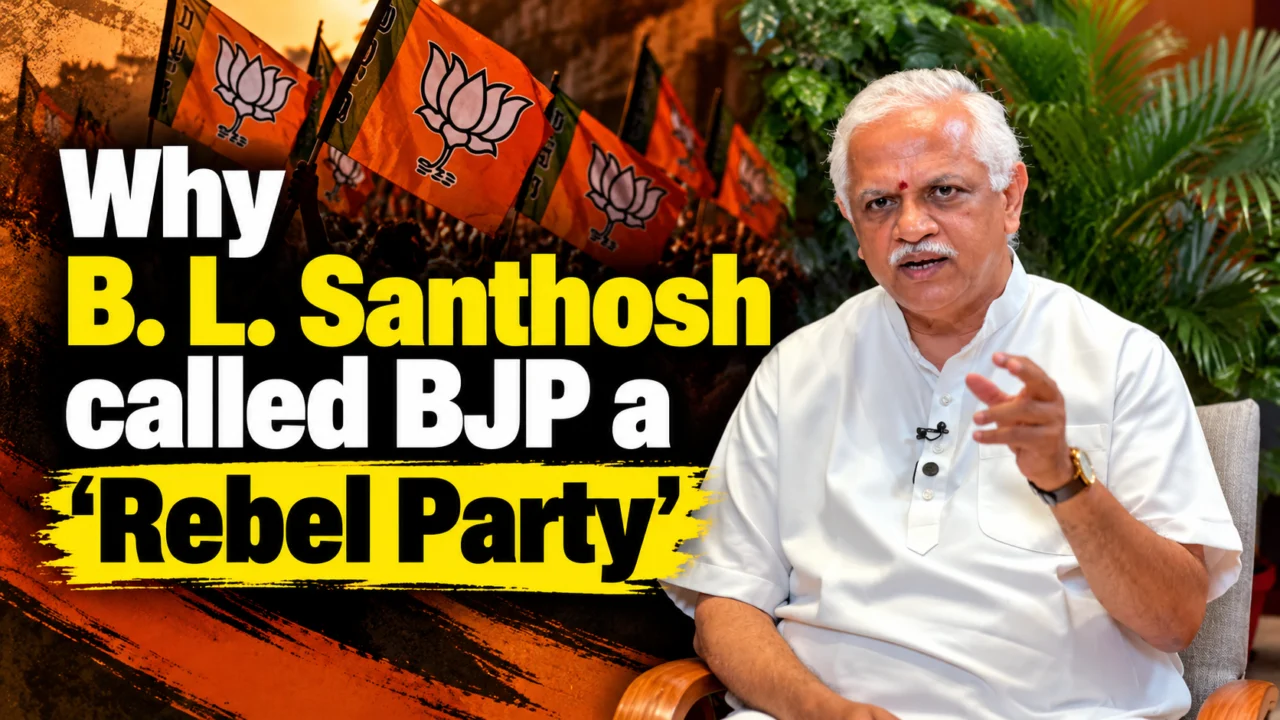
B. L. Santhosh explains why the BJP can be described as a “Rebel Party,” reflecting its ideological roots and political journey
BJP National General Secretary (Organisation) B. L. Santhosh described the Bharatiya Jana Sangh, the BJP’s predecessor, as a “rebel party” because it emerged after Dr Syama Prasad Mookerjee resigned from Jawaharlal Nehru’s Cabinet and founded a separate political party.
Santhosh said the party stood apart from the dominant political thinking of the time, particularly through its emphasis on economic nationalism and cultural nationalism.
Explaining the ideological journey from the Bharatiya Jana Sangh to the BJP, Santhosh said the party was an outlier when it was founded in 1951. Its political ideas, he said, were different from those prevailing in the country’s political establishment.
“That day it was outlier party. Bharatiya Janata Party was a rebel party in the sense that Dr. Shyama Prasad Mukherji resigned from Nehru cabinet came out and founded a party. It was a rebellious party,” Santhosh said in an interview with Organiser.
He was speaking about the party’s 75-year journey and how the political ideas behind its formation had developed into a larger movement.
Santhosh highlighted economic nationalism as one of the ideas that distinguished the Jana Sangh from the prevailing political approach.
“In fact, economic nationalism was a very strong word used by Dr. Shyama Prasad Mukharji,” he said.
He argued that this idea was not part of the thinking of the administration led by Nehru at the time.
“This was never thought of by the Indian administration at that time which was led by Nehru,” Santhosh said.
He further argued that the Congress had moved away from the ideas associated with its original formation after taking over from the Gandhi-led Congress movement.
“After they took over from the Gandhi’s Congress then the Congress it went astray from the thoughts very thought which was for which it was formed,” he said.
Santhosh said ideas that were once outside the mainstream of Indian politics had gradually become part of the country’s political and governance discourse.
“The very ideology for which we were formed, the very political purpose that we were formed has taken a very large form in today’s context,” he said.
He added that ideas once considered anathema to the political system had become more widely accepted.
“The ideology that was an anathema to Indian political system at that time, this has become a mainstay of today’s political spectrum,” Santhosh said.
Recalling the party’s early electoral performance, he said the Jana Sangh won two seats in the 1952 general election and four seats in 1957.
He contrasted those early results with the BJP’s subsequent expansion and its presence in state governments and at the Centre.
For Santhosh, the journey from a party outside the political mainstream to a major governing force reflected the wider acceptance of the ideas behind its formation.
