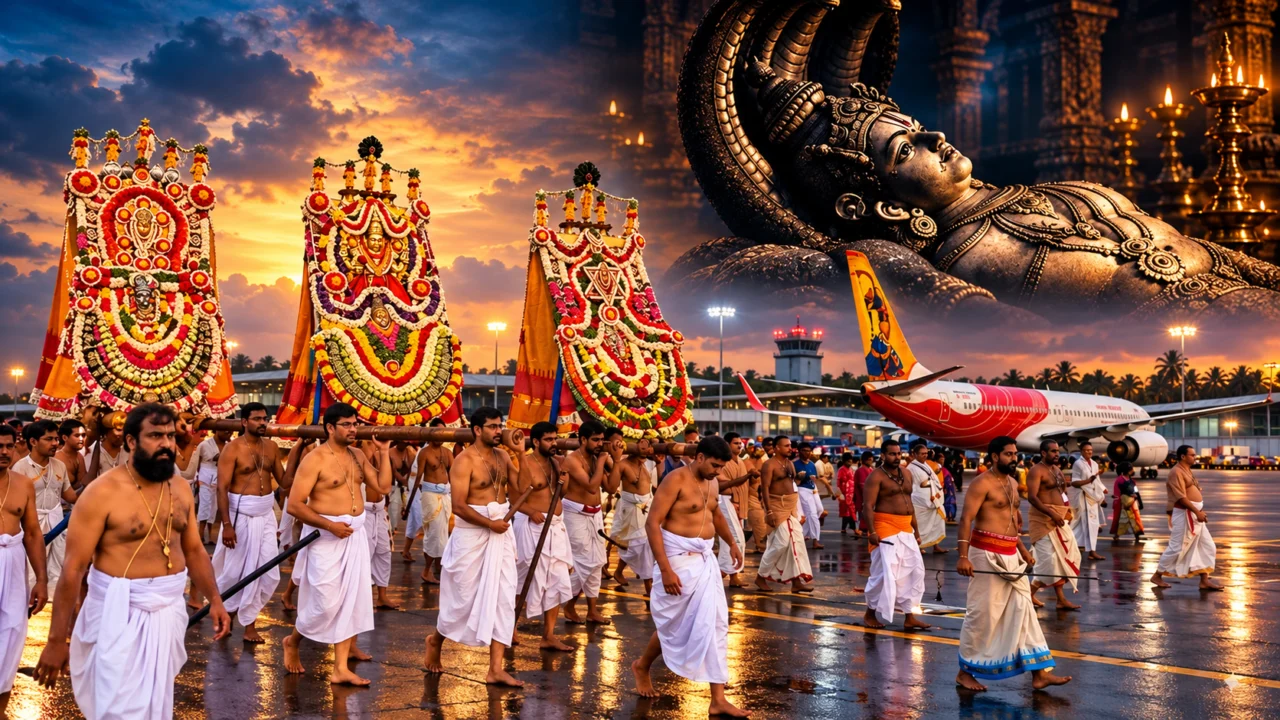
Thiruvananthapuram International Airport. Late afternoon. The radar screens that normally pulse with incoming traffic from Dubai, Chennai, Mumbai and beyond begin to empty. A formal Notice to Air Missions — a NOTAM — has already gone out to every airline and pilot who might approach this patch of Kerala sky. For the next five hours the runway belongs to someone else.
On 20 October 2026, flight operations paused from 4 pm until 9 pm. The reason was neither weather, maintenance nor emergency. It was the Alpassi (Alpashi) Aarattu of Lord Sree Padmanabhaswamy — the ceremonial sea bath of the deity.
Twice every year the same privilage happens. In the Malayalam months of Painkuni (March–April) and Alpassi (October–November), the utsava vigrahas — the processional idols of Lord Padmanabha, Narasimha Moorthy and Krishna Swamy — leave the great temple in the heart of the city. Caparisoned elephants, temple musicians, mounted police, members of the erstwhile Travancore royal family and thousands of devotees accompany them. The ancient route runs roughly six kilometres to Shangumugham Beach from the temple for the ceremonial holy bath in the Arabian Sea. That route still crosses the airport runway. So the modern world yields.
A A NOTAM (Notice to Air Missions, previously called Notice to Airmen) is the formal language of aviation: A NOTAM, a Notice to Air Missions, is the aviation world’s urgent bulletin board. Pilots and airlines are expected to read it before they fly. It warns of anything out of the ordinary: a closed runway, a rocket launch, a military exercise, a broken navigation aid.
Issued under the rules of the Convention on International Civil Aviation, a NOTAM delivers a clear warning to every crew approaching the area: do not assume the runway will be available. Carry extra fuel. Choose your alternate airport.
Here, the reason on the notice is not a hazard or technical disruption. It is a deity’s holy bath. Devotees revere this as a singular privilege granted to Sree Padmanabhaswamy alone — a living tradition that continues to be honoured with deep respect.
From 4 pm to 9 pm today, radar screens at Thiruvananthapuram International Airport emptied as the last commercial flights departed or held in pattern. A formal NOTAM restricting the airspace for five hours, temporarily handing the runway over to Lord Sree Padmanabha Swamy, was in force. The ancient procession—elephants, drums, royal escorts, priests and the sacred idols—crosses the tarmac on its way to Shangumugham Beach for the ceremonial sea bath and returns the same path after dusk. Airlines quietly adjusted fuel loads and crew rosters, passengers double-checked their timings, and the international airport settled into a deep, respectful silence. For these few hours the centuries-old promise was honoured once more: two days a year, the sky itself waits for the deity. Only after the Lord had bathed in the sea and the sacred procession cleared the runway did the lights brighten again and ordinary flights resume.
The traditional Alpassi Arattu procession of Sree Padmanabhaswamy Temple passes through the airport runway on its way to Shankhumukham Beach.
Flight operations at Trivandrum Airport will be suspended for five hours, from 4 PM to 9 PM. pic.twitter.com/Vd30sDpvov
— Akanksha Parmar (@iAkankshaP) October 20, 2026
The story begins in 1932, when the windswept coastal land first became the Royal Flying Club of the Travancore kingdom. In a gesture of profound devotion, Maharaja Sree Chithira Thirunal Balarama Varma declared that the airfield would serve the people for 363 days a year — but the remaining two days would belong solely to Lord Padmanabha, the beloved tutelary deity of the royal family. The sacred procession route to the sea was already centuries old. Rather than divert the path of the Lord, the runway was carefully laid around it.
When the modest flying club grew into Thiruvananthapuram International Airport in 1991, that ancient path still cut across the tarmac, untouched and unchallenged. Nearly a hundred years later, the promise endures. Empires fell, monarchy gave way to republic, governments changed, and the airport passed into the hands of Thiruvananthapuram International Airport Ltd (TIAL) — yet the tradition remains unbroken. Twice every year, as the idols of Lord Padmanabha Swamy and the accompanying deities move in solemn procession towards Shangumugham Beach for the holy Aarattu, a NOTAM is issued under international civil aviation rules. Airlines quietly rewrite schedules, adjust fuel and plan alternate landings.
Passengers are gently asked to check new timings. For those two precious days the modern world steps back, the airport yields, and the sky itself is asked to wait — so that an ancient covenant of faith may be kept.
Airport Stops for God:
The centuries-old Alpassi Arattu procession of Sree Padmanabhaswamy Temple crosses the runway of Thiruvananthapuram Airport on its sacred journey.
Jai Sree Padmanabha 🙌 pic.twitter.com/aUdNqN68Uz
— Akanksha Parmar (@iAkankshaP) October 20, 2026
Modern aviation lives by precision — slots counted in minutes, fuel measured in kilograms. Yet here, a living tradition, not any law of physics, quietly shapes the schedule. Airlines adjust fuel loads, choose alternate airports and rework timings without complaint. No one sees it as a burden. It is simply the way this airport breathes.
There is a rare and quiet beauty in this. In a world that almost never waits, a city of airplanes and algorithms still pauses for a few sacred hours, twice a year, so that faith and flight may share the same ground.Devotees and local tradition call it a unique privilege: an international runway suspended so that a deity may pass. Whether any other place on earth holds an exactly similar arrangement is hard to say with certainty.
What remains beyond doubt is this — nowhere else does a busy international airport regularly close its runway twice a year for a temple procession that has walked the same path for centuries. The modern world rearranges itself. The sky yields. The Lord walks to the sea and returns.On 20 October 2026 the five-hour window stretched from 4 pm to 9 pm. By nightfall the sacred idols were safely home, the runway was cleared, and the familiar rhythm of arrivals and departures began once more. For those few hours, however, the most powerful machines of our age had stood in respectful silence before a tradition older than the airport itself.
This is the story told year after year: the day the sky waited for Lord Sree Padmanabha Swamy.
Sree Padmanabhaswamy Temple in Thiruvananthapuram is one of India’s most ancient and sacred Vaishnava shrines, dedicated to Lord Padmanabha — a majestic form of Vishnu reclining in eternal yogic sleep (Anantha Shayana) upon the serpent Ananta. The 18-foot idol, crafted with 12,008 sacred saligrams, is the tutelary deity of the Travancore royal family, who have served as its hereditary custodians for centuries after Maharaja Marthanda Varma dedicated the entire kingdom to the Lord in 1750.
In 2011, court-ordered opening of the temple’s underground vaults revealed an astonishing treasure of gold, diamonds, ancient coins and priceless artefacts estimated at over Rs 1,00,000 crore, instantly making it the richest Hindu temple in the world. Yet the discovery also ignited intense controversies — legal battles over control between the royal family and the state government, allegations of missing valuables, and deep spiritual resistance to opening the still-sealed Vault B, believed by many to be protected by divine forces.
The Travancore royal family has always held that these treasures belong to the deity alone. In 2020 the Supreme Court upheld the rights of the Travancore royal family over the temple. The family has asked that Vault B remain closed, in keeping with tradition, and the court directed that it stay untouched. Today, the temple’s stewards continue to stress the careful safeguarding of the shrine’s treasures. For devotees, the true wealth of Padmanabhaswamy is the faith that has kept the temple, and the Aarattu tradition that stops the sky, alive for centuries.
