A representative image
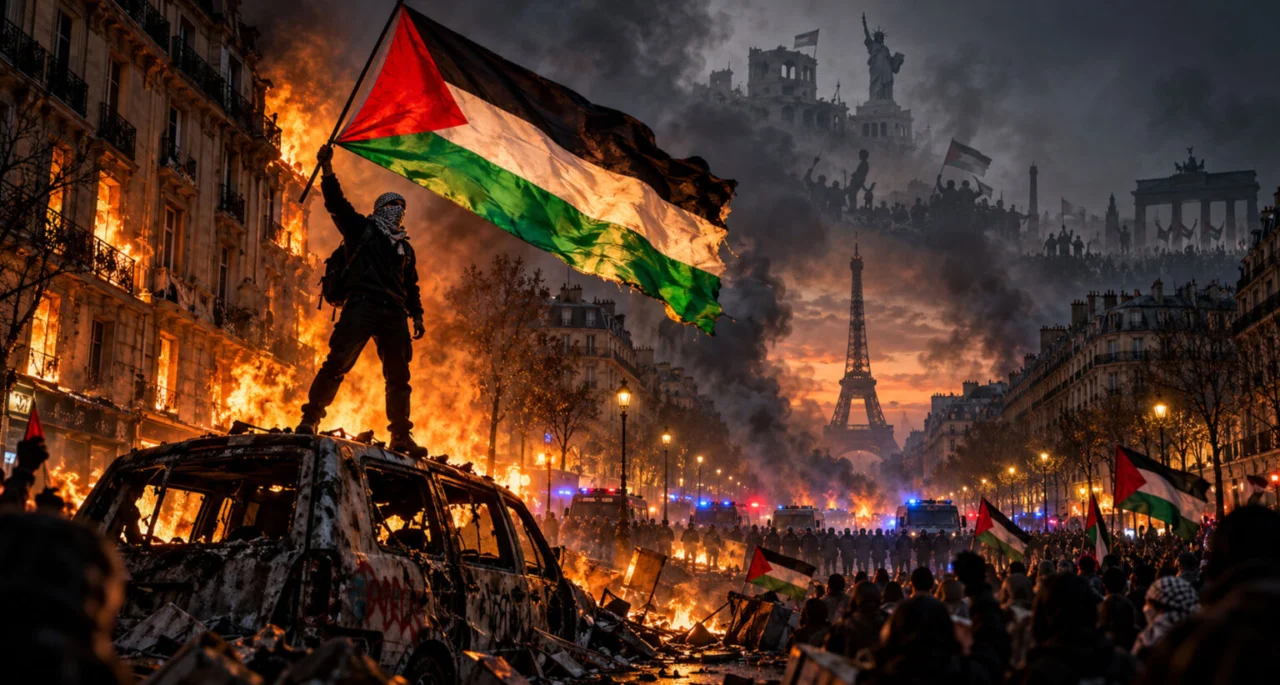
The Palestinian flag has become an increasingly visible feature of demonstrations across parts of Europe, appearing at protests whose original demands extend beyond the Israeli-Palestinian conflict. Recent demonstrations in France have brought this trend into focus, with the flag appearing alongside calls for better public services, improved education and relief from the rising cost of living.
In an article published on October 19, 2026, an Israeli author Ben M. Freeman argues that the Palestinian flag has moved from being associated primarily with Palestinian revolutionary movements to becoming a broader emblem of protest among sections of the international Left.
According to Freeman, French students have been protesting teacher shortages, overcrowded classrooms and deteriorating school infrastructure since September. He also cites a nationwide demonstration on October 17 against the rising cost of living, claiming that Palestinian flags appeared at several rallies despite the absence of Palestine-related demands in the students’ official campaign.
The article cites demonstrations in Carpentras, Marseille and Rouen as examples of the flag’s visibility. It also reports concerns within the Jewish community in Rouen over the atmosphere surrounding the protests. These accounts highlight the tension that can arise when international political symbols become prominent at demonstrations organised around domestic grievances.
Freeman traces the flag’s wider adoption to the intersection of Palestinian activism, anti-racism campaigns and Left-wing political movements. He identifies the 2001 UN World Conference Against Racism in Durban as a turning point, arguing that the Palestinian cause became more closely linked with anti-colonial and anti-racist activism in Western political discourse.
The article also examines the expansion of campaigns such as Israeli Apartheid Week and the Boycott, Divestment and Sanctions movement, alongside solidarity initiatives connecting Palestinian activism with other social movements.
This approach reflects a wider strand of Left-wing politics in which different causes are presented as connected struggles against perceived systems of oppression.
The article traces the flag’s origins to the Arab Revolt of 1916 and its later adoption by Palestinian nationalists. It notes that the Palestine Liberation Organisation formally adopted the flag in 1964 and that Palestinian political movements subsequently gave it a distinct national identity.
Freeman also examines historical links between Palestinian militant organisations and sections of Europe’s revolutionary Left during the 1960s and 1970s. These connections form part of his argument that the flag’s political associations have changed over time.
The appearance of Palestinian flags at demonstrations over education, wages and public services raises a question about the direction of contemporary protest politics: when does international solidarity complement a local campaign, and when does it overshadow the issue that brought people onto the streets?
For many who oppose the international Left, the repeated use of the same symbol across different movements reflects an ideological tendency to connect diverse grievances to a common political narrative centred on opposition to Israel and Western power.
The Palestinian flag’s growing presence at European protests has therefore become more than a question of symbolism. It reflects a wider debate about the internationalisation of domestic grievances, the influence of Left-wing activist networks and the boundaries between solidarity, political messaging and the original purpose of a protest.
