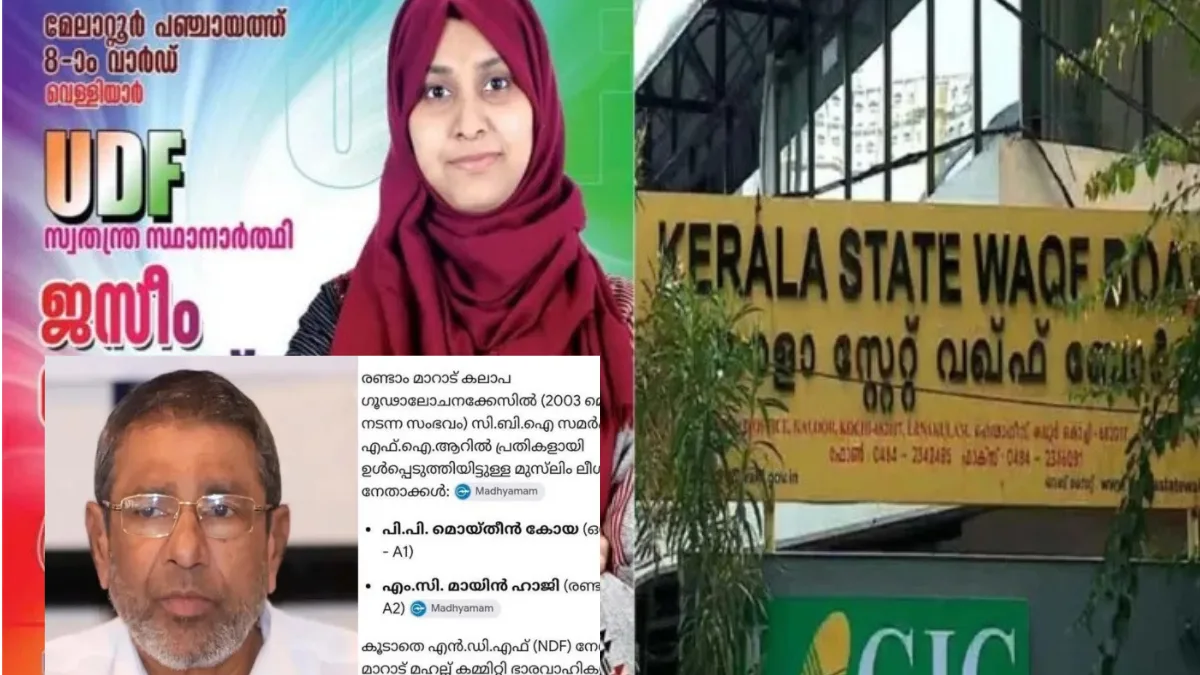
Jaseem Sabah, Welfare Party leader linked to Jamaat-e-Islami, and M.C. Mayin Haji, newly appointed chairman of the Keralam State Waqf Board.
The appointment of Indian Union Muslim League (IUML) leader M.C. Mayin Haji, whose name figures as the second accused in the CBI FIR relating to the Marad massacre of May 2, 2003, as the chairman of the newly reconstituted State Waqf Board in Keralam has drawn strong objections from Hindu Aikyavedi. Eight Hindu fishermen were brutally killed in the massacre at Marad beach in Kozhikode.
K.P. Sasikala Teacher, patron of the Sangh-inspired Hindu Aikyavedi, has questioned the appointment and accused the Congress-led United Democratic Front (UDF) government, headed by Chief Minister V.D. Satheeshan, of pursuing appeasement politics.
The UDF government has reconstituted the State Waqf Board with nine members. The new Board includes Jaseem Sabah, a woman leader of the Welfare Party, the political arm of Jamaat-e-Islami. She won the Grama Panchayat election in December 2025 with the support of the UDF.
The government has not included any non-Muslim member in the reconstituted Board, raising questions over the composition of the body under the Waqf (Amendment) Act, 2025, passed by Parliament in April 2025.
The new Board comprises M.C. Mayin Haji as chairman, Kurukkoli Moideen, Siraz D. Kapasi, Thodiyoor Muhammed Kunju Moulavi, Sajna Firoz, Jaseem Sabah, M.P. Musthafal Faisi, Dr Abdul Majeed Swalahi and Madeena Beegam.
Mayin Haji, the state vice-president of the IUML, has served as a member of the Waqf Board several times in the past. The entire membership of the previous Board, headed by K.S. Hamsa, has been replaced.
The previous Board was constituted by the CPI(M)-led Left Democratic Front (LDF) government headed by Pinarayi Vijayan.
Ummar Faisi Mukkam, a member of the Samastha Mushavara, the highest policy-making body of Samastha Kerala Jem-Iyyathul Ulama, an Orthodox Muslim organisation, was also a member of the previous Board.
According to reports, the Mujahid section has representation in the new Board, while no representative of the Kanthapuram Sunni section has been included.
K.P. Sasikala Teacher strongly criticised the appointment of Mayin Haji as chairman. She pointed out that his name appeared as the second accused in the CBI FIR relating to the Marad massacre.
She alleged that Chief Minister V.D. Satheeshan was acting under the influence of the IUML. She questioned why Satheeshan had selected these particular persons when there were lakhs of Muslims in the state and asked what message the government was sending through the appointment. She said the decision showed a lack of regard for democracy and the judiciary.
The composition of the new Board has also raised questions over the implementation of the Waqf (Amendment) Act, 2025. The amended law provides for non-Muslim representation in State Waqf Boards, subject to the provisions governing their composition.
However, the newly announced Board does not include any non-Muslim member. The government has told the court that the question of appointing two non-Muslim members was under consideration before the Supreme Court and that the relevant nominations would be made depending on the outcome of that case.
The reconstitution has also been challenged in the Kerala High Court. On October 17, the High Court, in a special sitting, refused to stay the State government’s order reconstituting the Board.
Justice S. Manu passed the order while hearing petitions filed by K.S. Hamza and C.K. Usman Haji, who had served as the chairman and a member, respectively, of the previous Board.
The petitioners questioned the government’s authority to remove the existing members and replace them. They also raised questions about whether the government had acted in accordance with its earlier submissions before a Division Bench regarding the filling of vacancies under Section 14 of the Waqf Act.
The State government argued that the previous Board had not been constituted in accordance with the Act and that reconstitution was necessary to meet the legal requirements, including representation for the Bohra community. The High Court observed that the earlier Division Bench had not restrained the government from taking steps to ensure that the Board was constituted in accordance with the law. It also referred to a Supreme Court judgment holding that the power to appoint members included the power to cancel their appointments.
However, the High Court did not give a final ruling on the legality of the new Board. It refused the interim stay but made the reconstitution subject to the final outcome of the petitions. The court also directed that the petitions be placed before a Division Bench because the issues were connected with other pending cases concerning the constitution of the Waqf Board.
The reconstitution has brought the UDF government’s approach to Waqf Board appointments under scrutiny. Hindu Aikyavedi has described the move as an example of Congress’s minority vote-bank politics and alleged that the government has given priority to political considerations. The legal challenge remains pending, and the High Court’s interim order does not settle whether the new Board fully complies with the amended Waqf law.
