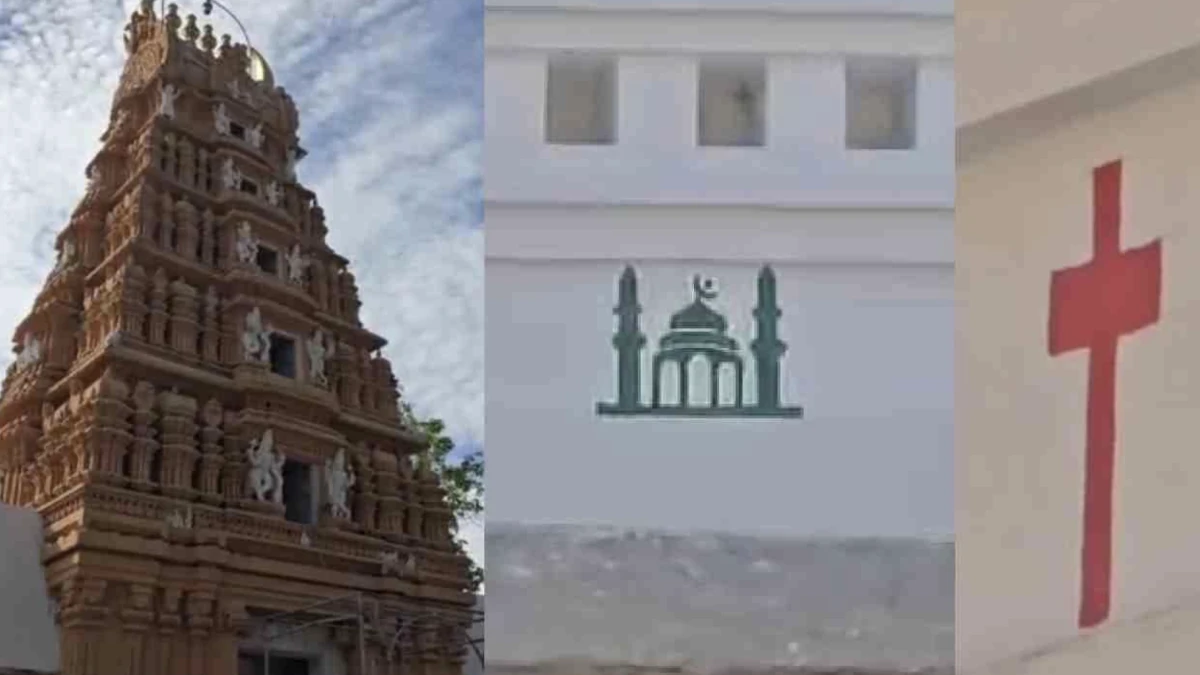
MYSURU: A controversy has erupted over the painting of religious symbols on a wall inside the premises of the historic Arkeshwara Temple at Edatore village in K.R. Nagar taluk of Mysuru district, prompting objections from local Hindu groups and leading to the registration of a police case against two persons associated with the temple’s renovation work.
The issue came to light while renovation work was being carried out at the temple. A cross painted in red and a mosque image painted in green on a wall within the temple compound reportedly sparked objections from parts of the local Hindu community. The paintings sparked discussion in the area, with some residents questioning the decision to depict the symbols on the wall of a Hindu place of worship.
The controversy gained momentum during the Mysuru Dasara period, attracting wider attention and sparking public debate. Members of local Hindu groups reportedly raised objections and sought an explanation for how the symbols were painted.
The matter also drew the attention of former Mysuru MP Pratap Simha, who reacted to the controversy through a social media post. He questioned whether the paintings would be removed and commented on the identity of those responsible for the work.
In his post, Simha said Muslims should not be blamed for the incident and alleged that Hindus who were “mixed” or had questionable loyalties were responsible. His remarks added a political dimension to the controversy, which had initially centred on the religious symbols painted on the temple wall.
However, the circumstances surrounding the paintings, including who proposed the design, who approved it and whether any specific instructions were issued to the artist, remain matters for investigation. The claims made in public statements have not, by themselves, established who was responsible for the decision.
Following the objections and the growing controversy, K.R. Nagar tahsildar Surendra Murthy visited the temple and inspected the site. The visit was aimed at examining the situation and understanding the issue that had arisen during the renovation work.
The incident subsequently led to a police complaint against the temple parupattedar, administrator Arati and artist Vinay. Based on the complaint, an FIR was registered at the K.R. Nagar police station. Police have begun investigating how the religious symbols were painted on the wall.
Investigators are expected to establish whether the paintings were part of an authorised renovation plan, who selected the symbols and colours, and whether the artist acted on instructions from the temple administration or anyone else. The investigation will also examine whether other persons were involved in planning or approving the work.
Registering the FIR marks a formal step in the inquiry, and the investigation will determine their roles and responsibilities based on the evidence collected.
The controversy has raised questions about supervising renovation work at places of worship and the need for clarity when decisions involving religious imagery are made. Temple renovation projects often involve artists, workers, administrators and local representatives. The approval process for designs and paintings can become particularly important when religious symbols are involved.
In this case, the central questions concern the paintings’ purpose and the authority under which they were executed. Police are expected to look into the sequence of events leading to the work, including whether the design was discussed with the temple authorities and whether any objections were raised before the matter became public.The involvement of a historic temple has also made the issue sensitive among residents and
devotees. For many worshippers, the appearance and traditional identity of a place of worship carry considerable religious and cultural significance. Any alteration to a temple’s premises can therefore attract scrutiny, particularly when the changes involve symbols associated with another religion.

