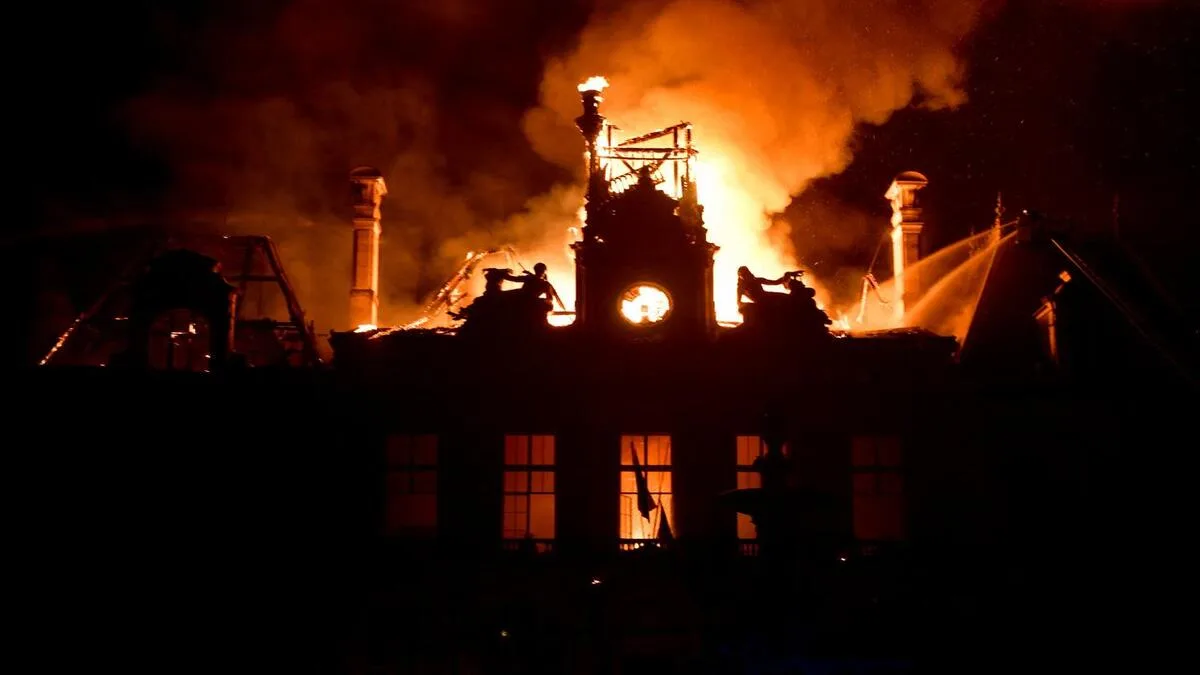
Fire burning and destroying the city hall after a group of individuals forced entry into the building during ongoing riots in Limoges, central France on October 17, 2026
PARIS: France has witnessed widespread violence, arson and looting during left-Islamist demonstrations in the name of rising cost of living, with a historic town hall in Limoges largely destroyed by fire, hundreds of shops ransacked and 1,200 people arrested.
The unrest has intensified political tensions, with clashes between police and protesters, attacks on public buildings and confrontations involving masked groups raising concerns about radical left-wing mobilisation and the convergence of far-left activism with Islamist-influenced street politics.
The violence comes amid weeks of student protests and growing opposition to President Emmanuel Macron, whose government faces mounting pressure over inflation and economic hardship.
The destruction of public property, including historic administrative buildings, has also brought renewed attention to the activities of radical groups and the political rhetoric surrounding the demonstrations.
The town hall in Limoges, a historic building more than 140 years old, was largely destroyed by a fire started by masked protesters who broke into the premises. The blaze became one of the most significant incidents in a day of unrest that affected several French cities, with public buildings, businesses and police facilities targeted during the demonstrations.
Two other town halls were broken into and vandalised in Marseille and Lille. In Bordeaux, a police compound was vandalised, while protesters in Lyon set fire to a tourist office. The attacks on administrative buildings have intensified concerns about the scale of the disorder and the vulnerability of public institutions during mass demonstrations.
In Paris, masked groups torched parked cars and ransacked shops, leaving entire streets damaged. City mayor Emmanuel Gregoire said that whole streets in the capital “have been devastated”. Scores of businesses were looted in Paris, Marseille, Nice, Nantes, Bordeaux, Limoges, Lille, Toulouse and Strasbourg. The targeted establishments included supermarkets, pharmacies, luxury boutiques, clothing retailers, opticians, cosmetic shops and consumer electronics stores.
Accounts from Paris described groups of approximately six young men carrying out coordinated attacks on commercial establishments. According to AFP reporters, the individuals wore masks and gloves, disconnected security cameras and then smashed shop windows to gain entry before taking merchandise from the premises.
The looting occurred during and after marches against the rising cost of living. Groups of young people moved through city streets, confronting police officers, starting fires and breaking into shops that had been closed or secured. French Prime Minister Sebastien Lecornu, who condemned the violence as being of “extreme intensity”, said late on the day of the unrest that 1,200 people had been arrested and 150 police officers injured.
President Macron also warned that those responsible for the destruction would face legal consequences. In a statement posted on X, he said that “those who carried out vandalism, attacked administrative offices or businesses, or carried out looting, even in our town halls, will be prosecuted and punished”.
The destruction of the Limoges town hall has drawn particular attention because of the building’s historical significance. Its extensive damage, alongside attacks on other municipal buildings, illustrates the extent to which the unrest spread beyond commercial districts and into public institutions.
The demonstrations were organised around the cost of living, with inflation aggravated in part by the war in West Asia, which has contributed to rising prices across Europe and other regions. The French Interior Ministry estimated that 550,000 people participated in the nationwide marches, while the CGT trade union, which took part in the demonstrations, put the figure at 800,000.
Police deployed tear gas and water cannon against protesters who threw projectiles and launched fireworks. In the southern city of Saint-Etienne, a 17-year-old boy reportedly lost his right hand after a crowd-control grenade exploded. The unrest has also intensified political confrontation between rasical-left and nationalist leaders. Marine Le Pen, a leading nationalist candidate seeking to replace Macron, condemned the rioters and accused the party of her radical left presidential rival, Jean-Luc Melenchon, of having “legitimised the violence”. Le Pen said on X that, if she came to power, she would protect the French “from the violence of the extreme left”.
🚨BREAKING: The historic Limoges town hall has just completely collapsed after far-left rioters set it on fire
It was built in 1876. It survived World Wars. It did not survive modern France. pic.twitter.com/LRjxvBQ5KV
— Inevitable West (@Inevitablewest) October 17, 2026
Melenchon, whose political movement had prominently supported the demonstrations and preceding student protests, urged demonstrators not to engage in looting, describing such actions as “contrary to our methods”.
The clashes have renewed scrutiny of the role of radical left-wing organisations in mobilising protesters and the relationship between far-left political activism and sections of the country’s immigrant and Muslim communities. Critics have raised concerns about a potential Left-Islamist nexus in street mobilisation, particularly where anti-government protests intersect with pro-Palestine activism and confrontational political rhetoric.
The demonstrations extended beyond economic grievances, with protesters expressing anger at political leadership, wealth inequality and the approaching presidential election in 2027. In Paris, tens of thousands of people marched through the eastern and northern parts of the capital. Some demonstrators shouted “Everyone hates the police” and “Macron, resign”, reflecting the hostility directed at the government and law enforcement authorities.
Kamil Alahyan, an 18-year-old high school student, said he was protesting “for so many reasons — the elections coming up in 2027, politicians who lie, the ultra-rich who’ve been taking more and more wealth over the past 10 years”. References to the French Revolution of 1789 also featured prominently in the demonstrations. In Marseille, protesters who forced their way into the mayor’s offices shouted, “It’s the Revolution, we’re taking the Bastille!”
In the western city of La Rochelle, demonstrators marched behind a placard bearing the words “Revolution or death”. In Montpellier, a large blue sign reading “The people will win” was unfurled above a central square. The burning of a 140-year-old town hall in Limoges, widespread looting, attacks on public buildings and 1,200 arrests underscore the intensity of the unrest, as France grapples with violent street clashes involving radical left-wing mobilisation and deepening tensions over Islamist influence, public order and national identity.
