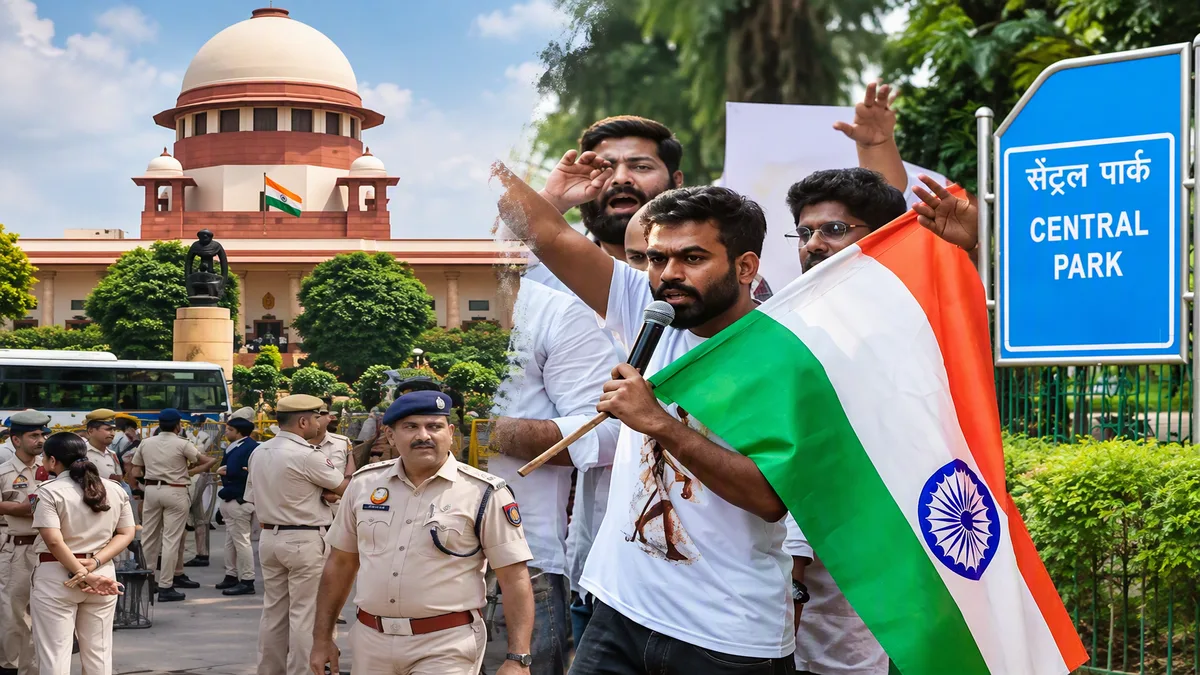
Supreme Court Raps CP Protests: Declines Urgent Plea on Central Park Closure Ahead of CJP Rally
NEW DELHI: The Supreme Court on Friday (October 16) declined an urgent hearing on a plea challenging the closure of Central Park in Connaught Place ahead of the Cockroach Janta Party’s (CJP) proposed ‘Lehra Do Tiranga’ march. However, it indicated that traders could be compensated if the restrictions were found to have deprived them of their livelihood.
The matter was mentioned before Chief Justice of India Surya Kant and Justice Joymalya Bagchi. The counsel informed the Bench that the New Delhi Municipal Council (NDMC) had issued directions late on Thursday night to close Central Park, thereby affecting commercial activities in the area.
The Bench refused to intervene immediately. It nevertheless took note of the difficulties that shopkeepers, particularly those dependent on daily earnings, could face during the festive season.
“We hope better sense will prevail on everyone,” the Chief Justice remarked.
Justice Bagchi pointed to the competing interests involved in the matter. While CJP supporters wanted to protest, traders wanted to carry on their business and the authorities had to maintain law and order.
“Someone wants to protest, someone wants to sell ‘mungfali’, someone wants law and order. All these are related,” he observed.
The judge went on to say that the Court could exercise its constitutional jurisdiction if the restrictions resulted in business losses. He also referred to the Court’s powers under public law to award compensation where disproportionate measures caused deprivation of livelihood.
No such relief was granted on Friday. The matter is to be taken up on October 26.
The NDMC had ordered Central Park to remain closed on October 16 and 17, citing administrative reasons. The decision followed CJP founder Abhijeet Dipke’s call for supporters to gather at the park with the national flag.
The march was announced following the arrest of CJP members Saurav Das and Ashutosh Ranka, who were sent to judicial custody for allegedly violating their peace bonds and entering Jantar Mantar despite its de-notification as a designated protest site.
A day earlier, the Delhi High Court had declined to restrain the proposed demonstration after recording the Delhi Police’s assurance that necessary measures would be taken to regulate it.
The Supreme Court has now left open the question of compensation if the traders establish that the restrictions caused an unlawful deprivation of livelihood.
