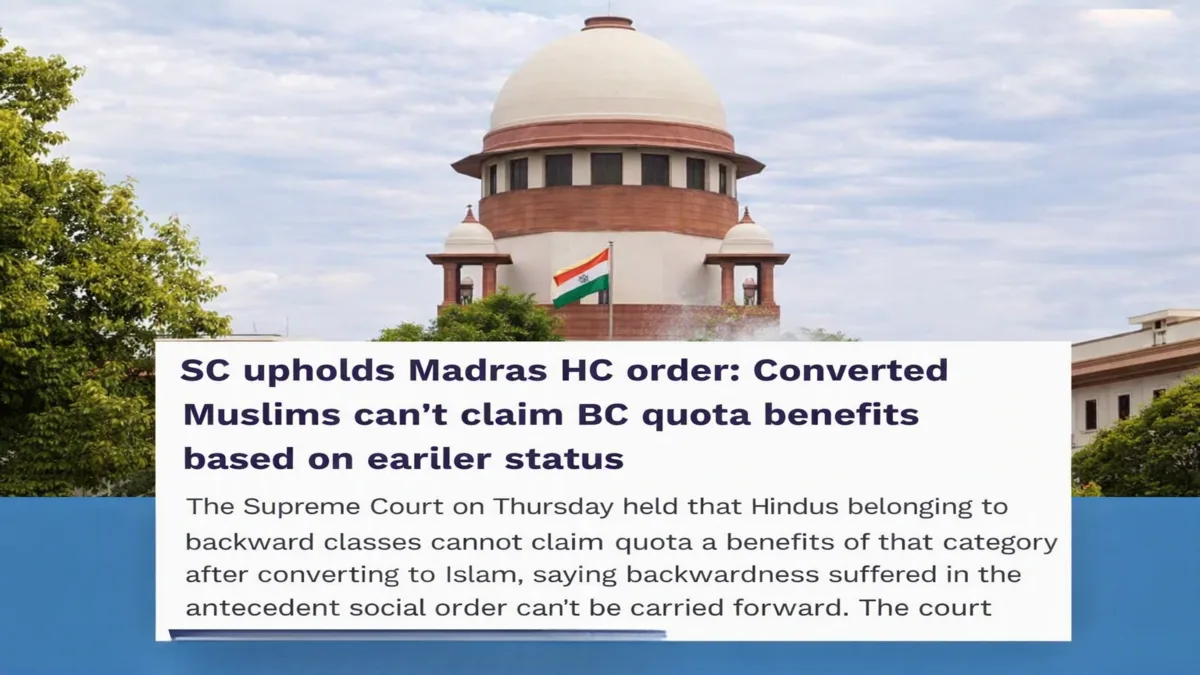
Supreme Court Reservation Ruling: Hindu Converts to Islam Cannot Retain Backward Class Quota Benefits
New Delhi: The Supreme Court on October 15 upheld a Madras High Court judgment which held that a Hindu belonging to a Backward Class cannot continue to claim reservation benefits based on his previous caste status after converting to Islam. The Court dismissed an appeal filed by the Tamil Nadu Government against the High Court’s decision striking down a Government Order that permitted such converts to obtain Backward Class Muslim (BCM) certificates.
A Bench comprising Justices Prashant Kumar Mishra and Shree Chandrashekhar held that a person’s social backwardness under the Hindu caste system cannot automatically be carried over to a different religious social order for claiming reservation under Article 16(4) of the Constitution.
The dispute arose from a petition filed by Sameer Ahamed, formerly known as Paramasivam, who converted to Islam in 2015. He subsequently applied for a community certificate identifying him as a Muslim Lebbai, one of the communities eligible for Backward Class reservation in Tamil Nadu. The Tahsildar rejected his application, following which he approached the Madras High Court.
While the petition was pending, the Tamil Nadu Government issued G.O. (Ms) No. 31 on March 9, 2024, allowing persons belonging to Backward Classes (BC), Most Backward Classes (MBC), Denotified Communities (DNC) and Scheduled Castes (SC) to obtain BCM certificates upon conversion to Islam.
The order followed a recommendation made by the Tamil Nadu Backward Classes Commission. It permitted eligible converts to be classified under any of the seven Muslim communities notified as backward in the State.
However, the Madurai Bench of the Madras High Court, comprising Justices G.R. Swaminathan and P.B. Balaji, declared the Government Order unconstitutional on June 25, 2026.
The High Court referred to an earlier ruling in G. Michael v. S. Venkateswaran, which held that a person’s position in Muslim society is not determined by the caste to which he belonged before conversion.
It also observed that the seven notified Muslim communities, including Labbais, Rowthars, Marakayars and Dekkani Muslims, were recognised as distinct communities. A person converting to Islam could not automatically become a member of one of these communities merely by obtaining a certificate from a Jamath.
The High Court also questioned the Government’s decision to place converts from SC, BC, MBC and DNC backgrounds in the same reservation category. It held that these were different classifications and could not simply be grouped together to ensure that converts continued receiving reservation benefits.
The State Government defended the order, arguing that persons who had already enjoyed reservation benefits should not lose them solely because of religious conversion. It also submitted that the order was based on the recommendation of a statutory commission.
The High Court rejected these submissions, holding that the Government could not use an executive order to overcome earlier judicial decisions. It consequently upheld the rejection of Sameer Ahamed’s community certificate application.
The Tamil Nadu Government challenged the judgment before the Supreme Court, which reserved its decision on August 7.
Dismissing the appeal today, the Supreme Court reportedly found no reason to interfere with the High Court’s judgment.
