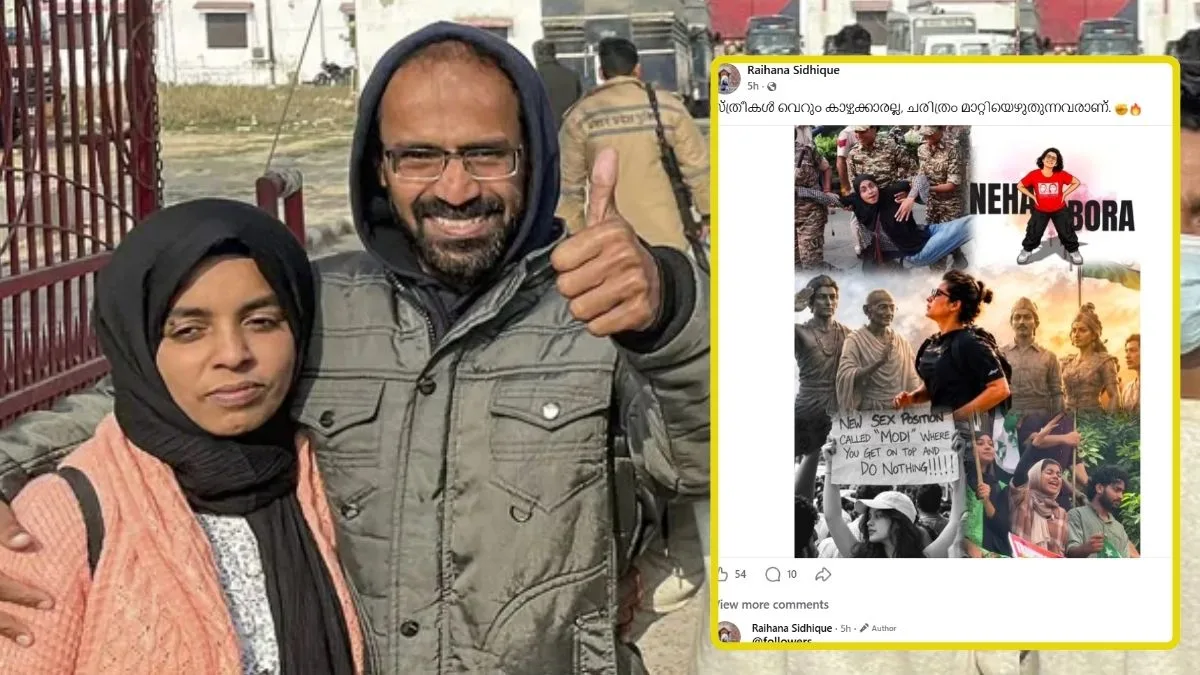
A Facebook post from Kerala is currently doing the rounds, drawing sharp reactions for its crude and abusive depiction of Prime Minister Narendra Modi. The post features a placard from a Citizens for Justice and Peace (CJP) related protest carrying the vulgar line: “New Sex position called ‘Modi’ where you get on top and do nothing.” The post has triggered questions over the use of abusive language against the Prime Minister, who holds the country’s highest elected executive office. Political disagreements and criticism of a government are part of democratic discourse. However, the use of sexually suggestive personal insults against political leaders raises questions about the standards of public debate, irrespective of the party or ideology involved.
The woman who shared it is Raihana Siddique. She may not be a household name, but her husband is. Siddique Kappan, the UAPA-charged journalist arrested in October 2020 while heading to Hathras, stands accused of attempting to incite communal violence, disrupt public peace, and promote unrest in the aftermath of the Hathras incident and other protests.
Kappan was intercepted at the Delhi-UP border along with associates linked to the Popular Front of India (PFI). He was carrying an Azhimukham identity card — a publication investigators alleged was used to push narratives that could inflame tensions. His links to the older money-laundering probes dating back to 2018 is also under investigation.
Statements from co-accused, including KA Rauf Sharif, Anshad Badarudheen, Firos Khan and references involving KP Kamal, revealed that he was as a key figure in the alleged conspiracy, operating under the cover of journalism. Investigators also noted his stay at the PFI national office in Shaheen Bagh, Delhi — the epicentre of the anti-CAA protests that later saw large-scale violence.
He spent more than two years in jail before the Supreme Court granted him bail in the UAPA case. He was finally released in February 2023 and has remained on bail since, claiming full compliance with court conditions for over three years.
Raihana’s social media post could potentially invite legal scrutiny if its content meets the requirements of a criminal offence under Indian law. While criticism of the Prime Minister and the government is protected under the constitutional right to freedom of speech and expression, that right is subject to reasonable restrictions prescribed by law. Abusive or vulgar language alone, however, does not automatically constitute a criminal offence.
Depending on the exact content, context and intent, relevant provisions could include Section 356 of the Bharatiya Nyaya Sanhita (BNS), which deals with criminal defamation and carries a punishment of up to two years’ simple imprisonment, a fine, both, or community service. Section 352, concerning intentional insult intended to provoke a breach of peace, provides for imprisonment of up to two years, a fine, or both. Whether either provision applies would depend on the facts and evidence. Merely insulting or criticising the Prime Minister does not automatically establish a criminal offence.
Raihana Siddique spent years moving between courts seeking her husband’s release. Her frustration is understandable in personal terms. Yet the post she chose to amplify does not target any specific alleged procedural lapse. It resorts to personal, sexually abusive ridicule of the Prime Minister of India. Such language does little to advance any cause and only deepens polarisation.
Meanwhile, Siddique Kappan has approached the Supreme Court once again. In his latest application, he has sought temporary release of his passport to undertake a two-week Umrah pilgrimage to Makkah and Madinah, with an undertaking to redeposit it upon return. He has also prayed for the de-freezing of his salary and Provident Fund accounts, citing financial hardship to his family, and the return of seized personal and professional belongings.
Main UAPA / Hathras Conspiracy Case
Money Laundering (PMLA / ED) Case
The Uttar Pradesh government told the Supreme Court that Siddique Kappan’s alleged online communications with PFI and Campus Front of India (CFI) leaders went beyond his journalistic work and claimed he was part of a conspiracy to foment communal tensions and spread terror. The state alleged that Kappan was part of a PFI/CFI delegation sent to meet the Hathras victim’s family under the direction of CFI leader Rauf Sharif, who allegedly funded the trip. It also questioned cash deposits of ₹45,000 in Kappan’s account in September–October 2020 and alleged that he wrote articles to incite communal unrest at the direction of PFI leadership.
Citing the organisation’s alleged links to earlier incidents, including the 2010 attack on professor T.J. Joseph and the 2013 Narath weapons-training camp case, the government opposed Kappan’s bail. Kappan, booked under the Unlawful Activities (Prevention) Act (UAPA), challenged the application of certain UAPA provisions, arguing that the FIR and charge sheet did not establish the required grounds. The Allahabad High Court’s Lucknow bench had rejected his bail plea, and the Supreme Court had sought the state government’s response. These claims about Kappan’s alleged role were the state government’s allegations, not established findings in the quoted material.
On 12 October 2026, Kappan moved the Supreme Court seeking further relaxation of bail conditions. He has specifically asked for:
The contrast is stark. On one hand, a man still facing serious charges of conspiracy to foment communal unrest and linked by investigators to a now-banned organisation seeks judicial indulgence for religious pilgrimage and financial relief. On the other, his wife publicly circulates content that reduces the elected head of government to crude sexual invective.

