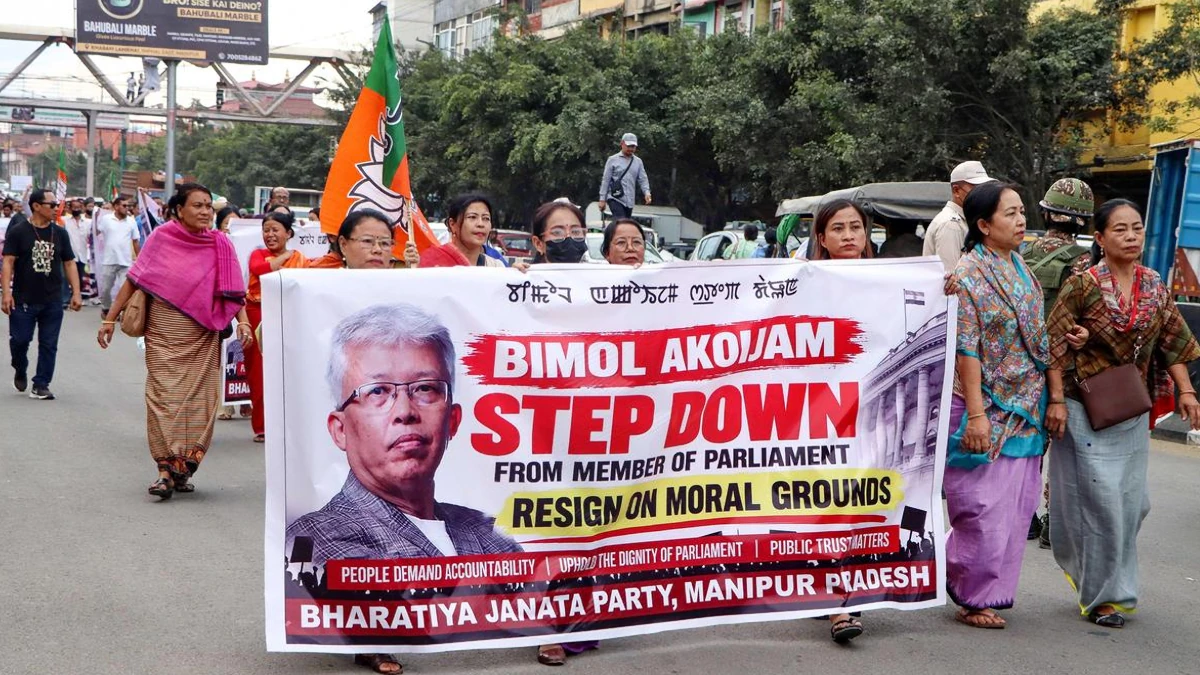
BJP Manipur staged a rally demanding the resignation of Congress MP Angomcha Bimol Akoijam
NEW DELHI: The Congress party is facing an escalating confrontation over its response to allegations of sexual harassment against its Lok Sabha MP and former Jawaharlal Nehru University (JNU) professor Angomcha Bimol Akoijam, the Bharatiya Janata Party (BJP) has slammed the opposition party of practising selective feminism and shielding its own leaders from accountability.
The controversy has intensified after JNU dismissed Akoijam from university service with immediate effect following an inquiry by its Internal Committee into complaints of alleged sexual harassment by female students. The BJP has now turned the issue into a nationwide political campaign, demanding answers from Congress leader Rahul Gandhi and questioning why the party has not publicly demonstrated the same urgency in holding its own MP accountable as it does when criticising its political opponents.
The BJP Mahila Morcha has announced its Nari Shakti Hunkar Andolan for October 12, with a march from Andhra Education Society School on Deen Dayal Upadhyaya Marg to the Congress headquarters at Indira Bhawan in New Delhi, followed by a demonstration. The party has also announced protests outside Congress offices and at district headquarters, seeking to turn the issue into a national debate over political accountability and the safety and dignity of women.
At a press conference, BJP MP Bansuri Swaraj accused the Congress of maintaining a troubling silence over the allegations against Akoijam. She questioned whether Rahul Gandhi’s campaign against patriarchy was being applied consistently or whether it was being used primarily as a political slogan.
“Are ‘Smash the Patriarchy’ events meant for only political posturing by Rahul Gandhi? Does the Congress party’s feminism start with a hashtag, but stop short of fixing accountability?” Swaraj asked.
Her remarks encapsulated the BJP’s political offensive against the Congress: a party that publicly invokes women’s rights, gender equality and the dismantling of patriarchal structures must also be prepared to confront serious allegations involving its own elected representatives.
Swaraj questioned why, despite the complaints reportedly emerging in May, the Congress leadership had not instituted an internal inquiry or issued a show-cause notice to Akoijam, according to the allegations raised by the BJP. She also demanded that the Congress suspend the MP.
The BJP’s argument is that the credibility of a political party’s commitment to women’s safety cannot rest on speeches, campaigns and slogans alone. It must also be measured by how swiftly and transparently its leadership responds when serious allegations concern someone from within its own ranks.
However, the allegations and the university’s disciplinary action must be distinguished from any separate determination of criminal liability. The university’s dismissal does not, by itself, establish that a criminal offence has been proved in court.
JNU’s decision to dismiss Akoijam marks a significant development in a controversy that has reportedly been unfolding since May 2026.
According to the university order dated October 9 and signed by Vice-Chancellor Santishree D. Pandit, the decision followed an inquiry by the university’s Internal Committee into complaints of sexual harassment. The committee recommended major punishment based on its findings.
The order stated: “Upon following due process and considering all available facts and as per the report of the Internal Committee, the punishment of dismissal from the services of the university is hereby imposed”.
Akoijam was a professor at the Centre for the Study of Social Systems under JNU’s School of Social Sciences. His dismissal came after the university considered the findings of its internal inquiry and imposed the disciplinary penalty under the applicable service rules.
Reports cited in the information provided state that 11 female students had filed complaints. The allegations included claims that Akoijam invited students to his campus residence under the pretext of meetings or gatherings and attempted to sexually harass them. Some complainants also reportedly alleged that he made obscene or inappropriate remarks during classes.
The case had already triggered protests on the JNU campus, with the Akhil Bharatiya Vidyarthi Parishad (ABVP), the student organisation affiliated with the Rashtriya Swayamsevak Sangh, demanding an independent, fair and time-bound investigation.
The organisation had questioned the delay in addressing the complaints and called for transparency in the process.
Welcoming the university’s decision, ABVP JNU president Mayank Panchal described the dismissal as an important step towards accountability. He maintained that complaints by women students must be treated seriously and investigated without delay.
In a statement, the organisation said: “For the ABVP, the safety, dignity and justice of female students are not matters of political gain but serious issues tied to student rights and university responsibility.”
The organisation added that justice, sensitivity and accountability must take precedence over political partisanship or double standards regarding women’s safety.
ABVP JNU secretary Praveen Kumar Piyush said the organisation had consistently campaigned for an impartial inquiry and staged a protest in September demanding urgent action. Piyush also argued that political influence should not obstruct accountability. He went further, demanding strict legal action against Akoijam and saying that resignation from Parliament alone would not be sufficient.
Akoijam represents the Inner Manipur constituency in the Lok Sabha, having won the seat on a Congress ticket in the 2024 general election. Before his dismissal, he was a professor at one of the country’s best-known universities.
His position as both an elected representative and a former faculty member has given the controversy an added political dimension. For the BJP, the central question is whether the Congress will take a clear public position on the allegations involving its MP and explain what, if any, internal disciplinary steps it has initiated.
The controversy presents a challenge not only for the Congress but also for political parties and educational institutions across the country.
Universities have a responsibility to provide students with a safe environment, establish effective complaint mechanisms and ensure that allegations of harassment receive timely and impartial consideration. Political parties, meanwhile, have a responsibility to respond transparently when serious allegations involve their elected representatives.
Neither political affiliation nor public prominence should determine whether a complaint is taken seriously. Equally, disciplinary action and criminal punishment are distinct matters, and the principles of fairness and due process must be respected throughout.
The BJP’s campaign is expected to intensify the political confrontation, with protest placing the Congress headquarters at the centre of the dispute. Demonstrations across state capitals and district headquarters are also intended to keep pressure on the opposition party.
The immediate question is whether the Congress will publicly clarify its response to the case and address the demand for disciplinary action against Akoijam. The broader institutional question is whether complaints involving students can be handled promptly and transparently, without allegations of political influence undermining public confidence.
