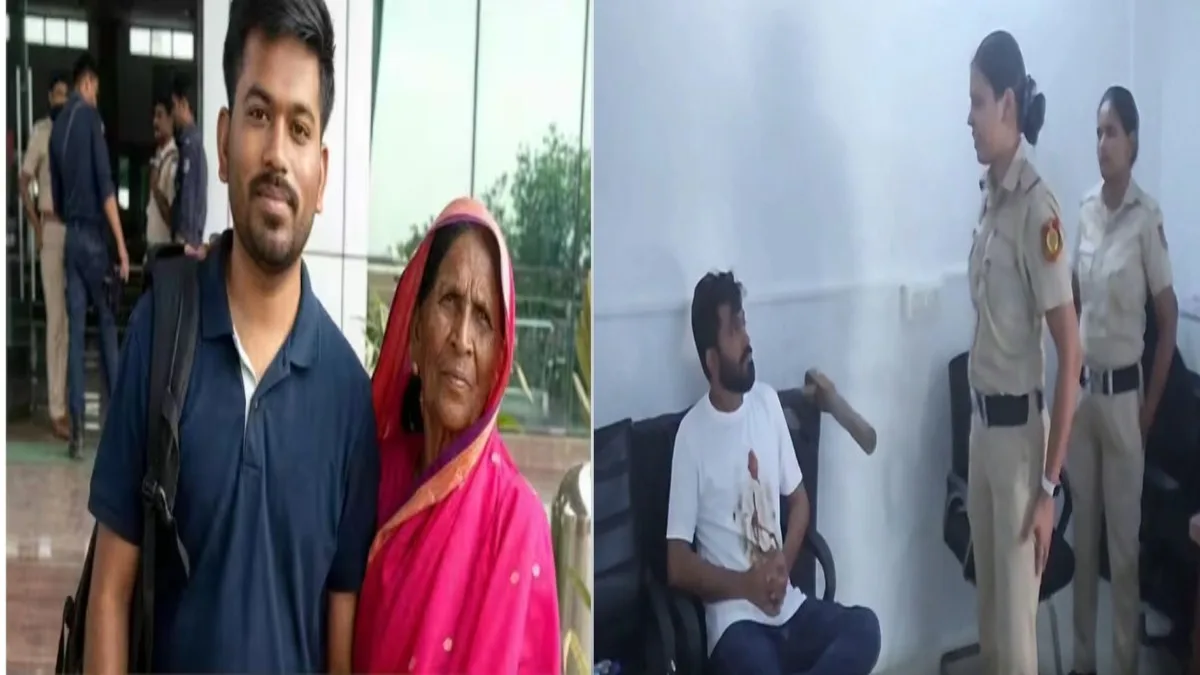
CJP Row: Video Shows Cops Offering Travel Help to Abhijeet Dipke After Grandmother's Death
NEW DELHI: Delhi Police on October 11 released video footage of the moment officers informed Cockroach Janta Party (CJP) founder Abhijeet Dipke of his grandmother’s death while he was in preventive custody.
The recording, posted with the caption “When claims and reality differ, let the facts do the talking,” shows the news being conveyed calmly, water being offered, and repeated assistance for travel to the funeral or contact with family, offers that Dipke turned down on camera.
In the footage, a woman police officer approaches Dipke in a room and informs him of the demise of his paternal grandmother, Savitribai Shankarrao Dipke, 85, who had died earlier that day (around 11:30 am on 10 October) at the family home in Santuk Pimpri village, Hingoli district, Maharashtra.
All the police officers can be seen standing while Dipke continues to be seated. The male officer is then seen offering water to Dipke. They then ask whether he wishes to travel for the last rites by any mode, plane, train, bus or other transport, and state that Delhi Police would arrange it on humanitarian grounds.
They also offer to facilitate a call to his family, specifically mentioning his father. Dipke is recorded declining the offers to speak to his parents at that time.
A higher-definition version with clearer audio-visual quality of the same video is available here:
The video was released after Dipke’s mother, Anita Dipke, publicly accused police of lying about informing her son and claimed the family could not reach him, with last rites put on hold.
Family members and CJP leaders had alleged that Dipke was prevented from attending the funeral in the remote Maharashtra village and that the handling was insensitive.
Dipke himself has not claimed he was never informed of the death. In his response to the police video, he acknowledged the information was given but focused on other points: he said he repeatedly asked for his phone “just for a couple of minutes” to retrieve his cousin’s number (the cousin lived with the grandmother) and for a call to his lawyer, both of which were denied.
He alleged that at around 3:30 am officers came with arrest papers and asked him to call his father to say he might go to jail for a long time, an action he described as further tormenting a family already grieving.
He also claimed the released video omitted the portions where he made the phone and lawyer requests, and that he refused to sign papers until he could speak to lawyers.
Delhi Police has maintained that standard custody protocols were followed. Under preventive detention linked to an unauthorised protest call (permission for the Jantar Mantar demonstration had been denied), contact is typically limited to immediate family; a cousin does not fall in that category in the same way. Officers say the humanitarian offers of travel and family contact were extended and declined on record.
Dipke, along with Ashutosh Ranka and Saurav Das, had been detained from their Mumbai-Delhi flight on October 10 as a preventive measure. They were reportedly produced before a Special Executive Magistrate on October 11 and released on a surety bond of Rs 50,000 each for maintaining peace for one year.
After release, Dipke left Delhi for Maharashtra, telling reporters he was going home to be with his family following his grandmother’s death. The last rites had already been performed that morning; he arrived too late to attend them.
The police video and Dipke’s subsequent posts leave a clear sequence on the core factual points: the death news was delivered, travel assistance to the remote Hingoli village was offered by any available transport, family contact (including to the father) was proposed, and those specific offers were declined on camera.
Dipke’s rebuttal centres on access to his phone for a cousin’s number, a lawyer call, the timing of the 3:30 am interaction, and the editing of the video, issues separate from the documented offers of travel and parental contact that he turned down.
Dipke’s mother, Anita Dipke, rejected the police version outright. Speaking from Maharashtra, she said the family had been unable to contact her son, accused Delhi Police of lying, and asserted that if he had received the news he would have returned immediately. “We have put the last rites on hold for him,” she stated.
Immediately after the detention (which had happened earlier in the day, before the unfortunate death of the octogenarian grandmother of Dipke), his mother Anita Dipke framed the police action as an “atrocity” and declared that Ambedkarites (Dalits, SC and ST communities) would make the Modi government “pay” and “teach them a lesson.”
“I feel very bad. That young man is doing good work for the country… The government is doing the wrong thing. Ambedkarite people will teach them a lesson and show them the consequences of their actions.”
Father Bhagwan Dipke compared the heavy police deployment on October 10 inside New Delhi to treating student protesters like “Chambal dacoits” and described his son as a modern-day Chandra Shekhar Azad or Bhagat Singh.
The family has consistently projected the episode through a caste lens, converting a preventive detention and a personal bereavement into a grievance of systemic targeting of Dalits.
Taken together, the family’s public interventions form a consistent pattern: emotional appeals about parental suffering and fear, followed at moments of confrontation by sharp accusations against authorities and explicit invocation of Ambedkarite identity to mobilise support along caste lines.
They have not succeeded so far in managing to divide Indians along those faultlines exploited to its unnatural extremes during the British era as citizens of India have fortunately till now been analysing issues for their truth and relevance.
Delhi Police, for its part, has maintained that legal procedures were followed, information was shared sensitively, and travel assistance was offered but declined, clearly presenting its actions as both preventive and humanitarian.
