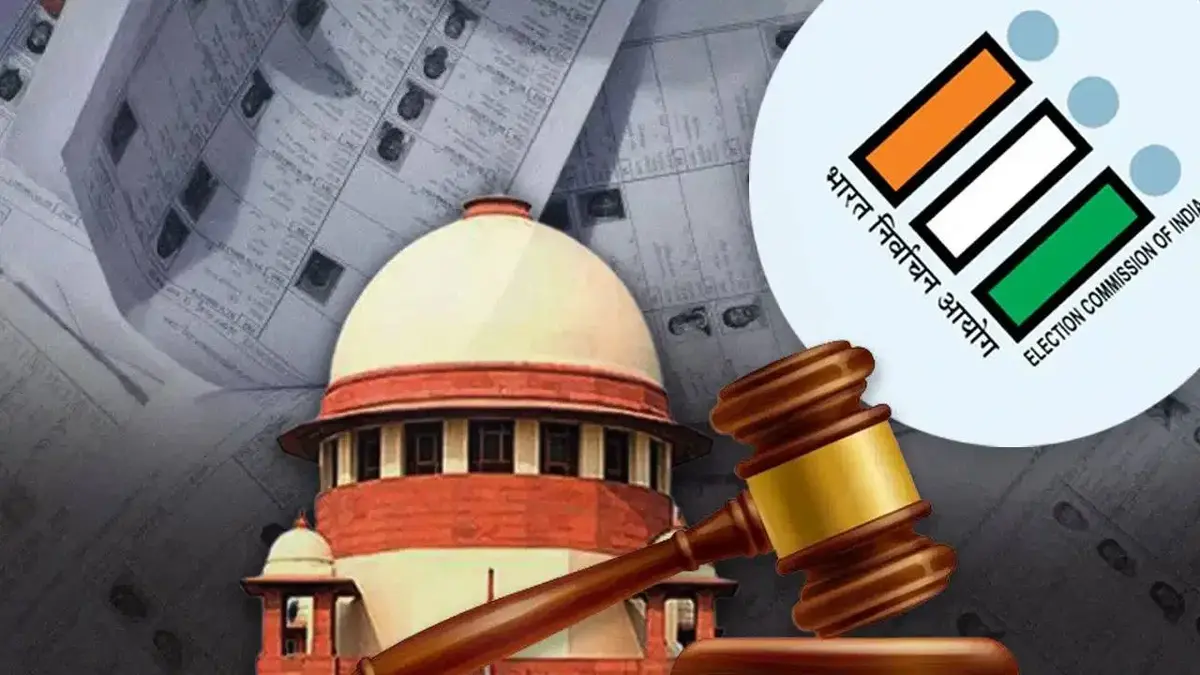
For months, the Opposition has accused the Narendra Modi government and the Bharatiya Janata Party (BJP) of “vote chori”, alleging that the Election Commission of India (ECI) has facilitated an organised effort to manipulate electoral outcomes. The accusation initially revolved around Electronic Voting Machines (EVMs). When that line of attack failed to establish credible evidence of systematic manipulation, the political focus shifted to the Special Intensive Revision (SIR) of electoral rolls.
The SIR, particularly in Bihar, has consequently become the latest battlefield in India’s electoral politics. Yet political rhetoric and judicial scrutiny are not the same thing. The Supreme Court’s judgment of May 27, 2026, in Association for Democratic Reforms & Ors. v. Election Commission of India & Ors. provides an important constitutional and statutory reference point for assessing the claims surrounding SIR.
The petitions before the Court were filed after the ECI decided to conduct SIR in Bihar. Among the petitioners were the Association for Democratic Reforms, activist Yogendra Yadav, and political figures including Mahua Moitra of the Trinamool Congress, Manoj Jha of the Rashtriya Janata Dal, K.C. Venugopal of the Congress and Supriya Sule of the NCP-SP.
The bench comprising Chief Justice Surya Kant and Justice Joymalya Bagchi confronted the controversy through four fundamental questions: Did the ECI possess the legal authority to conduct SIR? Was the exercise based on a legitimate objective and implemented through proportionate measures? Did its procedure violate the Representation of the People Act, 1950, or the Registration of Electors Rules, 1960? And could the ECI examine questions relating to the citizenship of persons seeking inclusion in electoral rolls?
The answers are significant because they directly challenge the legal foundation of the broad “vote chori” narrative.
The first claim was that the ECI lacked the authority to undertake such an exercise. The Supreme Court rejected that proposition.
Chief Justice Surya Kant noted that Section 21(3) of the Representation of the People Act, 1950, expressly permits a special revision “at any time, for reasons to be recorded and in such manner as the Election Commission may deem fit”. Consequently, the fact that SIR differs from the modalities of a routine electoral-roll revision does not make it unlawful.
The Court described SIR as an exercise that does not replace the statutory framework but gives effect to the constitutional responsibility entrusted to the ECI under Article 324. It concluded that the Commission had acted within its statutory authority.
This is an important distinction. The question before the Court was not whether every administrative decision made during SIR would necessarily be correct. It was whether the Commission had the constitutional and statutory power to conduct the exercise in the first place. The Court answered that question in the affirmative.
The second argument was that SIR was arbitrary and disproportionate. Again, the Court disagreed. The legitimate purpose identified by the Court was straightforward: ensuring the accuracy, completeness and integrity of electoral rolls. This is hardly an objective that can reasonably be characterised as antithetical to democracy. Indeed, it is difficult to imagine a free and fair election without an accurate electoral register.
The Court found a rational connection between the measures adopted and that objective. House-to-house enumeration, standardised enumeration forms and verification against prescribed documentation are designed to identify inaccuracies that may otherwise remain embedded in electoral rolls.
Electoral rolls are not static documents. People die, migrate, change residences and sometimes appear more than once in electoral databases. Administrative systems inevitably accumulate errors. The Court recognised that large-scale migration, non-reporting of deaths and duplication are matters of common administrative experience.
The crucial issue, therefore, is not whether electoral rolls should ever be revised. They clearly must be. The real constitutional question is whether the revision is conducted fairly, transparently and with adequate safeguards.
On that question, the Court found that the SIR framework contained sufficient protections, including scrutiny by designated officials, notice where doubts arise and appellate remedies.
Another major criticism was that asking existing electors to provide supporting documents effectively reverses the presumption of citizenship. The Court rejected this argument.
The existence of an elector’s name on a roll creates a presumption of validity, but that presumption is not absolute or irreversible. Electoral rolls can be revised precisely because circumstances change and because administrative records can contain mistakes.
Verification, therefore, is not equivalent to declaring an existing elector an illegal voter. It is a mechanism for confirming or correcting the electoral record. This distinction is crucial to the debate. A democracy cannot protect electoral rights by making electoral rolls permanently immune from scrutiny. At the same time, verification cannot become an arbitrary mechanism for disenfranchisement.
The Court’s reasoning attempts to occupy that constitutional middle ground: the presumption remains, but it does not prevent verification. The Court also distinguished the earlier Lal Babu Hussein case, observing that the principle involved there concerned adjudicatory proceedings and could not simply be transplanted into a systemic exercise aimed at revising electoral rolls.
The allegation that SIR inherently violates due process through mass deletion was similarly not accepted. The Court held that the safeguards contemplated by Rule 21A of the Registration of Electors Rules remain preserved in substance. Notice and hearing requirements continue to operate where necessary, ensuring that a person is not simply erased from the electoral register without procedural protection.
That does not mean that mistakes are impossible. No administrative exercise involving millions of people can be assumed to be infallible. But there is a fundamental difference between saying that an administrative process may produce individual errors and saying that the process itself is an instrument of electoral theft.
The former demands correction and judicial review. The latter demands evidence of deliberate institutional manipulation. The Court’s judgment does not establish the latter.
Perhaps the most politically sensitive aspect of the judgment concerns citizenship. The Court held that, in view of Section 16 of the Representation of the People Act, the ECI is empowered to examine questions relevant to citizenship while preparing or revising electoral rolls.
But this authority has limits. The ECI’s enquiry is electoral in character. It determines whether a person is entitled to be included in the electoral roll; it does not constitute a final adjudication of citizenship under the Citizenship Act.
That distinction matters enormously. Removal from an electoral roll on the ground of suspected ineligibility does not, by itself, extinguish a person’s legal claims to citizenship. The final determination of citizenship remains with the competent authority under the applicable law.
In other words, the ECI can determine electoral eligibility without becoming a parallel citizenship tribunal.
This is where the judgment becomes particularly important for those concerned about potential misuse. The verdict should not be interpreted as granting unlimited power to the Election Commission.
The Court directed that where the Commission is not satisfied that an individual meets the statutory conditions, the matter must be referred to the competent authority under the Union government. The ECI’s opinion cannot become the final word on citizenship.
For persons already deleted on the ground that they are not citizens, the Commission was directed to make the necessary reference within four weeks. The competent authority must decide the matter, preferably before the next parliamentary, assembly or local-body election, whichever comes first, after providing notice and an opportunity of hearing.
Most importantly, a person found to be a citizen must be included in the electoral roll. These safeguards demonstrate that the Court was conscious of the potentially serious consequences of electoral exclusion.
“Vote chori” is a politically powerful phrase because it suggests something much more serious than administrative error. It implies deliberate theft of democratic choice. The Supreme Court, however, examined SIR through the more exacting language of constitutional law: statutory authority, legitimate purpose, proportionality, procedural fairness, electoral integrity and the limits of citizenship-related enquiry.
Its conclusion was that SIR is legally traceable to Article 324 and Section 21(3), serves a legitimate objective, has a rational connection to that objective and contains safeguards against arbitrary exclusion.
That does not mean every implementation of SIR is beyond criticism. Nor does it mean that every deletion will necessarily be correct. Individuals who are wrongly excluded must have meaningful remedies and the ECI’s implementation remains open to scrutiny, including judicial scrutiny. But there is a considerable distance between criticising implementation and establishing a conspiracy to steal votes.
The Opposition remains entirely entitled to question the ECI, demand greater transparency, challenge individual exclusions and scrutinise the government’s political motives. That is the essence of democratic accountability. But allegations of systematic “vote chori” require evidence proportionate to the seriousness of the allegation.
A clean electoral roll is not the enemy of democracy. It is one of its prerequisites. The democratic principle should be simple: every eligible citizen must be allowed to vote, while no ineligible person should be permitted to distort the electoral mandate. Removing the dead, correcting duplicates, addressing migration-related inaccuracies and excluding those who are legally ineligible do not, in themselves, constitute theft of votes.
On the contrary, ensuring that the electoral roll accurately reflects the eligible electorate is an essential part of protecting every legitimate vote. The Supreme Court’s SIR judgment therefore does not settle every controversy surrounding the exercise. But it does make one proposition considerably harder to sustain as a matter of law: that SIR itself is inherently an unconstitutional mechanism of “vote chori”.
Political parties may continue the argument. Democracy requires that they do. But after the Supreme Court’s judgment, the debate must move beyond slogans. The real test is whether implementation remains faithful to the safeguards the Court has articulated and whether every eligible Indian citizen ultimately finds his or her rightful place on the electoral roll.
