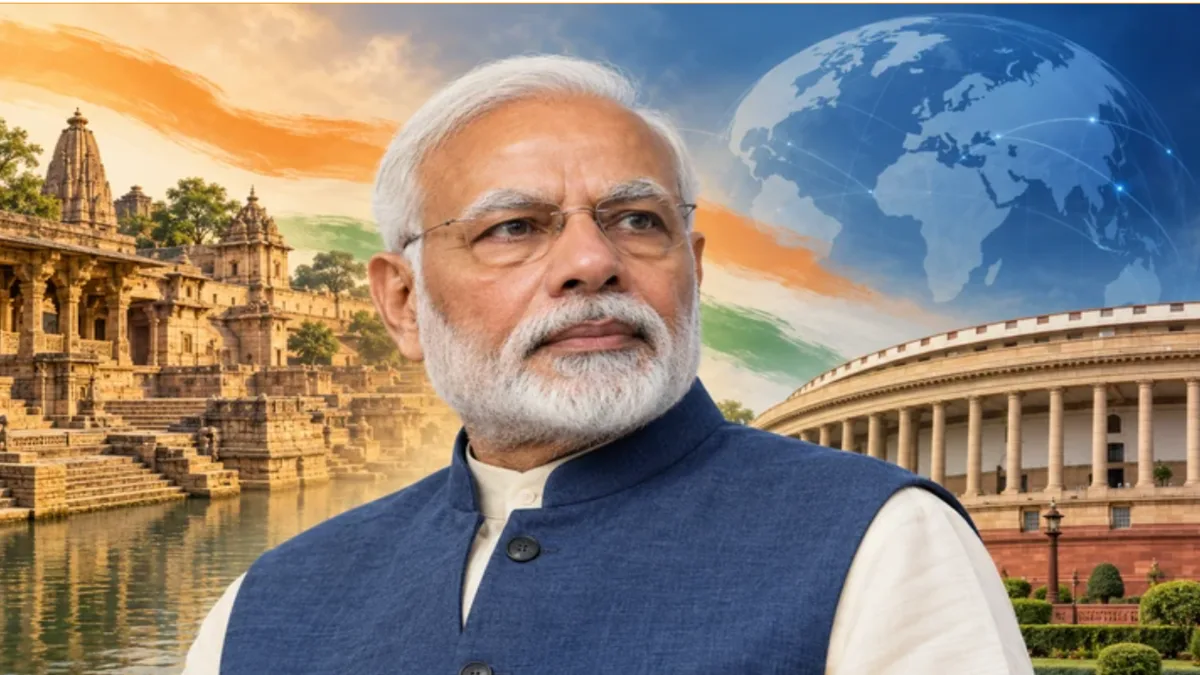
PM Narendra Modi
Under the leadership of Prime Minister Narendra Modi, a key message of India’s foreign policy has been that while there may be many friends and partners, India’s national interest is singular. This shift marks a journey that began in Vadnagar, Gujarat, and now extends to the global diplomatic corridors of New York, Paris, Moscow, Abu Dhabi, Tokyo, Tel Aviv, Johannesburg, and New Delhi.
If the current era of global politics were to be defined by a single word, that word would likely be ‘transition.’ It is a world where old power balances are crumbling and new equations are taking shape. The Russia-Ukraine war has challenged Europe’s security architecture; conflicts in West Asia have strained the lifelines of energy and maritime trade; strategic rivalry between the US and China has intensified; and global supply chains are constantly facing new risks. Simultaneously, developing nations are grappling with a host of challenges—ranging from food, energy, and debt to climate change and development.
In such times, rather than seeking the shadow of any single power bloc, India chose the path of strategic autonomy.
Since 2014, the most distinct shift in Indian foreign policy is evident not merely in the frequency of foreign visits, but in India’s growing global self-confidence.
India has expanded parallel relationships across the board—from the US to Russia, Japan to France, the Gulf nations to Africa, and the Indo-Pacific to Europe. This was not a policy of forging alliances against one nation in favor of another. The core principle was that India would engage with every power center based on its own circumstances, requirements, and national interests. This is why India today is simultaneously a strategic partner of the US, maintains historic ties with Russia, is expanding defense and high-technology cooperation with France, is active in the Quad alongside Japan and Australia, is strengthening energy and investment relations with West Asian nations, and is playing an active role in forums like BRICS and the SCO.
This multi-layered diplomacy is, in fact, a reflection of an India that no longer wishes to merely be part of a specific bloc within the global order but seeks to carve out its own space as a significant power center.
The 2023 G-20 presidency marked a pivotal milestone in this transformation. The message of the New Delhi G-20 summit—”One Earth, One Family, One Future”—served as a bridge between India’s civilizational ethos and contemporary global diplomacy.
On the G-20 platform, India went beyond discussing merely economic issues; it strove to amplify the voice of the Global South. The decision to induct the African Union as a permanent member of the G-20 was a significant outcome of this vision.
This decision was not merely symbolic. It accorded an institutional place in global economic decision-making to the collective voice of a continent whose population, resources, and development potential are crucial to the 21st-century global order.
India signaled that institutions of global governance cannot function indefinitely based on the power structures of the 20th century. As the world changes, decision-making institutions must also evolve.
In January 2023, India undertook a novel diplomatic initiative by hosting the ‘Voice of Global South Summit.’ The participation of 125 nations underscored the fact that the developing world possesses its own distinct set of problems, priorities, and a voice of its own. Issues such as food security, energy, debt, health, climate finance, technology, and development disproportionately affect the Global South.
Narendra Modi’s diplomacy highlighted the disparity wherein nations comprising a vast segment of the global population often lack commensurate participation in decision-making processes. The second ‘Voice of Global South Summit’ in 2023 further advanced this discourse. It represented an extension of India’s vision, wherein *Vasudhaiva Kutumbakam* (the world is one family) evolved from a mere cultural ideal into a political and ethical proposition for global governance.
In 2026, India assumed the BRICS presidency and hosted the 18th BRICS Summit in New Delhi in September. The theme—”Building for Resilience, Innovation, Cooperation, and Sustainability”—served not merely as a framework for economic collaboration but also addressed the collective potential of developing nations within a shifting global order.
BRICS has evolved into a platform far more expansive than the group originally envisioned two decades ago. Under India’s presidency, its three core pillars—political and security cooperation, economic and financial cooperation, and cultural and people-to-people ties—were aligned with a broader global agenda.
In New Delhi, India once again raised the issue of reforming multilateral institutions and ensuring more effective participation for the Global South. This was a continuation of the diplomatic philosophy evident in the ‘Voice of Global South’ initiative: that developing nations should not merely be rule-followers but active participants in rule-making.
The Russia-Ukraine war has been one of the toughest tests for India’s foreign policy.
On one hand, Russia is a long-standing strategic partner; on the other, India’s economic, technological, and strategic ties with the US and Europe have become increasingly significant.
India did not choose the easy path of siding with just one party during this crisis. Prime Minister Narendra Modi engaged with the leadership of both Russia and Ukraine, consistently maintaining that a resolution to the war is ultimately possible only through dialogue and diplomacy.
The Prime Minister’s visit to Ukraine in 2024 was also significant in this context. India’s message was clear: while India has its own interests, it is not oblivious to the humanitarian consequences of the war. Another facet of this approach was ensuring the safety of its citizens.
When thousands of Indian citizens—particularly students—were stranded in the conflict zone amidst the Ukraine war, the true test of India’s foreign policy lay not merely in diplomatic statements, but in action taken on the ground.
Thousands of Indian citizens were safely evacuated through ‘Operation Ganga’. This mission conveyed a powerful message: an Indian passport is no longer just a travel document, but a symbol of the State’s commitment to its citizens during times of crisis.
The true essence of foreign policy is revealed when the State mobilizes its full might to bring an Indian citizen home safely from a war-torn region.
West Asia is perhaps the most complex region for India’s foreign policy.
India shares defense, security, and technological ties with Israel, while maintaining historic civilizational and strategic relations with Iran. The Gulf nations are vital for India’s energy security, trade, investment, and the Indian diaspora. Consequently, India’s policy cannot simply follow a straight line of supporting just one side. Prime Minister Modi’s visit to Israel in February 2026 and the effort to elevate India-Israel relations to the level of a “Special Strategic Partnership for Peace, Innovation, and Prosperity” are part of this broader strategy; yet, at the same time, India maintains a dialogue with Iran and continuously strengthens its ties with the Arab world. This is not a contradiction, but rather the reality of modern diplomacy.
Severe tension arose in India-Pakistan relations following the Pahalgam terror attack in April 2025. In May 2025, India targeted terrorist infrastructure through ‘Operation Sindoor’. The significance of these events extended beyond mere military action; a comprehensive diplomatic campaign was also launched alongside it. India presented its stance to nations across the globe, framing terrorism not merely as a component of a bilateral dispute but as a distinct global security challenge.
This shift in India’s stated policy is significant—reflecting a stance of zero tolerance towards terrorism and the capability to strike at the very sources of terror. This message was directed not only at its neighbor but at the global community at large.
Power in the 21st century will not be determined solely on land. Maritime routes, supply chains, energy, critical minerals, digital networks, and maritime security will shape the global politics of the coming decades. Consequently, the Indo-Pacific has emerged as a crucial region in India’s foreign policy.
The Quad—comprising India, the US, Japan, and Australia—is not viewed merely as a military alliance. India envisions a free, open, inclusive, and rules-based Indo-Pacific. India’s concept of ‘SAGAR’ (Security and Growth for All in the Region) embodies this very vision. Here too, India does not appear as a follower of any power bloc, but rather as a partner striving for stability and cooperation within the maritime domain.
India’s global role extends beyond the realms of war and security. Initiatives such as the International Solar Alliance, the Coalition for Disaster Resilient Infrastructure, Mission LiFE, and the Global Biofuels Alliance have integrated India’s diplomacy with climate action, energy, and sustainable development. This shift is significant. In the 21st century, global leadership will not be secured through military might alone; the country that offers solutions to the world’s shared challenges will play an equally pivotal role. India’s message is that development and the environment need not be at odds; rather, they can be made mutually complementary.
A distinctive aspect of Narendra Modi’s foreign policy is civilizational diplomacy. Efforts to establish Yoga on the global stage, and the integration of concepts like Ayurveda, Indian philosophy, and ‘Vasudhaiva Kutumbakam’ (the world is one family) into international discourse, are not merely cultural activities.
For the first time, India is presenting its ancient civilization in the context of modern global challenges—such as health, mental well-being, the environment, human-centric development, and peace. During the G-20 presidency, the message of ‘Vasudhaiva Kutumbakam’ became a symbol of this civilizational self-confidence.
The state honours conferred upon Narendra Modi by various nations also reflect this diplomatic dynamism.
While it would be reductive to view the highest or major state honours bestowed by countries across various continents merely as proof of personal popularity, it is equally true that such honours serve as significant indicators of the depth of bilateral ties and the continuity of political engagement. Honours received from nations including Oman, Norway, and Sweden—spanning 2025 and 2026—demonstrate the sustained nature of this international outreach.
Narendra Modi’s foreign policy should not be evaluated solely based on the number of countries visited or foreign honours received. The real question goes deeper: has India redefined its role within the global order? The African Union’s permanent membership in the G20, the effort to give a voice to the Global South, active engagement in BRICS, a role in the Indo-Pacific, advocacy for dialogue during the Russia-Ukraine crisis, balanced relations in West Asia, a tough stance against terrorism, the safety of Indian citizens abroad, climate diplomacy, and the global projection of civilizational values—viewing these merely as isolated events fails to reveal the full picture. When seen together, they unveil a new India.
An India that can forge a friendship with the US while maintaining ties with Russia; that can build a strategic partnership with Israel while engaging in dialogue with Iran; that can expand energy ties with Gulf nations while championing Africa’s voice on the global stage; and that can welcome Western technology while taking equal pride in its own civilizational identity. This is not a contradiction; it is strategic autonomy.
No Prime Minister is ultimately judged during their tenure. History looks beyond immediate popularity to long-term outcomes. It asks how much a leader strengthened institutions, how the nation’s strategic standing evolved, and what legacy was left for future generations. While time will determine the final historical assessment of Prime Minister Narendra Modi’s foreign policy, one shift is palpable today: India is no longer merely a spectator in global politics. It refuses to remain a nation that watches events unfold from the sidelines. Instead, it seeks to be an active participant in the global discourse, bringing to the table its own voice, interests, civilizational vision, and economic-strategic capabilities.
The story of the boy from Vadnagar—who made India his karmabhumi (land of action) and service to the nation his life’s mission—as he presents India’s perspective on the global stage today, is not merely the story of Narendra Modi.
It is the story of an India that has rediscovered its self-confidence. An India that refuses to stand merely on the periphery of any power bloc. An India that seeks friendship but not dependency; that desires dialogue but not at the cost of its security; that yearns for peace but refuses to bow before terrorism; and that seeks not only to articulate India’s thoughts to the world but also to demonstrate the direction in which a changing world can move.
Perhaps this is the most significant journey—from Vadnagar to the global stage—and in the years to come, history will view this journey not merely as Narendra Modi’s personal political odyssey, but as the story of the resurgence of India’s self-confidence in the 21st century.
