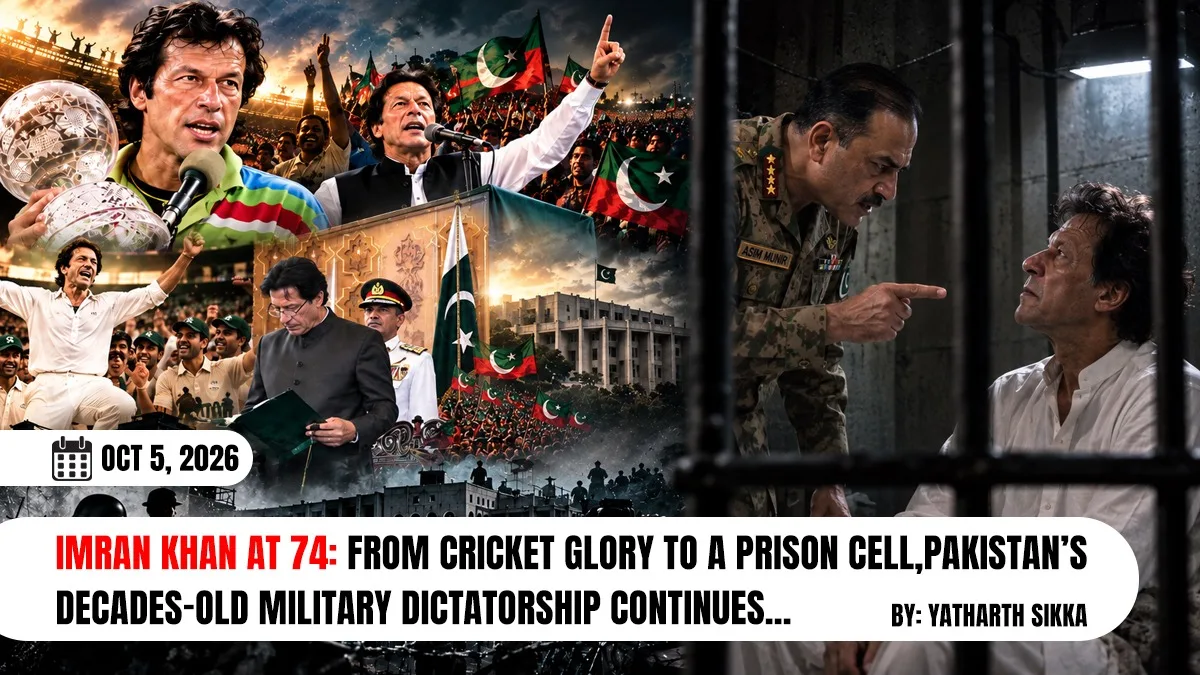
For Imran Khan, his 74th birthday is hardly a conventional birthday celebration. The former Pakistan Prime Minister, cricket legend and founder of Pakistan Tehreek-e-Insaf (PTI) remains behind bars, while his party continues to struggle. His political journey has included electoral success, controversies and multiple criminal cases. But Khan is not the central story here. He is merely another chapter in Pakistan’s much older struggle between civilian politics and the military establishment.
For decades, Pakistan has failed to establish a political system in which elected representatives can exercise constitutional authority without the shadow of the Army. Governments have changed, Prime Ministers have come and gone, but the military establishment has remained the most powerful constant in Pakistan’s political life.
There is a famous saying about Pakistan: every country has an army, but Pakistan’s army has a country. The phrase may sound like a joke, but Pakistan’s history explains why this joke has survived. Since 1947, the military has repeatedly moved beyond defending the country and entered the political arena.
Pakistan has witnessed coups, martial law, military governments and periods when civilian governments operated under military influence.
Pakistan’s first military takeover came in 1958. President Iskander Mirza abrogated the Constitution, dissolved the National and Provincial Assemblies and imposed martial law on October 7. He appointed General Muhammad Ayub Khan, then Army Commander-in-Chief, as Chief Martial Law Administrator. Within weeks, Ayub Khan removed Mirza and became President himself. Pakistan’s own National Assembly records this sequence.
The pattern returned in 1969, when General Yahya Khan took power from Ayub Khan. In 1977, Army Chief General Zia-ul-Haq overthrew Prime Minister Zulfikar Ali Bhutto and imposed martial law. In 1999, General Pervez Musharraf overthrew Prime Minister Nawaz Sharif and took control of the government. Pakistan consequently spent more than three decades under direct military rule.
This is the real context in which Imran Khan must be understood.
Khan rose from cricket to politics, founded PTI in 1996 and spent years outside the political mainstream. His party emerged as a major force in the 2018 general election, after which he became Prime Minister. His supporters presented him as a new alternative to Pakistan’s traditional Bhutto and Sharif political families.
But Khan’s own political career also demonstrated the limitations of his democratic narrative. His relationship with the military establishment, initially regarded as friendly, eventually deteriorated. In April 2022, he lost a vote of no confidence and was removed as Prime Minister. Khan accused the military establishment of conspiring against him.
The confrontation intensified after his removal. His arrest in May 2023 triggered violent protests, including attacks on military installations and government buildings. Thousands were arrested in the subsequent crackdown. The UK Government’s 2026 assessment says military influence significantly shapes electoral competition and governance and notes that the ability of political parties to operate has historically been affected by their relationship with the military establishment.
Khan also faces numerous criminal cases, including the Toshakhana cases concerning state gifts received by public officials. He has been convicted in corruption-related proceedings. His supporters call the cases politically motivated.
Nawaz Sharif’s chapter also shows how quickly an elected government can come into conflict with the military. In 1999, Sharif attempted to remove General Pervez Musharraf as Army Chief and replace him with General Ziauddin Butt. The military responded by seizing control of key state institutions on October 12, overthrowing Sharif’s government. Musharraf subsequently declared himself Chief Executive and placed the Constitution in abeyance. Notably, Musharraf was returning to Pakistan from Sri Lanka when the crisis erupted. Sharif’s government attempted to prevent Musharraf’s aircraft from landing in Karachi. Army units then moved against the civilian government.
Zulfikar Ali Bhutto faced an even more dramatic fate. General Zia-ul-Haq overthrew his government in 1977. Bhutto was subsequently convicted in a murder case and executed in 1979 while Zia remained in power.
Zia’s relationship with his own Prime Minister, Muhammad Khan Junejo, further demonstrated the limits of civilian authority. Junejo was nominated Prime Minister by Zia after the 1985 elections. In 1988, Zia dissolved the National Assembly under Article 58(2)(b), ending Junejo’s government.
Benazir Bhutto’s two governments were also dismissed through in 1990 and 1996. Nawaz Sharif’s first government was dismissed in 1993. His second government was overthrown by Musharraf in 1999. These dismissals demonstrate the instability of Pakistan’s civilian political order and the enormous influence of the military in politics.
That cycle continues. In the 2024 general elections, Imran Khan was imprisoned and PTI was prevented from contesting under its traditional electoral symbol. PTI-backed candidates consequently contested as independents and won the largest number of directly elected National Assembly seats, while PML-N and PPP later formed the government. The UK Government’s assessment notes that observers widely questioned the fairness of the electoral environment and that PTI faced significant restrictions.
The relationship between Prime Minister Shehbaz Sharif’s government and the military establishment also illustrates how civilian politics in Pakistan operates within the limits set by the Army.
Notably, following India’s Operation Sindoor against Pakistan in response to the brutal Pahalgam terror attack, the Pakistan Army suffered a major military setback and international embarrassment. India struck deep inside Pakistan, and Pakistan was pushed to seek an end to the fighting, including reaching out to the United States for intervention. Yet, in a familiar attempt to project victory and reassure its own public, Pakistan elevated General Asim Munir. The Pakistani Cabinet, chaired by Prime Minister Shehbaz Sharif, approved Munir’s promotion from General to Field Marshal.
The relationship became even more significant later that year. In December 2025, Prime Minister Shehbaz Sharif approved the appointment of Field Marshal Asim Munir as Chief of Army Staff concurrently with the newly created position of Chief of Defence Forces for a five-year term. President Asif Ali Zardari, husband of Benazir Bhutto subsequently approved the appointment.
Critics argued that these changes strengthened military power at the expense of civilian and judicial institutions, while the government defended them as necessary for governance.
This is important because it shows that the issue is not simply about Imran Khan. Pakistan’s political parties may fight one another, but they can’t survive without the support of military.
And then there is Muhammad Ali Jinnah, the founder of Pakistan. Jinnah died on September 11, 1948, barely a year after Pakistan came into existence. He had been seriously ill for months. His physician, Lieutenant-Colonel Dr Ilahi Bakhsh, recorded his final days, while Fatima Jinnah later described the events in My Brother.
After Jinnah was flown to Karachi on September 11, he was placed in an ambulance at Mauripur Aerodrome to be taken to Government House. The ambulance broke down after travelling a few miles.
Another ambulance eventually arrived, and he was taken to Government House. He died later that night.
This episode remains a striking example of administrative failure. The founder and Qaid-e-Azam of a newly created country, already critically ill, was left waiting on the roadside because an adequate replacement ambulance was not immediately available. Even Dawn, while recounting the episode, describes the breakdown as a bizarre and haunting episode in Pakistan’s early history.
There have also been allegations and theories surrounding Jinnah’s final days, including claims that military establishment was unhappy with some of his decisions.
Fatima Jinnah later became an important critic of military rule. She contested the 1965 presidential election against Ayub Khan. Her campaign was accompanied by a bitter political contest, including allegations of a smear campaign portraying her as an “Indian agent”. Her later public life and the delayed publication of My Brother also became subjects of controversy.
One point is notable here, Imran Khan and Jinnah are two of the most prominent figures in Pakistan’s political history, both of whom enjoyed enormous public popularity at different points in the country’s history. Yet, these experience shows that popularity alone does not guarantee political power when the military establishment remains the strongest institution in the state.
Pakistan’s democratic claims become even more complicated when one looks beyond Islamabad.
For decades, people living in Pakistan-occupied Jammu and Kashmir (PoJK) have continued to raise questions about political representation, economic conditions, governance and civil rights.
The protests in PoJK in 2026 brought these grievances into the spotlight. The same concerns extend to religious minorities, including Hindus and Christians, who have faced serious challenges in Pakistan.
There have been repeated reports of discrimination and violence against religious minorities. Reports have highlighted the vulnerability of Hindus and Christians to forced conversion, abduction, blasphemy accusations and mob violence.
Imran Khan is neither a political saint nor the sole cause of Pakistan’s crisis. His government had its own controversies. His politics has often been deeply polarising. The larger question is why Pakistan repeatedly reaches a point where political parties, elected governments and military enter confrontations over who ultimately controls the state.
The UK’s 2026 assessment notes that Pakistan’s military establishment continues to exercise substantial influence over policy and governance.
The military’s role in Pakistan has therefore gone far beyond conventional defence. It has repeatedly been involved in coups, changes of government, political negotiations, electoral politics and the wider direction of the state. Pakistan’s history also shows that military rule has not solved the country’s political, economic or security problems permanently.
The central problem is the imbalance between civilian institutions and the military establishment. When an Army becomes powerful enough to shape governments, political parties and constitutional arrangements, democratic institutions struggle to develop independently.
That is why the Pakistan story cannot end with Imran Khan. It began before him and will continue after him.
