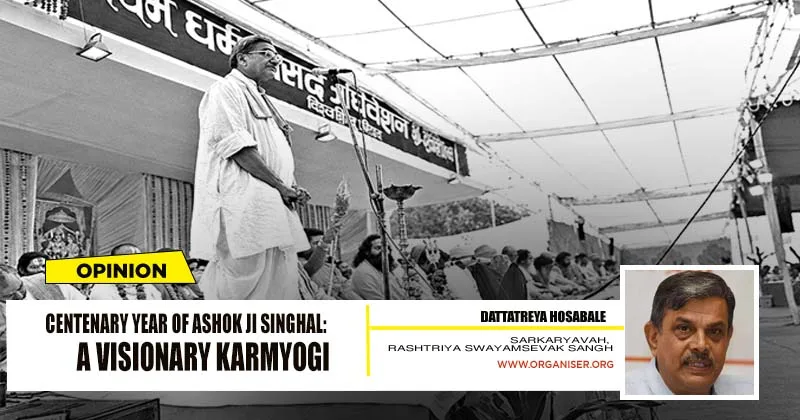
Ashok Ji addressing the first Dharma Sansad organised by VHP in New Delhi, on April 1984. The Dharma Sansad resolved to reclaim Ayodhya as the first priority and launch a nationwide mass awakening campaign to unlock the gates of Shri Ram Janmabhoomi
For Bharat, this is a moment of national reconstruction. The entire country is resolving to build a new Bharat with renewed self-confidence. Bharat is moving from a sense of self-denial towards self-pride, and its self-awareness is awakening. This transformation can be described as the resurgence of Bharat.
Among the great men whose tireless efforts awakened Bharat’s self-awareness and instilled confidence in Hindu society, the name of respected Ashok Ji stands in the foremost ranks. Society has addressed him with many titles as an expression of its reverence for him. Some called him the Hindu Hriday Samrat, others the pioneer of the Ram Janmabhoomi movement, the hero of Hindu resurgence, or the commander of the national awakening campaign.
Yet, if Ashok Ji’s personality were to be described in a single word, that word would be Karmayogi. He performed his duties with a spirit of selflessness. Whenever he achieved success in an endeavour, he did not take credit for it but dedicated it to Bhagwan, remaining detached from the fame that came with success. Even after reaching the pinnacle of recognition, he never sought fame. Whenever he was praised in his presence, he would feel uncomfortable. To rise above honour and dishonour, fame and infamy, and continue walking the path of duty with equanimity is the mark of a Karmayogi and a true Swayamsevak. This quality was clearly visible in Ashok Ji’s life.
Dedicated to National Service
Ashok Ji was exceptionally talented and a sharp-minded student. Yet, his intellect was not devoted to personal advancement; he dedicated it to the upliftment of the nation.
He was born into a distinguished and accomplished family. One of his brothers served in the Indian Police Service and rose to become the Director General of Police of Uttar Pradesh, while his other brothers became successful businessmen and industrialists. Ashok Ji himself studied Engineering in Metallurgy at Banaras Hindu University. He had many opportunities to pursue a successful personal career, but he chose instead to dedicate his entire life to the nation.
He was essentially an intensely realised sadhaka. Like Swami Vivekananda, he too sought nothing for himself and dedicated his life to society and the nation. His spiritual pursuit was centred not on himself, but on society and the nation.
Shaped by Sangh Sanskars
Ashok Ji came into contact with the Rashtriya Swayamsevak Sangh while still a student. In the early years of his life, he had the privilege of receiving the guidance of respected Prof. Rajendra Singh fondly known as ‘Rajju Bhaiya’. Respected Bhaurao Deoras shaped his personality like a skilled craftsman. He also continued to receive the guidance of Pujya Guruji.
The influence of these great men was clearly reflected in his dedication, diligence, determination, management skills, organisational ability and foresight. Immediately after completing his Engineering education, he became a Sangh Pracharak. Whatever responsibility he was given, he discharged it with complete dedication and hard work. It seemed as though he had been made for that very responsibility.
When Ashok Ji was the Prant Pracharak of the Delhi Prant, which included Delhi and Haryana, incidents of Islamic conversion in Meenakshipuram had caused concern throughout society. The need for widespread awakening among Hindu society was being keenly felt.
Ashok Ji was entrusted with organising the Virat Hindu Sammelan in Delhi. Bringing together different sections of society, including Dr Karan Singh, he successfully turned the plan for the Sammelan into reality. Under the guidance of revered sants, he brought together various sections of society and organised such a massive programme with great organisational skill. Through this, his ability to organise and mobilise society became evident to all.
The Sammelan helped awaken a sense of responsibility in society towards the challenge of conversion. Thereafter, Ashok Ji was given the responsibility of the Vishwa Hindu Parishad for wider awakening in the dharmik and social spheres.
He took up this responsibility with the same dedication and diligence. Understanding the circumstances of society, reflecting on them, formulating plans accordingly and taking those plans to the ground became the distinctive features of his working style.
Harmonious Hindu Society
Untouchability has been a serious social challenge before Hindu society for centuries. Without ending untouchability, the vision of a harmonious society cannot be complete.
Ashok Ji did not restrict his efforts on this issue to community meals or symbolic programmes. He urged revered sants to convey to Hindu society that untouchability was not in accordance with the fundamental ideals of Hindu Dharma. Sants began visiting the settlements of Scheduled communities, while study and discussion on the issue were also taken forward.
The role of Shri Kameshwar Chaupal, who belonged to a Scheduled community, in the foundation-stone laying ceremony of the Ram Janmabhoomi Mandir in Ayodhya on November 9, 1989, was part of this broader message of social harmony. Several revered sants and Dharmacharyas were present on the occasion. Similarly, revered sants having a meal at the home of the Dom Raja in Varanasi became another important example of the message of social harmony.
These efforts strengthened the belief in society that social discrimination could be ended and a harmonious Hindu society could be built.
Ram Janmabhoomi Movement
The Ram Janmabhoomi movement was one of the most widespread socio-religious movements of modern Bharat. From the 1980s through the Supreme Court’s judgement in 2019 and the subsequent construction of the Ram Mandir, the movement passed through several important stages.
Programmes such as the Ram-Janki Rath Yatra, Shila Pujan, Charan-Paduka Pujan and Ramjyoti generated widespread public awakening across different parts of the country.
Ashok Ji played an extremely important role throughout the movement. The circumstances during the 1990 Kar Seva and the sacrifice of many Karyakartas brought the movement to a decisive stage. Even in difficult circumstances, Ashok Ji’s firm faith remained a source of inspiration for the Karyakartas.
He firmly believed: “This is the work of Ram Ji. Ram Ji Himself will certainly complete this work.”
The Mandir was not completed during his lifetime, but the movement to which he had provided direction, organisation and energy for decades reached its culmination after his demise. Following the Supreme Court’s judgement on November 9, 2019, the way was cleared for the construction of the Mandir at Shri Ram Janmabhoomi. Bhoomi Pujan was performed on August 5, 2020, followed by the Pran Pratishtha of Shri Ram Lalla on January 22, 2024. Today, a grand Mandir stands there.
Not Limited to Ram Janmabhoomi
Ashok Ji came to be identified as one of the principal leaders of the Ram Janmabhoomi movement, but his sphere of work extended far beyond it.
His initiatives and guidance were notable in several areas, including the protection of Ram Setu, the Amarnath Yatra, cow research and the conservation of cattle, social harmony, connecting the intellectual class with Hindu thought, and creating awareness on various social and national issues.
Ashok Ji was essentially an intensely realised sadhaka. Like Swami Vivekananda, he too sought nothing for himself and dedicated his life to society and the nation. His spiritual pursuit was centred not on himself, but on society and the nation
He was a scientist in metallurgy, but he also had a deep understanding of the nature, capabilities and challenges of society. His working style reflected a remarkable combination of scientific outlook, organisational ability, adhyatmik and national conscience.
The greatest characteristic of Ashok Ji’s personality was that he never stopped after achieving a goal. As soon as one goal was achieved, he moved towards the next. He accepted every challenge before society and devoted himself to organising society for its resolution.
For him, organisation was the means, society was the end, and service to the nation was the purpose of life.
He gave up the possibilities of a personal life and chose national service. He attained fame, but remained detached from it. He provided leadership, but never sought credit for himself. He struggled, but never for personal gain.
That is why the life of Ashok Ji is not merely the story of an individual. It is an inspiring chapter of dedication, inner pursuit, organisation and Karmayoga.
Among the great men whose penance, sacrifice and endeavour have contributed to the present resurgence of Bharat, Ashok Ji occupies a prominent place. He dedicated his entire life to awakening self-confidence in Hindu society, advancing social harmony and strengthening national consciousness.
Therefore, to see him only as the great leader of the Ram Janmabhoomi movement
would be to limit the breadth of his personality.
He was, in fact, a Karmayogi — one whose life will continue to inspire generations to come. n


