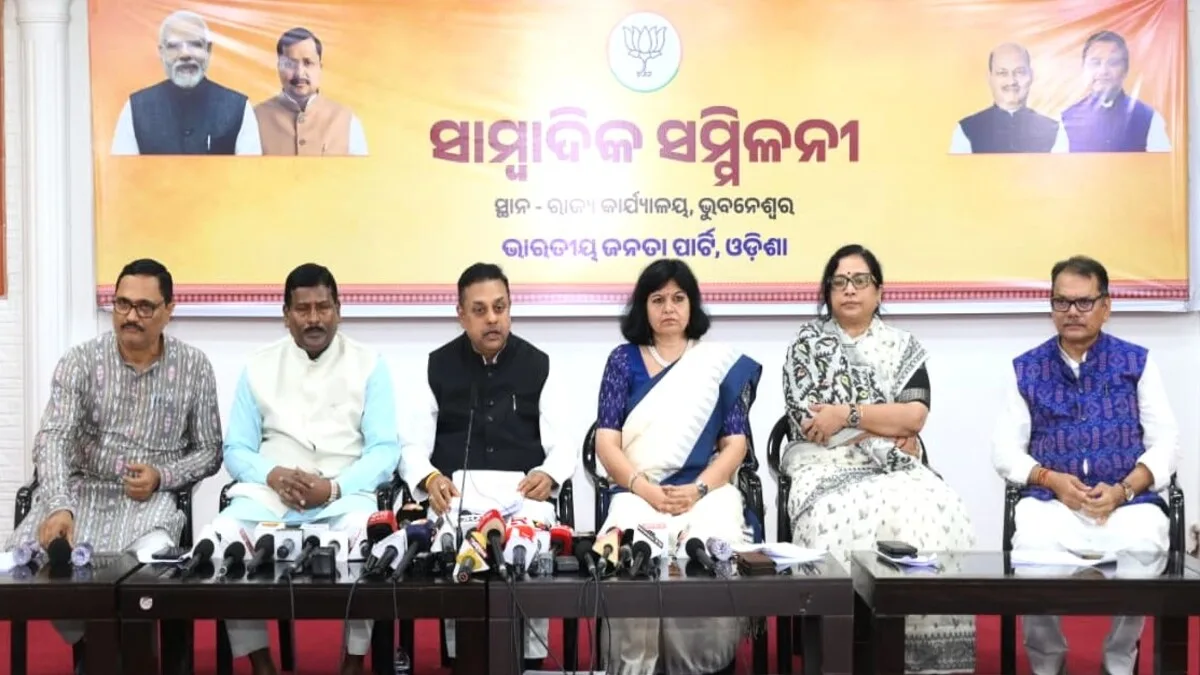
BHUBANESWAR: Senior BJP leader and Puri MP Dr Sambit Patra defended the recently amended Mines and Minerals (Development and Regulation) framework, saying the legislation aims to protect Odisha’s interests and ensure that the state and people in mineral-rich regions receive greater benefits from natural resource exploitation.
Addressing a press conference in Bhubaneswar, Patra rejected allegations by Opposition parties that the amended MMDR framework would weaken the federal structure or reduce the revenue-raising powers of states. He argued that mining-sector reforms introduced since 2015 had brought greater transparency to mineral allocation and significantly increased Odisha’s revenue from the mining sector.
Patra also launched a sharp attack on the previous BJD government over the long-pending ORISED act litigation, questioning why necessary legislative changes were not made during the prolonged period when the matter remained before the courts.
Bhubaneswar MP Aparajita Sarangi, who was also present at the press conference, backed Patra’s arguments and criticised the BJD’s opposition to the amended MMDR framework.
‘2015 Reforms Transformed Mining Sector’
Patra traced the evolution of India’s mining regulatory framework to the Mines and Minerals (Development and Regulation) Act of 1957, saying major reforms were introduced in 2015 following the change of government at the Centre.
According to him, the mining sector before 2015 was associated with allegations of non-transparent allocation, favouritism and corruption. He said the introduction of the e-auction system marked a major shift towards transparency and competitive allocation of mineral resources.
Patra said that Odisha’s annual revenue from mining, which he said was around Rs 3,300 crore to Rs 5,000 crore before 2014-15, had subsequently risen to between Rs 55,000 crore and Rs 60,000 crore.
He also highlighted the creation of the District Mineral Foundation (DMF) mechanism, under which funds are collected for the benefit of people and areas affected by mining. Patra claimed that Odisha had received around Rs 37,000 crore through DMF funds.
He further said changes in auction premiums and royalty rates had strengthened the revenue potential of mineral-producing states.
Patra argued that the Opposition’s contention that the revised MMDR framework would undermine the federal structure or curtail states’ taxation powers was “baseless and false”.
Questions BJD government’s handling of Orissa Cess law
Patra also raised questions over the handling of the Orissa Rural Employment and Social Development (ORISED) cess law by the previous BJD government. He said the Odisha government had introduced the law in 2004 with provisions for imposing additional cess on minerals, including 20 per cent on bauxite and 15 per cent on iron ore, with the stated objective of benefiting people in mining-affected areas, tribals and the poor.
He said NALCO had challenged the law in court and the Odisha High Court had stayed its operation in December 2005. The state government subsequently approached the Supreme Court in 2006 through a Special Leave Petition, which later became a civil suit.
Patra said the matter remained pending for 18 years, from 2006 to 2024, and questioned why the then BJD government did not make necessary legal amendments during this period despite opportunities to do so.
Referring to the Supreme Court’s July 25, 2024 judgment in the Mineral Area Development Authority v. Steel Authority of India case, Patra said the nine-judge Constitution Bench had held that states could impose taxes on mineral rights, subject to the constitutional and statutory framework.
He rejected claims by Opposition parties that Odisha had lost Rs 1 lakh crore in revenue, arguing that the absence of an appropriate legal framework had prevented recovery of the claimed dues. He said the state had the right to recover legitimate past dues, but questioned the legal basis for such recovery while the relevant legislation remained under litigation and had not been suitably amended.
Patra targets previous government over mining districts
Patra referred to the Justice M.B. Shah Commission’s findings on alleged large-scale irregularities in Odisha’s mining sector and said substantial penalties had been imposed on mining companies. He also cited a 2017 Supreme Court judgment concerning mining activities and environmental degradation in mineral-rich districts such as Keonjhar, Sundargarh and Mayurbhanj.
He claimed that despite substantial funds being available through the DMF for Keonjhar, the district had not witnessed corresponding development. Referring to the phrase “rich land, poor people”, he attributed the situation to the previous BJD government.
Patra also cited CAG findings relating to the utilisation of DMF funds in Keonjhar. He alleged that of more than Rs 983 crore, around Rs 976 crore had been spent in non-mining-affected villages, while 584 mining-affected villages were allegedly deprived of funds. He further claimed that 1,730 projects had been implemented without approval from gram sabhas, citing the CAG report.
He alleged that large amounts collected as taxes and other revenues from minerals were misappropriated during the previous BJD government.
Uniform mining policy necessary, says Patra
Patra said mineral resources were not merely an economic asset but were also linked to national security. He argued that uniformity in mining policy and taxation across the country was necessary to ensure the competitiveness of Indian industries.
He said higher domestic mineral prices could encourage industries to import raw materials from countries such as China and elsewhere, which, according to him, could adversely affect the Indian economy. He added that higher prices of coal, iron ore and bauxite could also increase the cost of steel, cement and electricity, ultimately affecting consumers.
Patra also highlighted increased allocations to Odisha, citing railway funding, state GST collections and the higher share of states in the divisible pool of central taxes following the 14th Finance Commission recommendations. He said the Union government under Prime Minister Narendra Modi was working for the welfare of Odisha’s poor, tribal and disadvantaged sections under the principle of “Sabka Saath, Sabka Vikas”.
BJP MPs defend revised MMDR law
Bhubaneswar MP Aparajita Sarangi, who was also present at the press conference, alleged that Odisha and its people had suffered losses of around Rs 1,03,220 crore due to what she described as mismanagement during the previous 25 years of BJD rule.
Sarangi referred to the Shah Commission report and various CAG audit reports while making the allegation. She also alleged that the previous state government had failed to effectively defend its position in the ORISED case, resulting in the law being struck down by the High Court.
Reacting to the BJD’s protests following Parliament’s passage of the revised MMDR law, Sarangi said the party’s opposition was unwarranted. She said the 20 BJP MPs from Odisha had studied and understood the objectives and provisions of the amended legislation before supporting it in Parliament.
She urged leaders of the Opposition BJD and Congress to study the revised MMDR law and understand its provisions. Sarangi said the BJP-led governments at the Centre and in Odisha were working with the interests of the state’s people and residents of mineral-bearing areas as a priority.
MPs Bibhuprosad Tarai, Anita Subhadarshini and Dr Rabinarayan Behera, along with state BJP general secretary Biranchi Narayan Tripathy, were also present at the press conference.