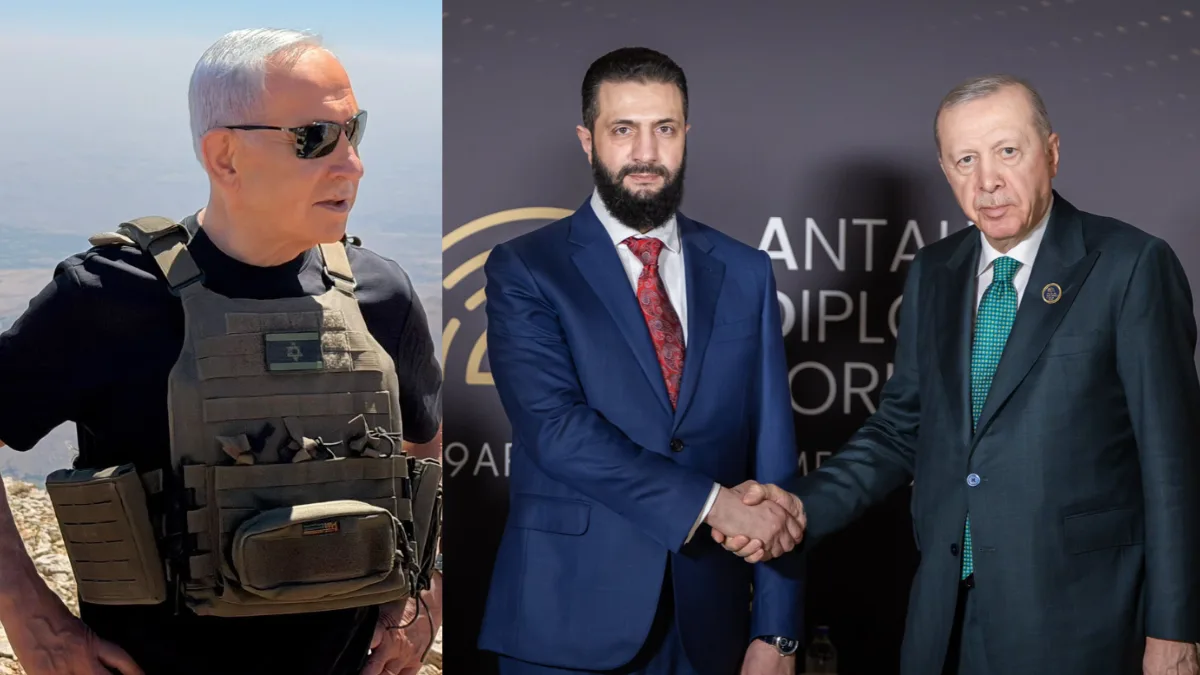
The relationship between Israel and Turkey has entered one of its most dangerous phases in decades. What began principally as a dispute over the Gaza war has increasingly developed into a broader contest for influence, especially in post-Assad Syria. In recent weeks, Israel has even carried out strikes on Syrian military infrastructure because of concerns about Turkey’s expanding military presence there.
This does not yet amount to an Israel–Turkey war. But the two countries are increasingly behaving as regional strategic competitors.
There was a time when Israel and Turkey had unusually close relations. Turkey was the first Muslim-majority country to recognise Israel, and the two developed substantial military, intelligence and economic cooperation.
The relationship deteriorated sharply under President Recep Tayyip Erdoğan, particularly after Israel’s Gaza operations and the 2010 Mavi Marmara incident. Diplomatic relations were eventually restored in 2022, but the Gaza war following Hamas’s October 7, 2023 attack destroyed much of that rapprochement.
Turkey became one of Israel’s most outspoken critics. Erdoğan has strongly supported the Palestinian cause and maintained political relations with Hamas, while Israel increasingly regards Ankara’s regional ambitions with suspicion.
Turkey suspended trade with Israel in 2024, saying the restrictions would remain until Israel allowed so called humanitarian assistance into Gaza.
For Erdoğan, Gaza is both a foreign-policy issue and an important domestic political issue.
Turkey has portrayed Israel’s military campaign as unacceptable and has supported international legal action against Israeli leaders. Israel, in turn, accuses Erdoğan of effectively taking Hamas’s side.
The personal relationship between Erdoğan and Prime Minister Benjamin Netanyahu has become exceptionally hostile. Recent exchanges have included accusations of genocide from Ankara and accusations of antisemitism and support for Hamas from Israel.
But Gaza alone does not explain the current strategic danger. In Syria a new battlefield has been opened. The fall of Bashar al-Assad in December 2024 transformed the regional balance.
Turkey became one of the principal external powers supporting Syria’s new government under President Ahmed al-Sharaa. Ankara has substantial military influence in northern Syria and has been helping the new Syrian authorities consolidate the country.
Israel, meanwhile, has established its own security objectives in southern Syria. It wants to prevent hostile forces from approaching its northern border and has been particularly concerned about developments in the area around the Golan Heights.
Consequently, Turkey and Israel now have overlapping military interests inside Syria.
This is fundamentally different from their earlier disagreements over Gaza.
Israel’s concern is not simply that Turkey supports the new Syrian government.
Turkey is a major military power with:
● a large conventional army;
● advanced drones;
● sophisticated air-defence systems;
● NATO-standard military infrastructure;
● extensive experience operating in Syria;
● growing political influence over Damascus.
Israeli analysts increasingly worry that a permanent Turkish military infrastructure in Syria could eventually constrain Israel’s freedom of action.
This concern became particularly acute in August 2026.
Israel struck the Abu al-Duhur airbase in northern Syria, near the Turkish border. Israel reportedly told Washington that the objective was to prevent a Turkish military buildup at the facility.
That is a significant development because Israel was no longer simply attacking Iranian or jihadist targets in Syria. Israel does not necessarily want a direct confrontation with Turkey. Turkey is vastly larger geographically and demographically than Israel and possesses a powerful conventional military. It is also a NATO member and has an important relationship with Washington.
Therefore, Israel’s preferred strategy is likely to be: prevent Turkish military entrenchment in Syria rather than fight Turkey directly. This explains why Israeli strikes have concentrated on preventing particular military developments rather than attacking Turkey itself.
Israeli officials and security analysts are increasingly discussing Turkey in strategic terms previously reserved for Iran. Some Israeli analysts have even described Turkey as potentially becoming the next major regional challenge after Iran.
There is another strategic problem: the eastern Mediterranean.
Israel has developed increasingly close security relationships with Greece and Cyprus, while Turkey has longstanding disputes with Greece over maritime boundaries, Cyprus and energy resources.
Turkey is therefore increasingly concerned about an emerging strategic alignment involving:
Israel – Greece – Cyprus
While Israel is concerned about Turkey’s growing influence across Syria and the eastern Mediterranean.
Recent reports indicate that Ankara is preparing for scenarios ranging from a serious crisis to possible military confrontation as Israel’s defence cooperation with Greece expands.
This means that the Israel–Turkey dispute is no longer simply an Arab-Israeli question.
It is becoming part of the larger eastern Mediterranean balance of power.
A direct Israel–Turkey war remains unlikely in the immediate future, because the costs would be enormous for both sides.
There are several reasons for restraint:
1. Turkey is a NATO member.
2. Israel has a very close strategic relationship with the United States.
3. Neither country has a territorial dispute requiring direct occupation.
4. Both have much more important security concerns elsewhere.
5. A direct conflict could destabilise Syria and the entire eastern Mediterranean.
However, the danger of indirect confrontation is considerably higher.
The most likely scenario is therefore not Israeli aircraft bombing Turkish cities or Turkish forces attacking Israel.
It is more likely to involve:
Syria → Turkish military deployment → Israeli airstrikes → Turkish response → diplomatic escalation.
That is the dangerous escalation ladder.
Turkey’s NATO membership makes the situation particularly complicated.
NATO’s Article 5 does not automatically mean NATO would fight Israel if Turkey and Israel came into conflict.
Article 5 applies when a NATO member suffers an armed attack in circumstances covered by the treaty. A Turkish-Israeli confrontation would therefore create an extraordinary political problem for NATO and the United States.
Washington would almost certainly try to prevent such a confrontation from escalating. The fact that the United States has already been involved diplomatically in the Syrian issue demonstrates how important American mediation could become.
There is also an unusually strong personal dimension. Erdoğan has made the Palestinian issue a central component of his regional identity, while Netanyahu has increasingly portrayed Turkey as an emerging threat to Israel.
Recent exchanges between the two leaders have become extremely personal and inflammatory.
This matters because personal hostility can make compromise considerably more difficult.
Nevertheless, the deeper problem is structural rather than personal.
Even if Erdoğan and Netanyahu disappeared tomorrow, Israel and Turkey would still have competing interests over Syria, regional alliances, Gaza and the eastern Mediterranean.
The most important change is that Iran is no longer the only major regional power Israel is worried about.
For many years Israel’s strategic problem was relatively straightforward:
Iran → Hezbollah → Syria → Israel
After the weakening of Iran’s regional position and the fall of Assad, the strategic map has changed.
Turkey has emerged as one of the strongest outside powers influencing the new Syria.
Israel therefore faces a new strategic triangle:
Israel ↔ Turkey ↔ Syria
With Gaza and the eastern Mediterranean adding further complications.
Another significant development is Turkey becoming part of the Makkah Joint Defence Agreement popularly known as the Islamic NATO. Besides Turkey, Saudi Arabia and Pakistan are other two signatories. There are reports that some other Islamic nations like Egypt and Bangladesh are also contemplating joining it.
Geopolitics of the Middle East is changing rapidly; days ahead will throw light on role of Europe, the USA and Bharat in context of new alignments coming up in the region.