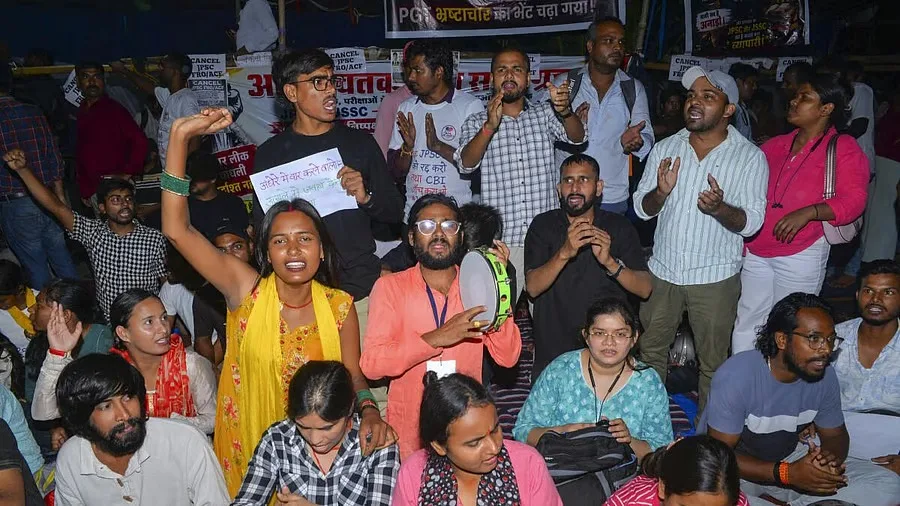
Students protesting in Ranchi
The Jharkhand government’s decision to cancel the JSSC-CGL examination and all recruitment examinations conducted through TSR Data Processing Private Limited (TDPL) has brought a major breakthrough in the 24-day-long student agitation on August 17, but it has not ended the protest.
The protesters have welcomed the government’s decision to scrap the examinations, results and selections associated with TDPL and investigate recruitment irregularities dating back to 2014. However, they have made it clear that cancellation of examinations is only one part of their demands.
Their principal unresolved demand is a CBI investigation into irregularities in the state’s recruitment examination system. Student leaders said they would continue their agitation until the demand is accepted.
The government’s announcement came after a prolonged Cabinet meeting chaired by Chief Minister Hemant Soren on August 17. Soren announced that the JSSC-CGL examination would be cancelled and that “everything” associated with TDPL, including examinations conducted, results published and selections made, would also be scrapped.
BIG NEWS from Ranchi:
Celebrations erupt at Jaipal Singh Stadium as Jharkhand govt cancels all exams conducted by TDPL, student leader Ravindra Paswan breaks down. pic.twitter.com/kI9q9hyE6O
— News Arena India (@NewsArenaIndia) August 17, 2026
The government also ordered a comprehensive inquiry into recruitment examinations conducted from 2014 onwards and announced a committee headed by senior IAS officer Amitabh Kaushal to frame rules and procedures aimed at preventing examination irregularities in the future.
But significantly, the government did not announce a CBI probe, despite the demand being at the centre of the student agitation.
‘We are not going anywhere’: Protesters hold ground
The immediate reaction from the protesting students was one of relief over the cancellation of the CGL examination but determination to continue the larger fight.
Student leader Ravindra Paswan said the cancellation demand had been fulfilled, but the CBI investigation had not been accepted.
“All our demands have not been met yet,” Paswan said, making it clear that the protesters would not leave until the CBI demand was addressed.
#WATCH | Ranchi, Jharkhand: Student leader Ravindra Paswan says, “Ministers Dipika Pandey and Irfan Ansari visited us and appealed to us to call off the agitation. However, the government has not yet agreed to our demand for a CBI inquiry. We are still persisting with our demand… https://t.co/CffDI6D4bn pic.twitter.com/6U9ICDH0NE
— ANI (@ANI) August 17, 2026
Another student leader, Piyush Kumar Singh, described the cancellation of JSSC-CGL and TDPL examinations as only the “first step”. He said the demand for a CBI investigation remained pending and that the students would also seek clarity on the 11th to 13th JPSC examinations.
The protesters said they would examine the government’s formal notification before deciding their next course of action, but leaders have repeatedly indicated that the movement will continue if the outstanding demands remain unresolved.
It has been reported that the CBI demand remained unanswered even after the government’s announcement and that protesters had set a deadline before considering further escalation, including a proposed march towards the Chief Minister’s residence.
Why students are insisting on a CBI investigation
The demand for a CBI probe stems from the students’ broader allegation that irregularities in Jharkhand’s recruitment examination system cannot be properly investigated by agencies working within the state government structure.
For the protesters, merely cancelling examinations is not enough. They want those responsible for alleged malpractice, paper leaks and manipulation of recruitment processes to be identified and prosecuted.
The government, meanwhile, has chosen to rely on an ongoing investigation by state agencies. Chief Minister Hemant Soren said investigations by the Special Investigation Team and Criminal Investigation Department had already brought several “shocking facts” to light.
According to Soren, the investigations had indicated an interconnected network involving different companies that had operated in the recruitment examination system at different points. He said the government had directed the concerned department and CID to conduct a thorough investigation covering examinations from 2014 onwards.
This is precisely where the government’s position and the students’ demand continue to diverge: the government has agreed to a wider investigation, but the protesters want that investigation handed over to the CBI.
24 days of agitation forced government’s decision
The confrontation did not emerge overnight.
For 24 days, students had been protesting against irregularities in JPSC and JSSC recruitment examinations. What began as a demand for action over examination irregularities gradually developed into a sustained movement involving demonstrations, hunger strikes, negotiations and an Assembly gherao.
Students initially gathered at Morabadi Maidan and later shifted to Jaipal Singh Stadium. The protest continued despite difficult weather conditions and repeated attempts at negotiations.
The movement eventually expanded beyond Ranchi, drawing support from students and youth from different parts of the country.
The protesters also announced an Assembly gherao, following which thousands gathered on August 10. The confrontation with the administration involved barricades, water cannons, tear gas and lathi-charge, further intensifying the agitation.
Multiple rounds of talks failed to break deadlock
The government attempted to resolve the crisis through dialogue.
A four-member ministerial group held talks with the students on August 7. The meeting failed to produce a settlement.
Another round of talks involving different student organisations followed on August 9, but the core dispute remained unresolved.
The students continued to insist on cancellation of the disputed examinations, action against those responsible for alleged irregularities and an independent investigation.
The government subsequently made another effort to engage with the protesters, but the agitation continued to gather momentum.
The August 15 Tricolour march became another significant moment in the movement, with large numbers of students participating.
By August 17, the government finally accepted one of the movement’s central demands and cancelled the JSSC-CGL examination along with TDPL-linked examinations.
Government scraps TDPL-linked exams, results and selections
The government’s decision goes beyond the cancellation of one examination.
Soren announced that all activities associated with TDPL would be cancelled, including examinations conducted by the company, results published and selections made.
The government has also ordered a comprehensive inquiry into recruitment examination irregularities from 2014 to the present.
The move is significant because TDPL had been at the centre of the student allegations concerning the recruitment examination process.
The government has also constituted an examination-reform committee headed by senior IAS officer Amitabh Kaushal. The committee is expected to work with institutions, experts and other stakeholders to frame procedures aimed at preventing future irregularities.
A portal has also been opened to collect suggestions from students, teachers and parents on examination reforms.
11th-13th JPSC exams remain another flashpoint
While the government has cancelled the JSSC-CGL examination and TDPL-linked examinations, another issue remains unresolved, the fate of the 11th to 13th JPSC examinations.
Student leaders have specifically pointed out that no decision has yet been taken on these examinations.
This means the protesters’ list of outstanding demands extends beyond the CBI probe.
The students have said they will study the government’s formal orders before deciding their next move, but leaders of the JPSC-JSSC Reform Manch have already indicated that the agitation will continue until the remaining demands are addressed.
Devendra Nath Mahato ends 16-day hunger strike
The agitation also saw prolonged hunger strikes by student leaders.
Devendra Nath Mahato, who had been on hunger strike for 16 days, ended his fast following the government’s announcement.
Mahato welcomed the government’s decision and thanked the Chief Minister, administration, police, media, students and parents who supported the movement.
He said students would cooperate with the ongoing investigation and efforts to clean up the recruitment system, while stressing that their larger struggle for examination reforms would continue.
Mahato’s decision to end his fast, however, does not mean the broader agitation has ended. Other student leaders have maintained that the CBI demand remains unresolved.
These students are namely: Rahul Kranti, Rupesh Kumar, Umme Habiba and Sbaita Kumari.
CGL cancellation creates fresh crisis For 1,932 appointed candidates
Even as protesting students celebrated the cancellation, another group of candidates found themselves facing a fresh crisis.
The cancellation affects candidates who had already cleared the JSSC-CGL recruitment process and secured government appointments.
According to the report, 1,932 candidates had been selected through the recruitment process and received appointment letters from the state government on December 30, 2025.
Many of them had subsequently joined government departments and had been working for months.
The government’s decision has now left their employment status uncertain.
Several successful candidates gathered outside the state Secretariat after the announcement and protested against the cancellation.
Their argument is fundamentally different from that of the protesting aspirants. While the latter demanded cancellation of the examination, the successful candidates say they cleared the process and received appointments after a prolonged legal and administrative battle.
Some of them said they would challenge the government’s decision in court.
Successful candidates point to court orders
The legal dimension of the controversy could now become the next major battleground.
One successful candidate said the appointments had been made following a High Court division bench ruling and that the Supreme Court had also upheld the process.
The candidates questioned how they could suddenly be rendered unemployed after receiving appointments through a process that had gone through judicial scrutiny.
They also pointed out that several selected candidates had resigned from earlier jobs after receiving their new appointments.
The candidates have therefore indicated that they will return to court to challenge the government’s decision.
This creates an unusual situation in Jharkhand: one set of students is demanding that the recruitment process be scrapped, while another set of candidates who cleared the same examination is fighting to protect their jobs.
Government says irregularities need to be rooted out
Defending the decision, Soren said the government was committed to restoring transparency and credibility in the recruitment system.
He said the existing standard operating procedure for conducting examinations should have prevented irregularities if it had been properly followed.
The Chief Minister said the government would make further improvements based on suggestions from students, teachers, parents and experts.
The government has also said the inquiry will cover both major and minor errors dating back to 2014.
The Core Deadlock: Cancellation accepted, CBI demand not
The developments on August 17 have therefore produced a partial breakthrough rather than a complete settlement.
The government has accepted the demand for cancellation of the JSSC-CGL examination and TDPL-linked examinations. It has also agreed to a comprehensive investigation into recruitment examination irregularities since 2014 and announced a mechanism for examination reforms.
But the students have drawn a clear line.
They want a CBI investigation.
Until that demand is addressed, student leaders say the agitation will continue.
The JPSC-JSSC Reform Manch has also raised the unresolved issue of the 11th to 13th JPSC examinations.
The government, on the other hand, appears to be relying on the ongoing CID and SIT investigations and the proposed reform mechanism.
That gap between the two sides means that the 24-day agitation may have entered a new phase rather than ended.
What happens next?
The immediate focus will now be on the government’s formal notification and the precise legal consequences of cancelling the examinations, results and selections linked to TDPL.
For the protesting students, the next question is whether the government will agree to their demand for a CBI probe.
For the 1,932 candidates who had already secured government jobs, the focus is likely to shift to the courts.
And for thousands of future aspirants, the larger question is whether the promised reforms can restore confidence in Jharkhand’s recruitment system.
The government has made a significant concession after 24 days of protests. But the protesters are signalling that cancellation is not the end of their movement.
Their message is now clear: the examinations may have been cancelled, but the fight for an independent CBI investigation is still on.
