Recently, a short video of Param Poojaniya Sarsanghchalak Dr Mohan Bhagwat went “viral” on social media. The public watched with great delight as the Sarsanghchalak demonstrated a playful hand gesture used by Gen Z kids to indicate “Clock it” (meaning understood or noted) and remarked from the stage, “Today I learned a new expression from you.” The background echoed with the continuous applause and cheers of young audience members. Mohan Ji was addressing youth at an event in Mumbai on August 6. Media outlets continue to discuss his answers to the innocent questions, doubts, and concerns raised by the children.
What we witnessed there was an exceptionally warm, sincere, and heartening dialogue. Gen Z and Gen Alpha, born and raised alongside the 21st century, are now the main topic of discussion. Society and the media look on with amazement, wondering how the elder of a century-old organisation connects so warmly with such young people. Many may ponder as to how this is achieved.
More Than Child’s Play
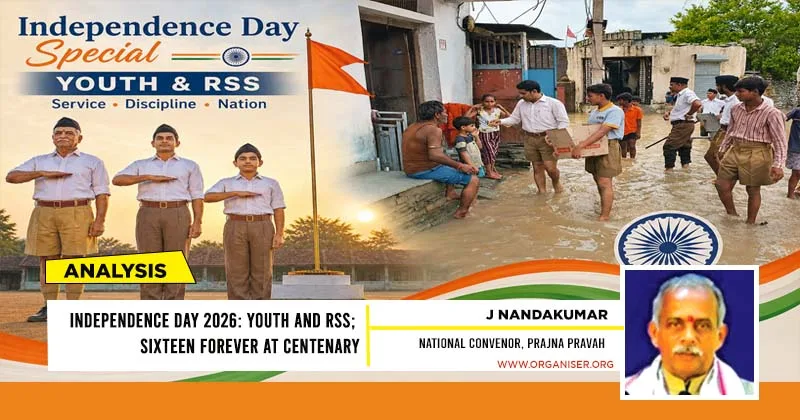
Most people today know that the origin, growth, and expansion of the Rashtriya Swayamsevak Sangh (RSS) took root through children. The Sangh, initiated by the late Dr Hedgewar by gathering a few young boys, overcame every obstacle and moved forward precisely through the collective spirit and dedication of the youth of each generation. The Sangh grew while enduring taunts about being a “boys’ club” or mere “child’s play.” Whenever the Sangh faced bans or extreme challenges like the Emergency, or when volunteers rallied on the frontlines of war against the nation and disaster zones, it was the young Swayamsevaks who stepped forward courageously. Across successive generations, it was young individuals who endured brutal tortures and sacrificed their lives to fulfill the Sangh’s mission.
From a single shakha, the network expanded to 88,949, according to the 2025-26 annual report, with the vast majority being run and sustained by Gen Z Swayamsevaks and Karyakartas. During the Sangh’s centenary year programmes, the representation of Gen Z youth was unprecedented. At the 2025 Vijayadashami festival, 2,708,186 youth (Tarun) and 5,36,955 children (Bal) Swayamsevaks participated. Combined, these numbers reflect a massive youth presence. Furthermore, the Pathsanchalans (route marches) and events held during the RSS centenary year stood out due to the overwhelming participation of the new generation. Specifically, 2,16,215 Tarun and 3,83,663 Bal Swayamsevaks took part in full Ganavesh (uniform) in Pathsanchalans organised across the country. These Swayamsevaks come forward from urban, rural, and Janajatiya areas, as well as schools and professional colleges, representing every sphere of society. It is also worth remembering that there are millions of fellow-travellers and well-wishers within this age demographic.
In an organisation completing 100 years of organisational work, there are many senior Swayamsevaks who have been part of the Sangh for over ninety years. Yet, anyone who closely observes its activities will say in unison that the Sangh’s age remains sixteen. This is because the tens of thousands of Shakhas across Bharat are driven primarily by Tarun and Bal Swayamsevaks. Annual reports consistently show that over 60 per cent of daily shakha attendees are students. Even during the COVID-19 period, 61 per cent of daily shakha attendees were students, meaning young people born after the year 2000. Additionally, Akhil Bharatiya Vidyarthi Parishad (ABVP), the world’s largest student organisation with over 7.5 million active members, forms a crucial part of this demographic. Millions of students receiving value-based education in over 8,000 schools managed under Vidya Bharati also belong to this same generation.
The Age of the Sangh
According to figures shared with the media by the then Sah Sarkaryavah Dr Manmohan Vaidya ahead of the Akhil Bharatiya Pratinidhi Sabha (ABPS) in 2022, 125,000 young people expressed their desire to join the Sangh through the “Join RSS” online platform during the COVID period alone. Since its inception in 2012, millions of youth have come forward through this platform to participate in Sangh activities, including tens of thousands of young women. It is very delightful to note that a significant proportion of these applicants are young people from North Eastern states such as Arunachal Pradesh and Manipur.
From a single shakha, the network expanded to 88,949, according to the 2025–26 annual report, with the vast majority being run and sustained by Gen-Z Swayamsevaks & Karyakartas
On the occasion of the centenary, Sarsanghchalak Ji appealed for full-time volunteers (Vistaraks) to dedicate two years to organising and coordinating various activities. In response, 2,453 Swayamsevaks stepped forward as full-time Shatabdi Vistaraks, putting aside their home and personal pursuits. Such spirit of sacrifice belongs to this very generation. According to Akhil Bharatiya Sah Sarkaryavah Mukunda CR, speaking at a press conference during the ABPS held in Bengaluru in 2025, out of 222,962 participants in the previous year’s Prarambhik Varg (Initial Training Camp), 163,000 were between the ages of 14 and 25. Over the past 100 years, the Sangh has demonstrated to society that a five-year-old or a fifteen-year-old can contribute as constructively to nation-building as a fifty-year-old.
It is this new generation that leads not only daily Sangh activities but also most of its educational and service initiatives. Viewed from this perspective, today’s Gen Z serves as the driving force behind the grand movement that is the RSS. The daily shakhas stand as proof that a fully vibrant new generation endowed with clear vision, capacity for action, and national spirit is thriving in our society. The next generation is actively shaping the future of the RSS. The public saw Gen Z from various parts of the country interacting with the Sarsanghchalak on a single stage through the media. However, it is worth recalling that the Sarsanghchalak and other Sangh Karyakartas have been continuously engaging with these young groups for the past 100 years, reaching out directly to their spaces and speaking in their language. This remains the secret behind why the Sangh continues to function with the energy of a sixteen-year-old, even in its hundredth year.

