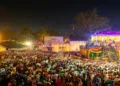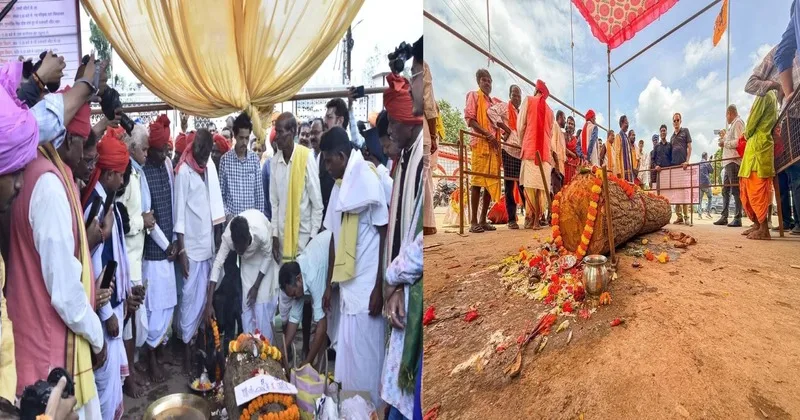
Jagdalpur: The world-famous 75-day Bastar Dussehra festival has begun in Jagdalpur with the traditional Pat Jatra ritual, setting in motion one of Bharat’s most distinctive and enduring cultural celebrations. Unlike the conventional Dussehra festival associated with Bhagwan Ram’s victory over Ravana, Bastar Dussehra is primarily a celebration of tribal faith, devotion to Danteshwari Devi, nature worship and centuries-old social and cultural traditions.
The festival, deeply rooted in the history and cultural identity of Bastar, brings together traditional priests, tribal communities, members of the Bastar royal family, local representatives and thousands of devotees. Its elaborate rituals continue for nearly 75 days and culminate in a series of unique ceremonies centred around Goddess Danteshwari.
Pat Jatra Marks the Beginning
The festival formally commenced on August 12, coinciding with Hareli Amavasya, with the traditional Pat Jatra puja performed in front of the Maa Danteshwari Temple in Jagdalpur.
#WATCH | Jagdalpur, Chhattisgarh: The 75-day Bastar Dussehra festival began with the traditional 'Pat Jatra' ritual on the day of Hareli Amavasya. pic.twitter.com/LpB4vXcHdn
— ANI (@ANI) August 12, 2026
At the heart of the opening ceremony was the ‘Thurlu Khotla’, a piece of sal wood regarded as the first and most important piece of timber for the construction of the Dussehra chariot. The wood was brought from the forest near Bilouri village, continuing a traditional practice associated with the festival for generations.
Prayers were offered to Goddess Danteshwari and the forest deity, seeking blessings and the availability of the required wood for the elaborate rituals and construction of the ceremonial chariot.
In the local tradition, the first piece of wood used for the construction of the Dussehra chariot is also referred to as Thurlu Khotla or Tika Pata.
A Ritual Rooted in Centuries of Tradition
Kamal Chandra Bhanj Deo, a member of the Bastar royal family, said the historic festival begins with the Pat Jatra ritual and that the tradition of bringing the Thurlu Khotla from the forest has continued for centuries.
#WATCH | Jagdalpur, Chhattisgarh: Kamal Chandra Bhanj Deo, a member of the Bastar royal family, says, "…The historic 75-day Bastar Dussehra festival begins with the 'Pat Jatra' ritual. As part of this, the 'Thurlu Khotla'—a wooden stand—is brought from the forest; specifically,… pic.twitter.com/yfpDQ58Ft6
— ANI (@ANI) August 12, 2026
He said the ritual reflects the deep connection between Bastar’s religious traditions, forests and tribal way of life. Priests participate in the ceremony while devotees offer prayers, with the materials required for the ritual traditionally being sourced from the region.
Dalpati, a traditional carpenter from Jhar Umargaon entrusted with the construction of the Dussehra chariot, performed the ceremonial worship. The puja included offerings of jaggery, puffed rice, gram, betel leaves, sweets and flowers.
Sacred Wood and the Ritual of Protection
The Thurlu Khotla was brought to Jagdalpur a day before the Pat Jatra ceremony by villagers from Bilouri. Following the puja, Dalpati hammered a nail into the sacred wood as part of a customary ritual believed to protect the festival and its proceedings from the evil eye.
The ritual demonstrates how every stage of Bastar Dussehra is closely linked to traditional beliefs and practices that have been preserved across generations.
Collector Highlights Grandeur and Continuity
Bastar Collector Akash Chhikara described the commencement of the festival as a matter of pride for the region. He said the age-old traditions and rituals associated with Bastar Dussehra have been preserved and continue to be observed with great enthusiasm.
#WATCH | Jagdalpur, Chhattisgarh: Bastar Collector Akash Chhikara says, "Bastar's world-famous 75-day Bastar Dussehra festival has commenced today… It is a matter of great pride for us that this festival has been celebrated in the traditional manner for so many years… The… pic.twitter.com/ql2AyawUWg
— ANI (@ANI) August 12, 2026
According to Chhikara, the rituals have begun in a systematic and proper manner and are being conducted in accordance with established traditions and norms. He said the celebrations would be organised with grandeur and enthusiasm with the cooperation and participation of all those associated with the festival.
Balram Manjhi, Vice President of the Bastar Dussehra Committee, said people have been participating in the worship with great enthusiasm. He noted that devotees and visitors from across India and abroad are expected to witness the unique rituals of Bastar Dussehra.
#WATCH | Jagdalpur, Chhattisgarh: Balram Manjhi, Vice President of the Bastar Dussehra Committee, says, "…Bastar's 75-day Dussehra, which is famous worldwide, has begun today… People are participating in this worship with great enthusiasm… The rituals will be performed, and… pic.twitter.com/UaEZ9wwOgN
— ANI (@ANI) August 12, 2026
Manjhi emphasised that the festival’s 75-day duration makes it exceptionally distinctive and unlike Dussehra celebrations elsewhere.
A Dussehra Unlike Any Other
Bastar Dussehra is fundamentally different from the popular Dussehra narrative centred on the victory of Bhagwan Rama over Ravana. The festival pays homage to Goddess Danteshwari, the presiding deity of Bastar, and incorporates a wide range of tribal religious traditions.
पाट जात्रा के साथ आज बस्तर की गौरवशाली संस्कृति और सदियों पुरानी आस्था के प्रतीक बस्तर दशहरा का शुभारंभ हुआ।
इस पावन महापर्व की आप सभी को हार्दिक बधाई एवं शुभकामनाएं।
जय माँ दंतेश्वरी#bastardussehra #bastar pic.twitter.com/dpgLhmO5mz
— Kedar Kashyap (@KedarKashyapBJP) August 12, 2026
Several tribal communities also worship their own traditional deities, many of whom are closely associated with forests, rivers, hills, animals and other manifestations of nature. As a result, Bastar Dussehra represents not merely a religious festival but a living expression of the region’s relationship with nature and its indigenous cultural traditions.
Preparations traditionally begin during the Krishna Paksha of Shravan, the waning phase of the lunar month, and continue through a succession of rituals and ceremonies until the later stages of the festival.
Royal Tradition at the Heart of the Festival
One of the most distinctive features of Bastar Dussehra is the continuing involvement of the Bastar royal family in the traditional organisation and rituals of the festival.
Unlike many major festivals that are primarily organised by government departments or private organisations, Bastar Dussehra retains a strong connection with the traditional royal institution and the indigenous social structure of Bastar.
The festival brings together the royal family, traditional community leaders, priests, Manjhi-Chalki representatives, Patels, Naik-Paik groups and a large network of local participants and volunteers.
1408 and the Historical Legacy
Bastar Dussehra is widely described as a festival with a history stretching back several centuries. Local accounts place its institutionalised celebration in the medieval history of Bastar, with references to its origins during the reign of King Purshottam Dev. Some accounts trace the tradition to the 13th century, while the festival is also documented as having been celebrated in Bastar since around 1408 AD.
Regardless of the precise historical dating of its origins, the festival’s continuity over several centuries has made it one of the most important cultural traditions of the Bastar region.
Its rituals, chariot ceremonies, religious practices and community participation have helped preserve a distinctive cultural heritage that remains deeply embedded in the everyday life of Bastar.
The Grand Chariot and Danteshwari Tradition
One of the major attractions of the festival is the ceremonial two-storey chariot, on which the sacred umbrella or Chhatra of Danteshwari Devi is ceremonially placed and pulled through the streets of Jagdalpur.
The construction of this chariot itself is an elaborate traditional process, beginning with the Pat Jatra and the ceremonial worship of the first piece of wood. Every subsequent stage is governed by established customs and rituals.
The chariot procession eventually becomes one of the central public expressions of the festival, bringing together people from across Bastar and visitors from different parts of the country.
A Living Symbol of Bastar’s Cultural Identity
The opening of Bastar Dussehra is therefore much more than the beginning of a religious festival. It marks the continuation of a centuries-old cultural institution that brings together faith, tribal traditions, nature worship, community participation and royal heritage.
The festival’s extraordinary duration, distinctive rituals and deeply rooted indigenous traditions have earned Bastar Dussehra a reputation as one of the most unique Dussehra celebrations in India.
As the 75-day festivities progress, Jagdalpur is set to become the centre of a cultural celebration that showcases Bastar’s enduring traditions and its rich tribal heritage to visitors from across India and around the world.
Bastar MP Seeks National Spotlight for 619-Year-Old Bastar Dussehra
Bastar Lok Sabha MP Mahesh Kashyap has urged Union Information and Broadcasting and Railways Minister Ashwini Vaishnaw to give national and international exposure to Bastar’s rich tribal heritage and the historic 75-day Bastar Dussehra festival.
Kashyap met Vaishnaw in New Delhi and held discussions on initiatives to showcase Bastar’s distinctive traditions, indigenous culture and the region’s changing identity as it moves towards peace, development and new opportunities.
Demand for Special Doordarshan and All India Radio Coverage
During the meeting, Kashyap specifically requested special live coverage of major events of Bastar Dussehra 2026 on Doordarshan, along with special and live broadcasts through All India Radio (Akashvani).
He said wider national coverage of the festival would help audiences understand Bastar beyond its past association with Maoism and highlight its rich cultural traditions, peaceful environment and development trajectory.
Kashyap said that for decades, the impact of Red Terrorism had shaped Bastar’s image in the country and abroad, often associating the region with fear and violence. However, he said Bastar is now steadily moving beyond the shadow of extremism and emerging as a region of peace, development and new possibilities.
Dussehra as a Symbol of a Changing Bastar
According to Kashyap, Bastar Dussehra provides a significant opportunity to present a positive image of the region before national and international audiences.
He said the 75-day festival can showcase Bastar as a peaceful, secure, culturally rich and developing region, while bringing its distinctive tribal traditions and indigenous practices to a wider audience.
The MP also recalled that Union Home and Cooperation Minister Amit Shah had visited Bastar during last year’s Dussehra celebrations and participated in the Muria Darbar. He further said that President Droupadi Murmu is expected to visit Bastar during this year’s festival, which would further enhance the national significance of the celebrations.
Vaishnaw Gives Positive Response
Vaishnaw responded positively to Kashyap’s proposal and directed the concerned officials to take necessary action regarding special coverage of Bastar Dussehra.
The Union Minister also directed officials to examine arrangements for broadcasting the festival through Doordarshan and All India Radio, besides exploring the possibility of producing a documentary film focusing on Bastar Dussehra and the region’s cultural heritage.
Showcasing a 600 Year-Old Cultural Tradition
Kashyap said Bastar Dussehra represents a unique tribal cultural and religious tradition that has continued for nearly 600 years.
The festival is distinguished by its unique worship practices, traditions associated with local deities, tribal customs, the Muria Darbar, ceremonial chariot processions and community-based social and cultural systems.
He said these features give Bastar Dussehra a distinct identity compared with other Dussehra celebrations across the country.
Proposal for a Documentary on Bastar
The Bastar MP also urged the Union Minister to facilitate the production of a high-quality documentary covering the history of Bastar Dussehra, its religious traditions, tribal culture, folk life and the region’s transformation and development.
He said such a documentary could help take Bastar’s rich cultural heritage beyond India and introduce international audiences to the region’s unique traditions and way of life.
‘A Matter of Pride for Bastar’
Kashyap expressed gratitude to Vaishnaw for his prompt and positive response, saying that bringing Bastar’s centuries-old cultural heritage to a national platform would be a matter of pride for the people of the region.
He emphasised that Bastar Dussehra is not merely a local festival but a living expression of India’s rich tribal culture, faith and traditions.
The MP said wider coverage through Doordarshan, All India Radio and documentary filmmaking would help present Bastar’s authentic identity, cultural richness and transformation to audiences across India and around the world.