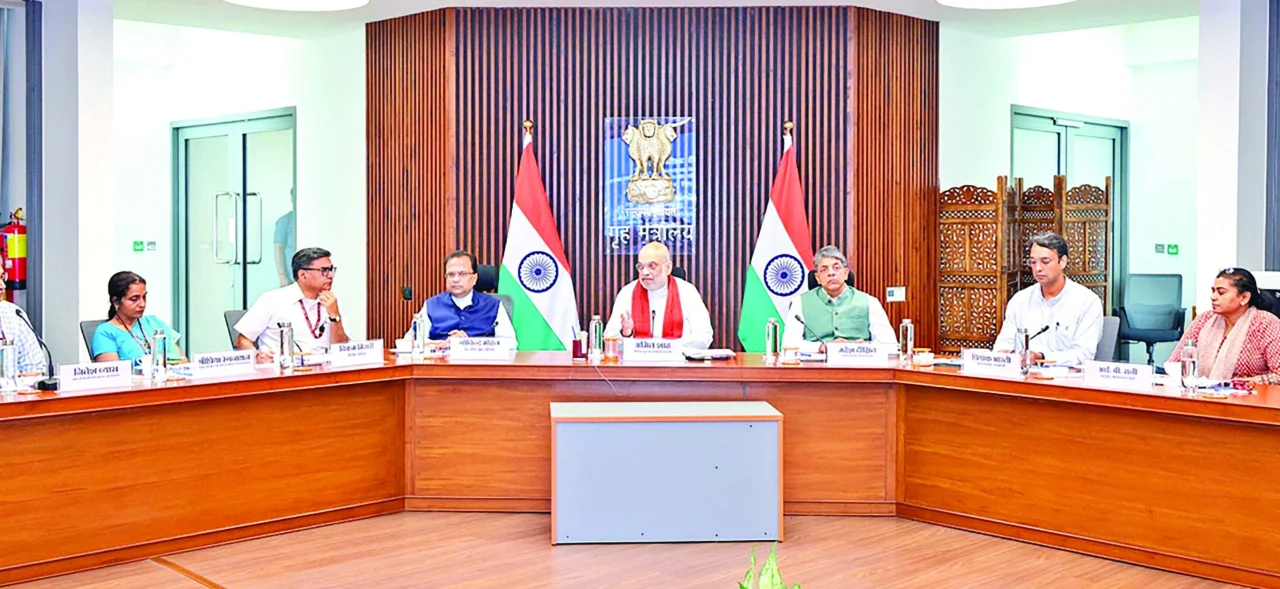
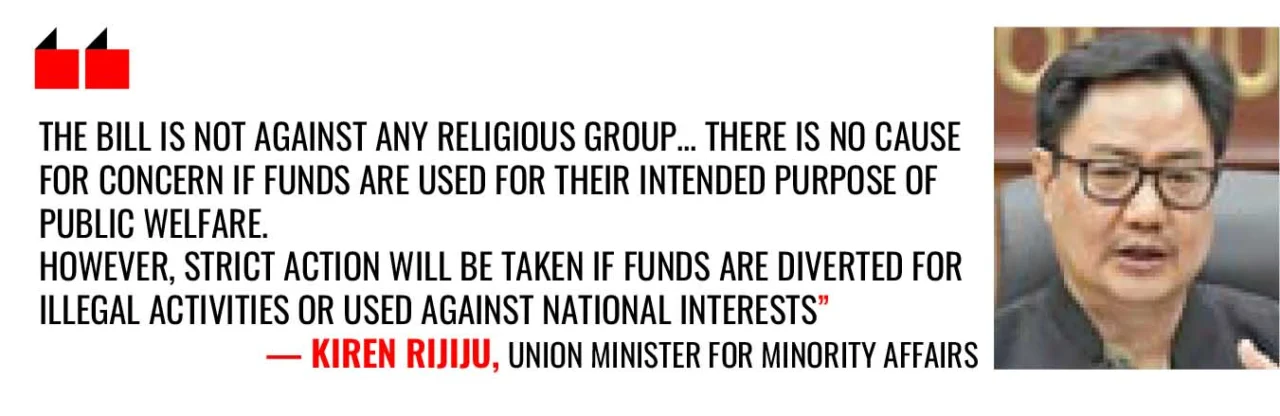
Speaking in the Lok Sabha on March 25 while introducing the Foreign Contribution (Regulation) Amendment Bill, 2026, Minister of State for Home Affairs Nityanand Rai said the legislation aims to make the use of foreign contributions more transparent and accountable, and that the Government would not tolerate any attempt to act against the Constitution, the law, or the national interest. He added that any institution, educational or otherwise, whose work aligns with Bharat’s sovereignty and integrity, would face no obstruction whatsoever. In the Government’s own words, a nation receiving thousands of crores in foreign contributions every year has both the right and the duty to know precisely how that money is used, and to act when it is not.
Bharat’s non-profit sector is, by most counts, the largest in the world. NITI Aayog’s NGO Darpan portal, the Government’s voluntary platform for accessing central grants, lists close to 1.9 lakh organisations. A much larger figure, roughly 37 lakh, has been cited in Central Bureau of Investigation affidavits before the Supreme Court as the total number of societies, trusts, and associations registered under various state laws. The gap between these figures is itself instructive: Bharat has never built a single national database capturing every voluntary body operating in the country. It is precisely this scale and opacity that the Foreign Contribution (Regulation) Amendment Bill, 2026, seeks to bring under a tighter, more traceable framework.
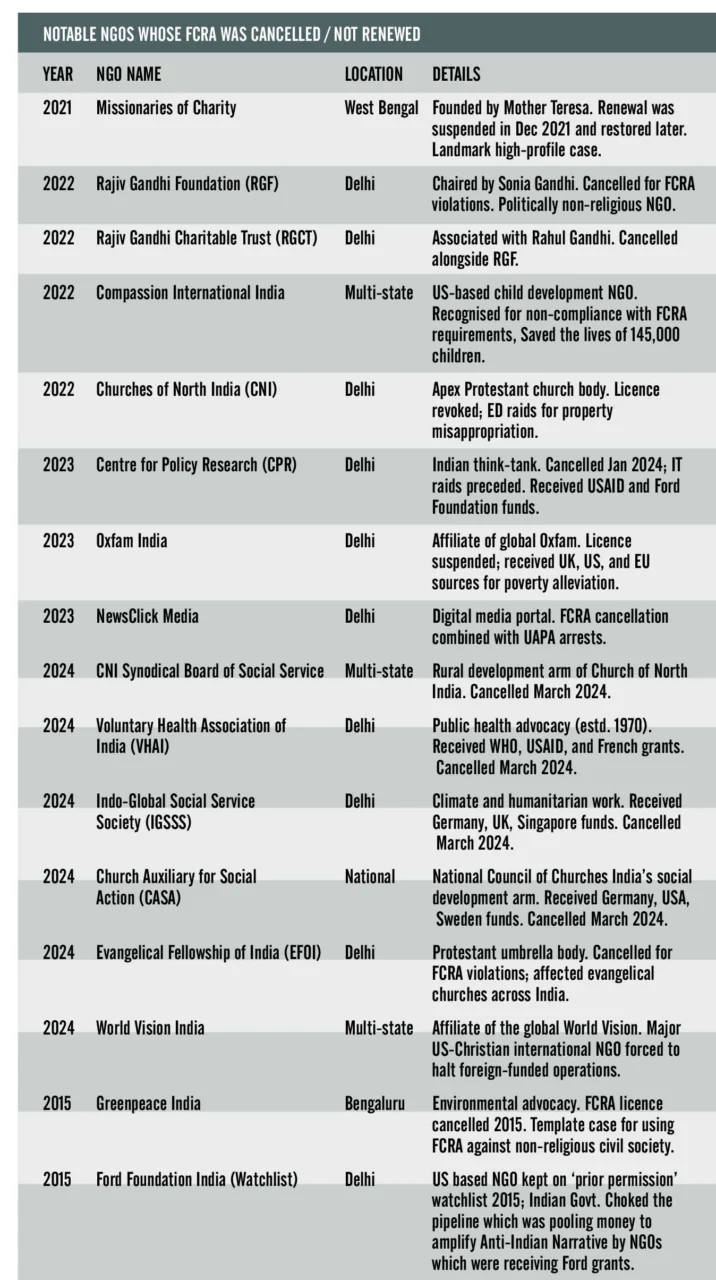
The Rajiv Gandhi Foundation and the Rajiv Gandhi Charitable Trust also had their FCRA registrations cancelled in 2022 for regulatory non-compliance, a case the Government has cited as evidence that enforcement follows the law rather than political alignment
Does Bharat Need Foreign Funding?
Two figures anchor the debate. Bharat’s FCRA Division shows that, as of early 2026, roughly 16,000 organisations hold an active foreign-contribution registration, while 22,273 certificates have been cancelled and another 15,182 have lapsed without renewal. Together, 37,455 organisations have been removed from the foreign-funding ecosystem since 2011, according to the Government’s reply to Rajya Sabha Unstarred Question No. 3253. Annual inflows through this system averaged approximately Rs 18,600 crore during FY 2020-22. The Centre and States spend several lakh crore rupees annually on welfare and development through more than 450 Central Sector and Centrally Sponsored Schemes covering food, housing, health, sanitation, employment guarantees, and direct farmer transfers. Against this, foreign NGO funding represents only a small fraction of Bharat’s own welfare spending. This comparison is central to the Government’s case: foreign contributions to Indian civil society are not filling a developmental gap the Indian state cannot meet, shifting the debate from whether Bharat needs the money to how it is used.
The Enforcement Record
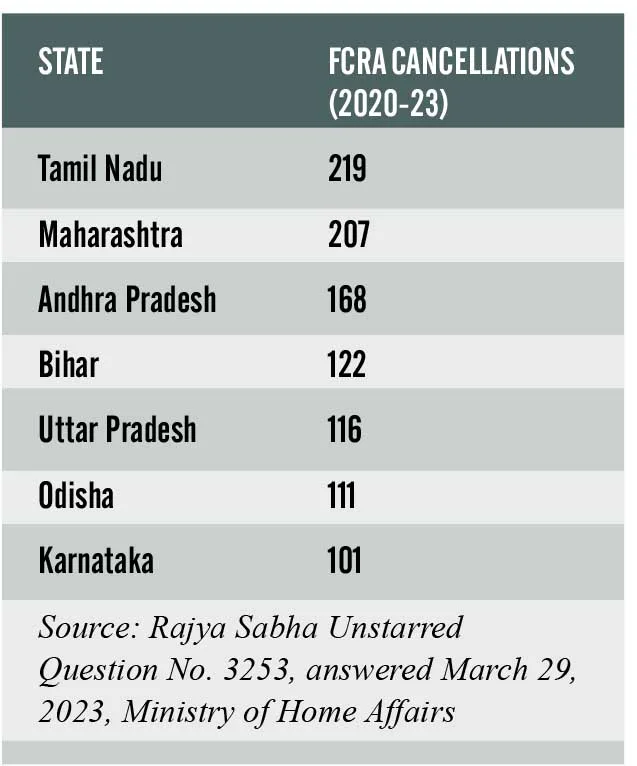
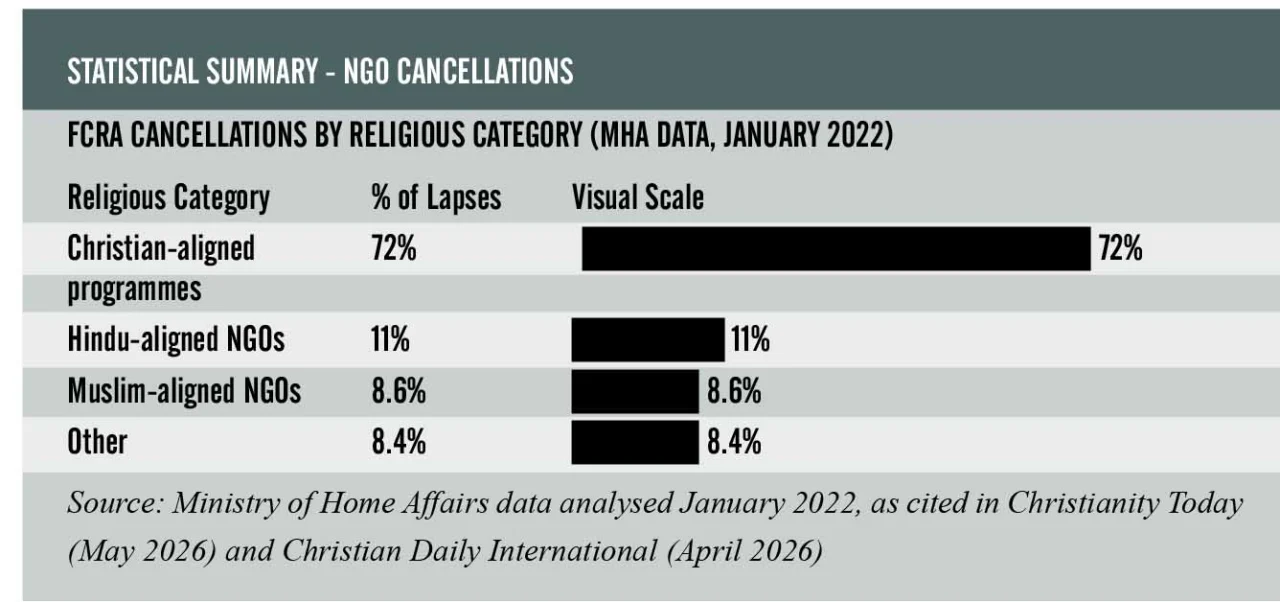
The scale of cancellations over the past decade is, according to the government’s own records, not a crackdown but a long-overdue clean-up of a licensing regime that had operated for years with limited oversight. MHA data shows that most cancellations were made under Section 18 of the parent Act for basic compliance failures, including not filing mandatory annual returns or submitting false information on how foreign funds were received and used. State-wise data from the same Rajya Sabha reply shows that enforcement was concentrated in states with the highest historical NGO density rather than in any particular region or ideological group.
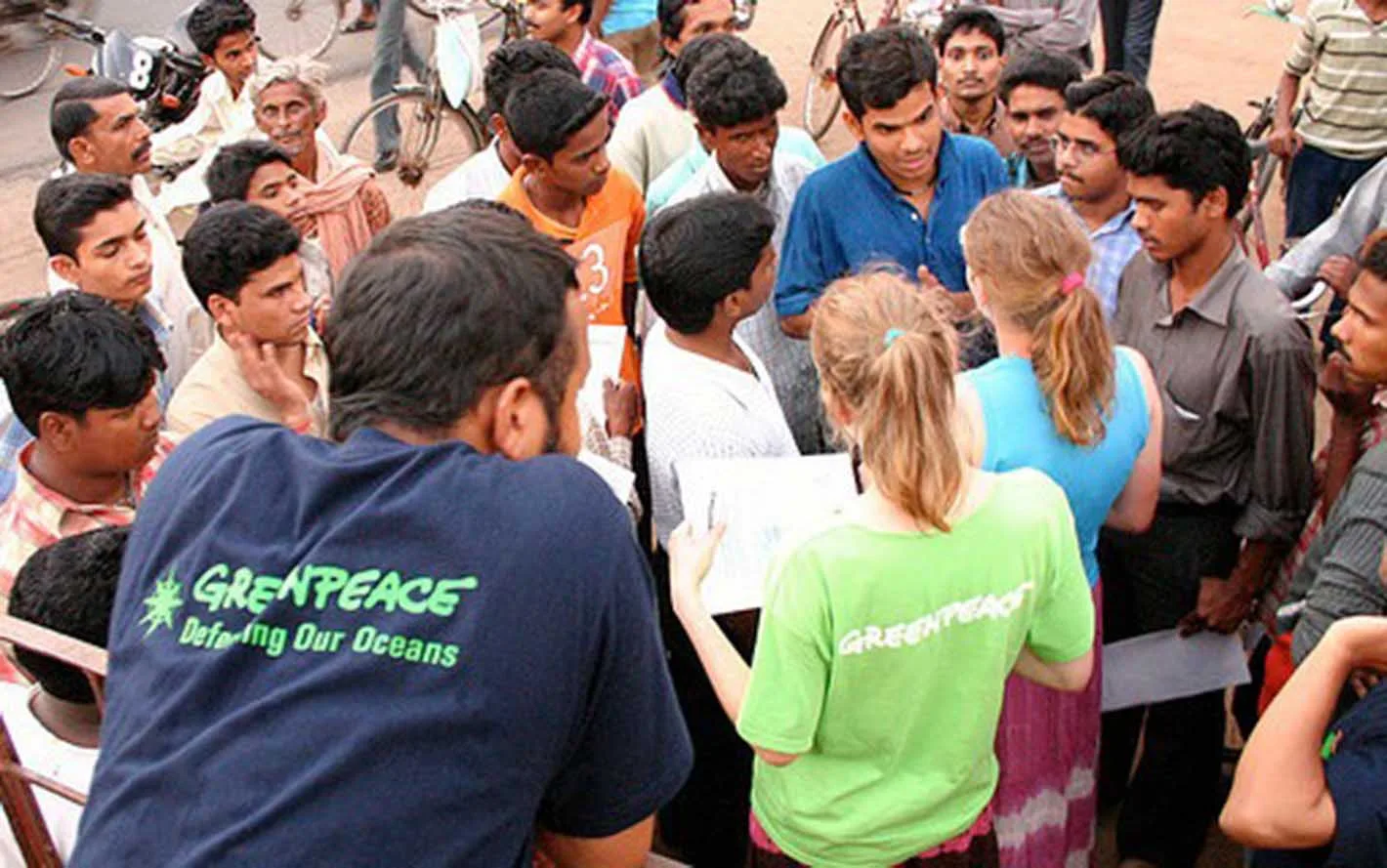
Several well-known organisations have been subject to this enforcement process. Greenpeace Bharat’s FCRA licence was cancelled in 2015 after the Intelligence Bureau flagged its funding of anti-nuclear and anti-mining campaigns. Amnesty International India closed its India operations in 2020 after the Enforcement Directorate froze its accounts over the structure of its foreign funding. Compassion International, a US-based child-sponsorship organisation, wound down its India operations after its FCRA registration lapsed in 2022. Between 2022 and 2024, the FCRA registrations of several Church-linked organisations — including the Church of North Bharat’s social service arm, the Church’s Auxiliary for Social Action, the Evangelical Fellowship of India, the Voluntary Health Association of India, the Indo-Global Social Service Society, the Indian affiliate of World Vision, and the Centre for Policy Research, a Delhi-based think tank that had received Ford Foundation and USAID funding — were cancelled or not renewed following compliance reviews. The Missionaries of Charity, founded by Mother Teresa, briefly had its FCRA renewal suspended in December 2021 before it was restored weeks later. Enforcement has not been limited to one ideological spectrum. The Rajiv Gandhi Foundation and the Rajiv Gandhi Charitable Trust also had their FCRA registrations cancelled in 2022 for regulatory non-compliance, a case the Government has cited as evidence that enforcement follows the law rather than political alignment. Separately, the Sabrang Trust, associated with activist Teesta Setalvad, faces a CBI investigation and chargesheet alleging irregularities in the use of funds meant for riot-victim rehabilitation; the matter remains before the courts.
The 2026 FCRA Overhaul
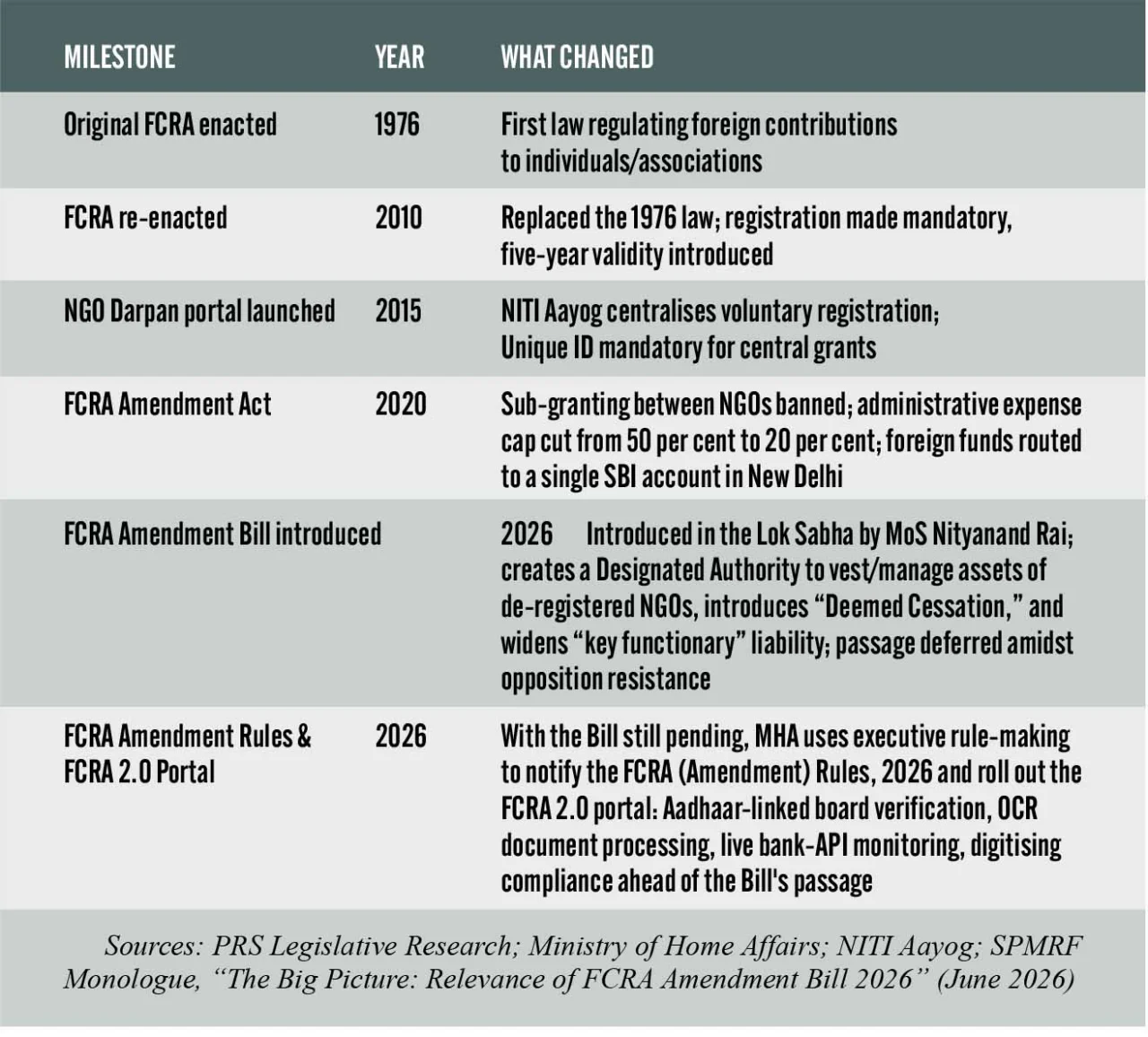
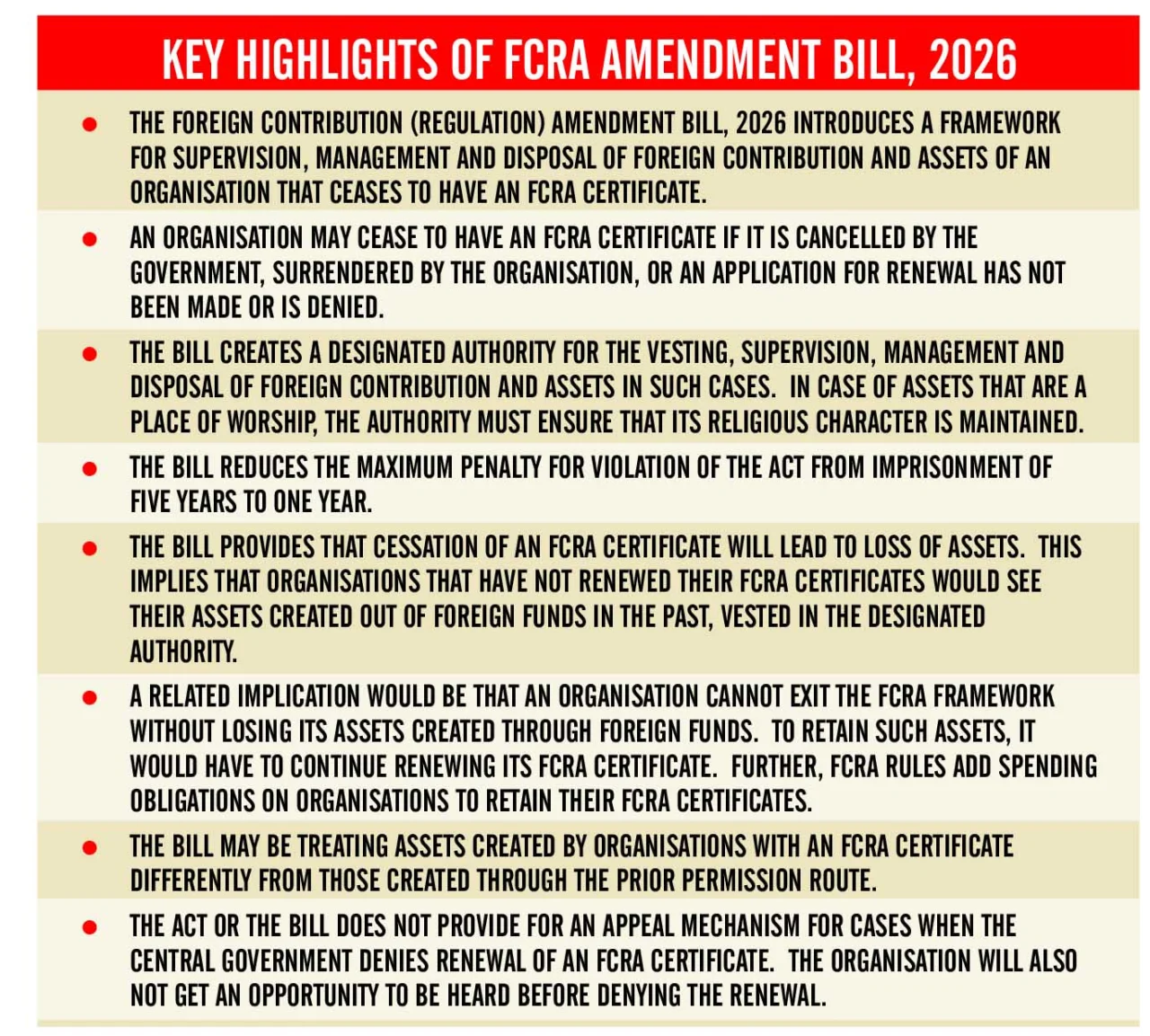
The Foreign Contribution (Regulation) Amendment Bill, 2026, introduced by Minister of State for Home Affairs Nityanand Rai, is the most significant structural change to the FCRA framework since 2010. It rests on three key mechanisms. The first is a Designated Authority, created under a new Chapter IIIA, empowered to take provisional and, eventually, permanent control of assets — including land, buildings, equipment, and bank balances — created with foreign funds once an organisation’s FCRA registration is cancelled, surrendered, or allowed to lapse, with sale proceeds credited to the Consolidated Fund of India. This addresses a long-standing gap under the earlier law, which lacked a clear mechanism for taking control of foreign-funded assets after an organisation lost its registration. The second is the Deemed Cessation doctrine under Section 14B, under which an organisation’s right to use foreign-funded assets ends automatically when its registration is cancelled, expires, lapses, or renewal is rejected while an investigation is pending, preventing continued operations through prolonged litigation. The third is an expanded definition of key functionary, covering directors, trustees, partners, the karta of a Hindu Undivided Family, and others exercising managerial control, making them personally liable for violations unless they can demonstrate due diligence and lack of knowledge.
Bharat’s NGO Density in Global Perspective
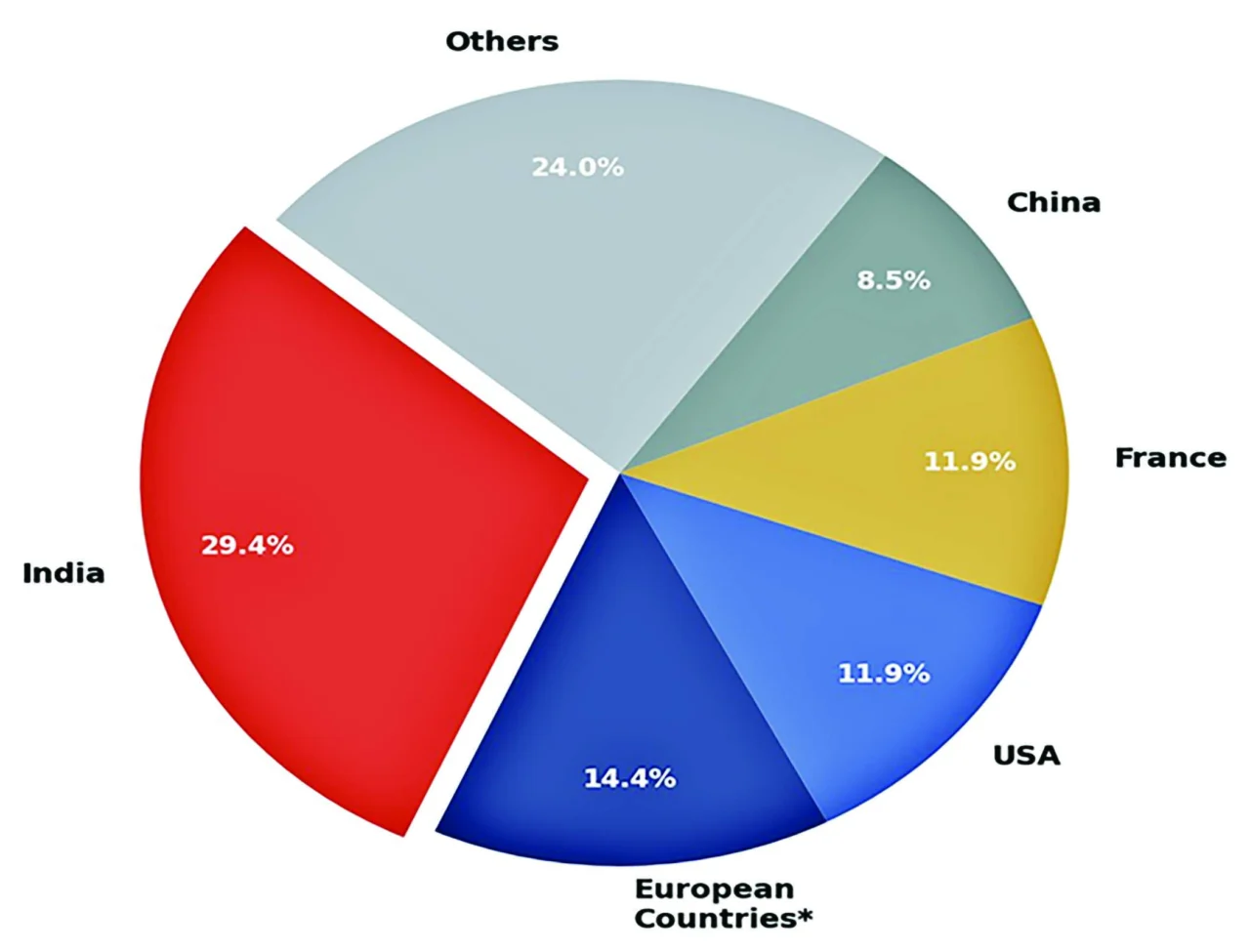
The infographic published by The Matrix presents data of national security significance. India, with 3,700,000 NGOs, hosts 29.35 per cent of all NGOs in G20 nations. The next largest group, European countries (excluding France, Germany, and Italy), accounts for 14.40 per cent of the total, with 1,815,874 organisations. The United States and France each account for 11.90 per cent with 1,500,000 entities apiece.
This concentration has two implications. First, the sheer scale makes comprehensive oversight difficult, creating structural opacity that foreign principals can exploit. Second, it means that when even a small proportion of NGOs is compromised or instrumentalised, the aggregate impact on India’s political economy, infrastructure planning, and demographic stability is disproportionately large. The 2014 Intelligence Bureau assessment, which estimated a 2 per cent to 3 per cent GDP drag due to NGO-led anti-development activism, was calculated against a much smaller registered FCRA base than what exists today.
The Bill also requires State Police and investigative agencies to obtain prior Central Government approval before initiating FCRA-related inquiries, aligns procedures with the Bharatiya Nagarik Suraksha Sanhita, 2023, brings crowdfunding and online donation platforms within the compliance framework, and tightens the definition of religious activity to prevent foreign funds from being used for inducement-based religious conversion. It also reduces the maximum prison term for FCRA violations from five years to one, shifting the emphasis from criminal punishment to asset control and institutional accountability.
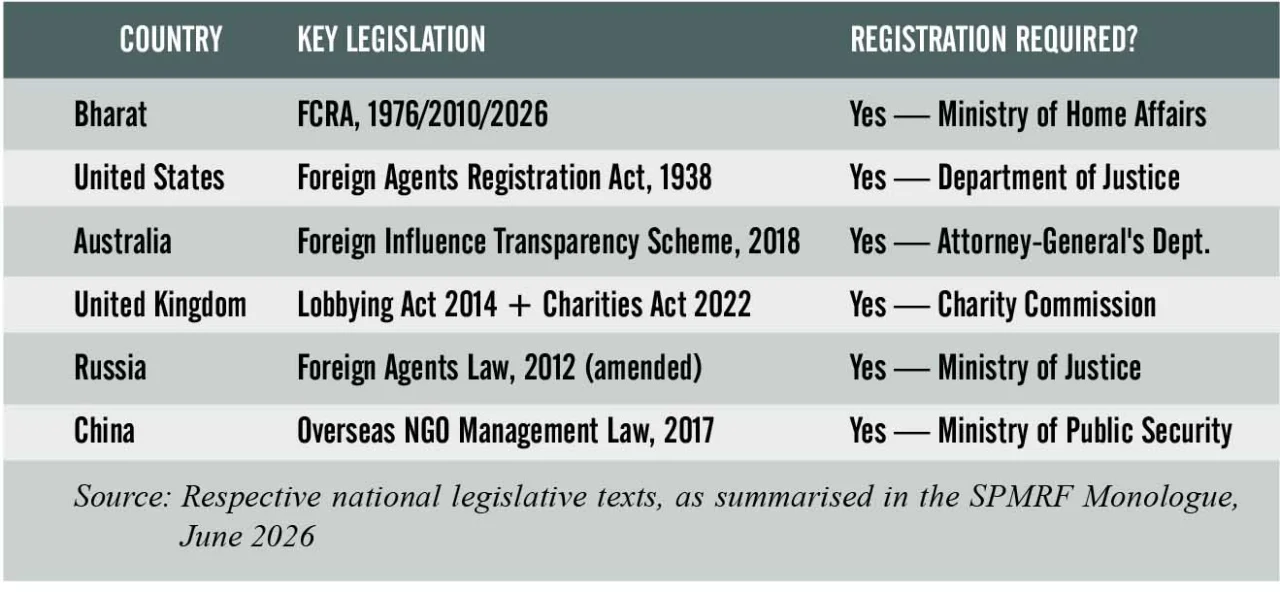
The United States’ Foreign Agents Registration Act, in force since 1938, imposes criminal penalties of up to five years for non-compliance and requires disclosure of relationships with foreign principals
Global Practice, Bharatiya Framework
Supporters of the 2026 amendments argue that they bring Bharat’s FCRA framework closer to international practice rather than making it more restrictive. The United States’ Foreign Agents Registration Act, in force since 1938, imposes criminal penalties of up to five years for non-compliance and requires disclosure of relationships with foreign principals. Australia’s Foreign Influence Transparency Scheme, introduced in 2018, mandates registration for political-influence activities undertaken on behalf of foreign principals. The United Kingdom’s Charities Act and Lobbying Act place strict limits on political activity by foreign-funded charities. Russia’s Foreign Agents Law and China’s Overseas NGO Management Law go much further, requiring registration with security authorities and permitting organisations to be shut down for unauthorised political activity. Against this backdrop, Bharat’s FCRA, even with the 2026 amendments, remains comparatively permissive: organisations that register, disclose their funding, and use it for their declared purposes can continue to operate freely.
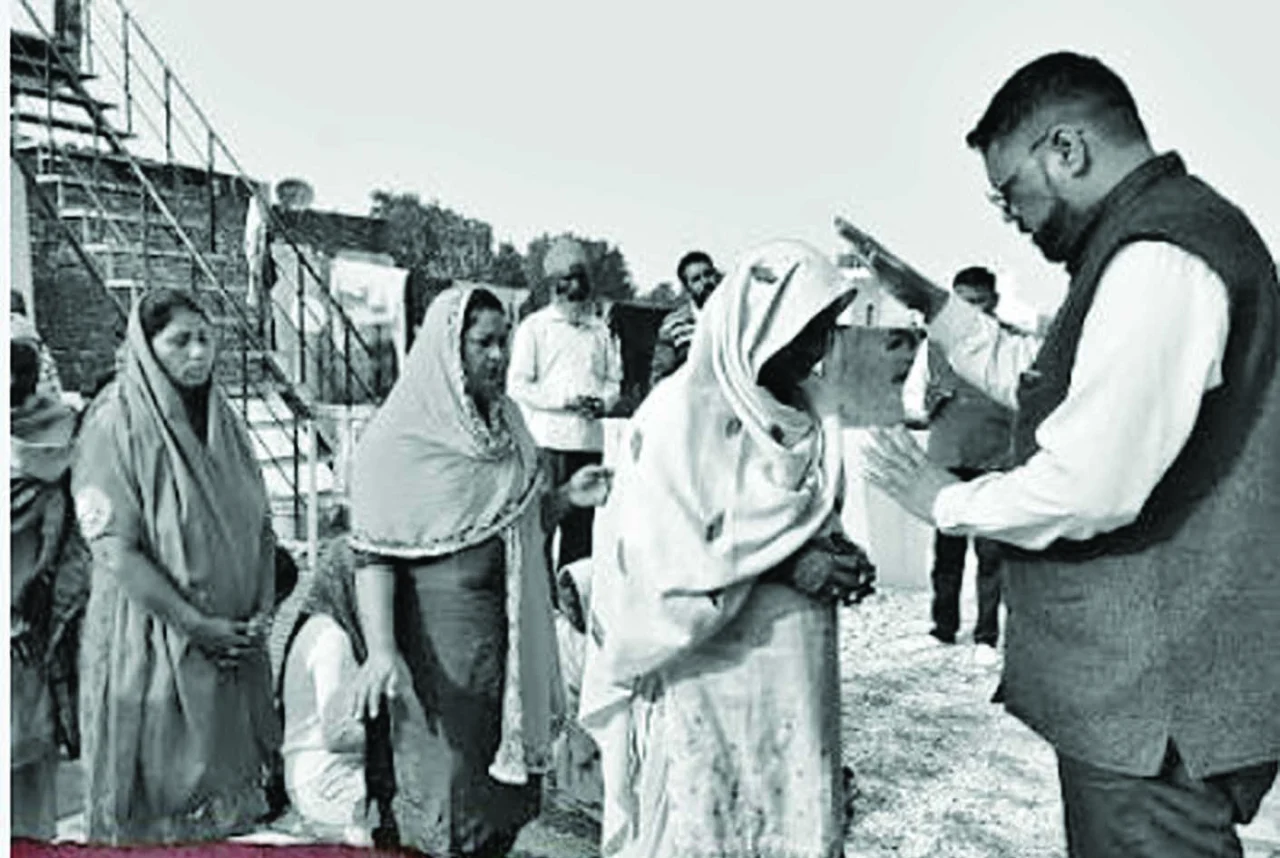
The Bill also requires State Police and investigative agencies to obtain prior Central Government approval before initiating FCRA-related inquiries
The Legal Position
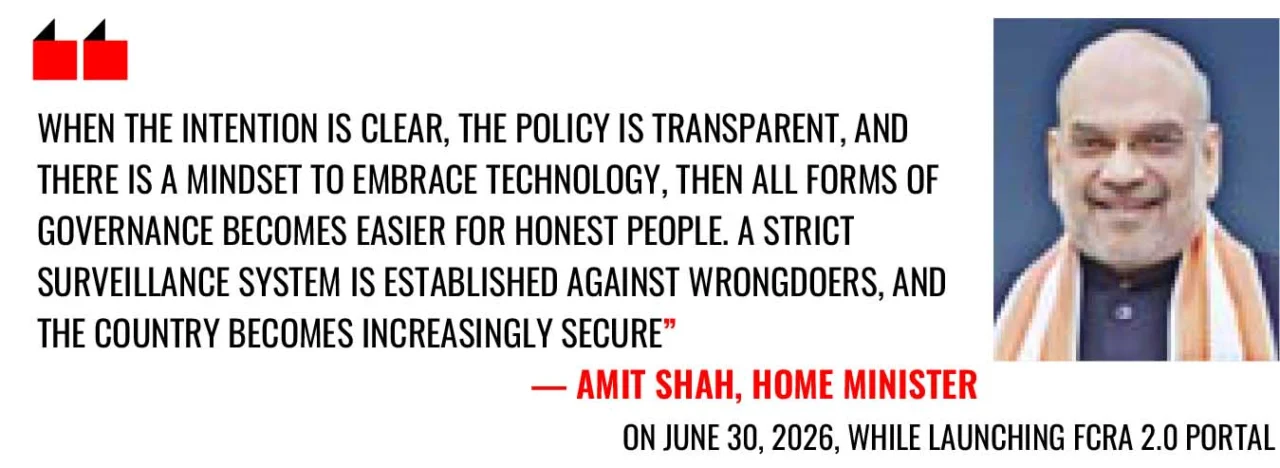
The Government’s position rests on a consistent line of Supreme Court judgements. In Bharat Kumar Paliwal v. Union of India (1996), the Court held that regulating foreign contributions does not infringe fundamental rights, recognising the state’s legitimate interest in ensuring foreign money does not influence Bharat’s domestic political processes. The 2020 FCRA amendments were also examined in Noel Harper v. Union of India (2022), where a three-judge Bench upheld almost all the challenged provisions, modifying only the Aadhaar-only identification requirement. This suggests the judiciary has generally given Parliament broad latitude to regulate foreign contributions on grounds of sovereignty and national security, and the 2026 Bill is expected to be tested along similar lines once it clears Parliament. Introducing the 2026 Bill, Minister of State for Home Affairs Nityanand Rai said its purpose is to make the use of foreign contributions more transparent and accountable, while ensuring that genuine educational and welfare institutions aligned with Bharat’s sovereignty and integrity face no obstruction. Although the Bill remains pending after facing opposition in Parliament, the Government has notified the FCRA (Amendment) Rules, 2026, on June 22, and launched the FCRA 2.0 portal to digitise compliance. As with any major regulatory change, some opposition parties and affected organisations have raised concerns about the pace and scope of the changes, which the government says will be considered as the Bill proceeds through Parliament.
In October 2024, the Income Tax Department in India has conducted a significant crackdown on several NGOs, including Oxfam India, Centre for Policy Research (CPR)- the Delhi-based think tank, Environics Trust (ET), the Legal Initiative for Forest and Environment (LIFE), and Care India Solution for Sustainable Development (CISSD). The FCRA licences of these NGOs were subsequently suspended by the Central government.Following the searches conducted by the Income Tax Department, it was concluded that threse NGOs had violated provisions of the 2010 Foreign Contribution Regulation Act (FCRA). The violations were primarily related to discrepancies or a “mismatch” between the NGOs’ annual returns and the statements of their foreign currency bank accounts. Additionally, the NGOs were accused of the “misutilisation” of foreign currency funds
The 2026 Bill represents the next step in that process, closing gaps previously used by a small section of the sector, aligning Bharat’s framework more closely with international practice, and allowing the wider welfare ecosystem to continue its work
The Broader Context
The overwhelming majority of Bharat’s voluntary sector has nothing to do with foreign funding or political mobilisation. It comprises teachers, doctors, and volunteers carrying out essential work with domestic resources or small, transparently used foreign grants, and the Government has consistently maintained that such institutions have nothing to fear from tighter oversight. However, the well-documented removal of more than 37,000 organisations from the foreign-funding ecosystem since 2011, together with a Bill centred on asset vesting, deemed cessation, and personal accountability for key functionaries, explains why New Delhi has progressively treated foreign contribution regulation as an issue of national sovereignty rather than routine financial compliance. The 2026 Bill represents the next step in that process, closing gaps previously used by a small section of the sector, aligning Bharat’s framework more closely with international practice, and allowing the wider welfare ecosystem to continue its work.