Bastar sees peaceful ‘Shaheedi Week’ as maoist grip weakens
September 13, 2026
  • Read Ecopy
  • Circulation
  • Advertise
  • Careers
  • About Us
  • Contact Us
Android AppiPhone AppArattai
Organiser
  • ‌
  • Bharat
    • Assam
    • Bihar
    • Chhattisgarh
    • Jharkhand
    • Maharashtra
    • View All States
  • World
    • Asia
    • Europe
    • North America
    • South America
    • Africa
    • Australia
  • Editorial
  • International
  • Opinion
  • RSS @ 100
  • More
    • World Hindu Congress 2026
    • Op Sindoor
    • Analysis
    • Sports
    • Defence
    • Politics
    • Business
    • Economy
    • Culture
    • Special Report
    • Sci & Tech
    • Entertainment
    • G20
    • Azadi Ka Amrit Mahotsav
    • Vocal4Local
    • Web Stories
    • Education
    • Employment
    • Books
    • Interviews
    • Travel
    • Law
    • Health
    • Obituary
  • Subscribe
    • Subscribe Print Edition
    • Subscribe Ecopy
    • Read Ecopy
  • ‌
  • Bharat
    • Assam
    • Bihar
    • Chhattisgarh
    • Jharkhand
    • Maharashtra
    • View All States
  • World
    • Asia
    • Europe
    • North America
    • South America
    • Africa
    • Australia
  • Editorial
  • International
  • Opinion
  • RSS @ 100
  • More
    • World Hindu Congress 2026
    • Op Sindoor
    • Analysis
    • Sports
    • Defence
    • Politics
    • Business
    • Economy
    • Culture
    • Special Report
    • Sci & Tech
    • Entertainment
    • G20
    • Azadi Ka Amrit Mahotsav
    • Vocal4Local
    • Web Stories
    • Education
    • Employment
    • Books
    • Interviews
    • Travel
    • Law
    • Health
    • Obituary
  • Subscribe
    • Subscribe Print Edition
    • Subscribe Ecopy
    • Read Ecopy
Organiser
  • Home
  • Bharat
  • World
  • Operation Sindoor
  • Editorial
  • Analysis
  • Opinion
  • Culture
  • Defence
  • International Edition
  • RSS @ 100
  • Magazine
  • Read Ecopy
Home Bharat

From Fear to Freedom: Bastar marks peaceful ‘Shaheedi Week’ as maoist grip weakens

Bastar, Chhattisgarh, saw its first disruption-free so-called ‘Shaheedi Week’ as Maoist influence declined. Once marked by fear, shutdowns, and forced participation, the July 28–August 3 observance passed quietly. Improved security and sustained government action have restored normal life across previously affected regions

Dr Samanwaya NandaDr Samanwaya Nanda
Aug 3, 2026, 06:00 pm IST
inBharat, Chhattisgarh
Follow on Google News
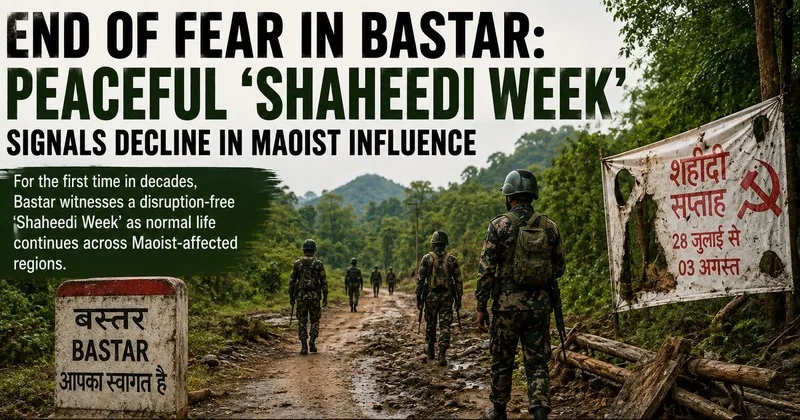
Bastar witnessed a peaceful ‘Shaheedi Week’ as declining Maoist influence allowed normal life to continue uninterrupted

Bastar witnessed a peaceful ‘Shaheedi Week’ as declining Maoist influence allowed normal life to continue uninterrupted

Facebook
Twitter
WhatsAppTelegramEmail

Jagdalpur: In a significant shift reflecting the weakening grip of Red Terrorism, Chhattisgarh’s Bastar region witnessed an unprecedented development this year: the annual “Shaheedi Week” (Martyrs’ Week), observed by Maoists from July 28 to August 3, passed without any noticeable impact. For the first time in decades, areas once overshadowed by fear and enforced shutdowns remained active, with normal life continuing uninterrupted.

The change follows sustained efforts by both the Central and State governments in their decisive campaign against Maoists . Several regions in Bastar have recently been declared Maoist-free, and the effects of this transformation are now becoming visible on the ground.

In previous years, ‘Shaheedi Week’ would bring daily life to a standstill across large parts of Bastar. Villagers were often forced to stay indoors, markets shut down, transport services halted, and participation in Maoist-organised events was sometimes made compulsory. The atmosphere was marked by fear, uncertainty, and the constant threat of violence.

However, this year presented a stark contrast. Across traditionally Maoist-affected areas, shops remained open, buses operated normally, and villagers carried on with agricultural activities and daily labour without disruption. There were no reports of violence, road blockades, or intimidation—clear indicators of a shifting security landscape.

Administrative Push and Security Measures Drive Change

Officials attribute this transformation to sustained security operations and a proactive administrative presence in previously inaccessible regions. Areas declared Maoist-free on March 31 have since witnessed accelerated implementation of government schemes. Development initiatives, including road connectivity, electrification, water supply, and expansion of Anganwadi services, have significantly improved living conditions.

The combined efforts of security forces and civil administration have helped restore confidence among local residents. Continuous monitoring, improved intelligence networks, and stronger infrastructure have reduced the operational capabilities of Maoist groups, allowing governance mechanisms to function effectively.

Unlike previous years, administrative activities and development projects continued without interruption during the ‘Shaheedi Week,’ signalling a stable and secure environment. Officials emphasise that such continuity is crucial in ensuring that normalcy is not just restored but sustained.

Chintagufa: From Epicentre of Violence to Symbol of Change

The transformation is particularly evident in the Chintagufa police station area, once considered one of the most Maoist-affected zones in Bastar. This region had witnessed some of the deadliest attacks in the history of the insurgency, including the 2010 Tadmetla ambush in which 76 CRPF personnel were killed, and the 2017 Burkapal attack that claimed the lives of 25 security personnel. Overall, more than 150 security personnel have lost their lives in Maoist-related incidents in this region.

During past ‘Shaheedi Week’ observances, Maoists frequently targeted vehicles, leading to arson and complete disruption of transport services. Roads such as Bijapur–Konta and Jagargunda–Sukma were particularly vulnerable, often becoming inaccessible.

This year, however, these sensitive routes remained fully operational. Buses under the Chief Minister’s Rural Bus Scheme and other vehicles moved freely without any security incidents. The uninterrupted transport services are being seen as a strong indicator of improved law and order and a decline in Maoist influence.

Villages in the Chintagufa area further highlight the depth of change. Residents were observed engaging in routine activities without fear. Farmers were busy preparing their fields, while electricity department workers carried out maintenance, such as trimming trees along power lines—activities that were once unthinkable in this region.

Also Read: 99.7 per cent marks, no selection: Why the silence on Jharkhand’s PGT recruitment row after Delhi erupted over NEET?

Villagers expressed a newfound sense of confidence and freedom. Many stated that the pervasive fear that once dominated their lives has significantly diminished. Women reported regularly receiving benefits under the State government’s ‘Mahtari Vandan Yojana,’ which has contributed to improved household stability.

Residents also noted the arrival of basic infrastructure, including roads, Anganwadi centres, and a reliable electricity supply. Importantly, they pointed out that Maoist diktats, which once dictated their daily routines, are no longer a part of their lives.

From Forced Shutdowns to Uninterrupted Life

According to locals, earlier ‘Shaheedi Week’ observances meant a complete halt to daily activities from July 28 to August 3. Movement outside villages was restricted, markets remained closed, and agricultural work was suspended. In several instances, villagers were compelled to attend Maoist gatherings.

This year, however, many villagers claimed they were unaware of when the ‘Shaheedi Week’ began or ended—an indication of how irrelevant the observance has become in the current context. The absence of fear and coercion has allowed communities to function normally, marking a psychological shift as much as a physical one.

A New Chapter of Stability and Development

The ineffectiveness of this year’s ‘Shaheedi Week’ is being seen as a strong signal of the declining influence of Maoist insurgency in Bastar. The region, long associated with violence and instability, is gradually transitioning toward peace and development.

Authorities believe that sustained security presence combined with focused development initiatives will be key to maintaining this progress. As roads expand, connectivity improves, and welfare schemes reach the grassroots, the foundation for long-term stability is being strengthened.

For the people of Bastar, the return of normal life after years of conflict represents not just a change in circumstances, but the beginning of a new chapter—one defined by hope, security, and opportunity.


 

Topics: Red terrorMaoist insurgencyChhattisgarh GovernmentMaoist free BastarShaheedi WeekMaoistChhattisgarhBastar
Share
Tweet
SendShareSend
✮ Subscribe Organiser YouTube Channel. ✮
✮ Join Organiser's WhatsApp channel for Nationalist views beyond the news. ✮
Previous News

Tamil Nadu: CPM attacks TVK minister for seeking Bhagwan Venkateswara’s blessings at Tirumala before agriculture budget

Next News

PML-N now has 23 legislators in PoJK assembly, heading towards government formation

Related News

Five Maoists were convicted in the 2015 Bhainsgaon-Nagarmari ambush case in Chhattisgarh

Chhattisgarh: Five Maoists convicted in 2015 Bhainsgaon-Nagarmari ambush case; Couple gets seven years each

Former Naxals seek spiritual path at Sri Sri Ravi Shankar's Art of Living ashram

Former Naxals seek spiritual path at Sri Sri Ravi Shankar’s Art of Living ashram as India declares win over red terror

Large cache of maoist arms, explosives and other materials recovered in Sukma

Chhattisgarh: Major maoist dump recovered in Sukma; Weapons, BGL pipes, detonators and explosives seized

Security forces recovered 14 Maoist dumps containing weapons and IEDs in Bijapur

Chhattisgarh: Security forces recover large Maoist dumps, weapons and explosives in Bijapur and Kondagaon

Bilaspur Police detains 23 people from the Sirgitti area.

Chhattisgarh: Crackdown on Bangladeshi infiltrators: 23 detained in Bilaspur, shifted to detention centre

Weapons, BGL cells and other materials recovered from suspected Maoist dump in Chhattisgarh’s Bijapur

Chhattisgarh: Security forces recover Maoist weapons dump hidden inside hollow tree in Bijapur forest

Load More

Latest News

Exterior of the Lokayukta Building

Karnataka Lokayukta records 1,248 cases in four years, 887 linked to bribery

RSS Akhil Bharatiya Karyakarini Sadasya Dr Manmohan Vaidya at a Pramukh Jan Samvad Sangosthi organised by Kashi Mahanagar on the occasion of the RSS Centenary Year,

Entire society must unite with a sense of oneness; This Is the spirit of Sangh Work: Dr Manmohan Vaidya

‘Samuel Could Never Do This’: Mother Rejects Blasphemy Allegations Against Son in Lahore

Pakistan Blasphemy Case: Mother of Christian man Samuel Arif claims false implication, seeks justice

Prime Minister Narendra Modi, along with Chinese President Xi Jinping, Russian President Vladimir Putin and other world leaders, poses for a picture at a joint tree plantation initiative during the BRICS Summit

BRICS Summit 2026: India as the voice of Global South, shared responsibilities & scripting inclusive world order

Chinese President Xi Jinping and Prime Minister Narendra Modi

BRICS Summit 2026: PM Modi hold talks with President Xi; Stresses border peace & tranquility as key to India-China ties

Tamil Nadu: Hindu Munnani flags TVK govt’s restrictions on Vinayaka pandals, barring women, children from processions

Lashkar-e-Toiba founder Hafiz Saeed. (File image)

J&K Terror Case: Hafiz Saeed gets second NBW; NIA says he operates from Pakistan

Pakistan’s push for a place in the expanding BRICS bloc faces a difficult diplomatic road ahead, despite backing from key partners.

Pakistan knocking BRICS Door: Why Islamabad’s 2023 membership bid remains elusive despite Chinese and Russian support

BRICS Bazaar

BRICS Bazaar: Global traditions and cultural diplomacy take center stage at New Delhi’s National Crafts Museum

(From Left to Right): Russian President Vladimir Putin, PM Modi & Chinese President Xi Jinping

BRICS New Delhi Declaration | Key Takeaways: Cross-border payment, counter-terrorism to tech ties & supply resilience

Load More
  • Privacy
  • Terms
  • Cookie Policy
  • Refund and Cancellation
  • Delivery and Shipping

© Bharat Prakashan (Delhi) Limited.
Tech-enabled by Ananthapuri Technologies

  • Home
  • Search Organiser
  • Bharat
    • Assam
    • Bihar
    • Chhattisgarh
    • Jharkhand
    • Maharashtra
    • View All States
  • World
    • Asia
    • Africa
    • North America
    • South America
    • Europe
    • Australia
  • Editorial
  • Operation Sindoor
  • Opinion
  • Analysis
  • Defence
  • Culture
  • Sports
  • Business
  • RSS @ 100
  • Entertainment
  • More ..
    • Sci & Tech
    • Vocal4Local
    • Special Report
    • Education
    • Employment
    • Books
    • Interviews
    • Travel
    • Health
    • Politics
    • Law
    • Economy
    • Obituary
  • Subscribe Magazine
  • Read Ecopy
  • Advertise
  • Circulation
  • Careers
  • About Us
  • Contact Us
  • Policies & Terms
    • Privacy Policy
    • Cookie Policy
    • Refund and Cancellation
    • Terms of Use

© Bharat Prakashan (Delhi) Limited.
Tech-enabled by Ananthapuri Technologies