
Life insurance helps protect your loved ones from financial uncertainty if something unexpected happens to you. For many working professionals, life insurance coverage begins at the workplace through an employer-sponsored group plan. Others choose to buy an individual personal policy to guarantee their family’s long-term financial security.
While both options provide an essential financial safety net, they differ fundamentally in ownership, duration, flexibility, and cost. Understanding how these two models stack up against each other can help you assess whether your existing workplace cover is sufficient or if additional personal protection is needed to meet your family’s long-term financial responsibilities.
Comparing the Two Types of Cover
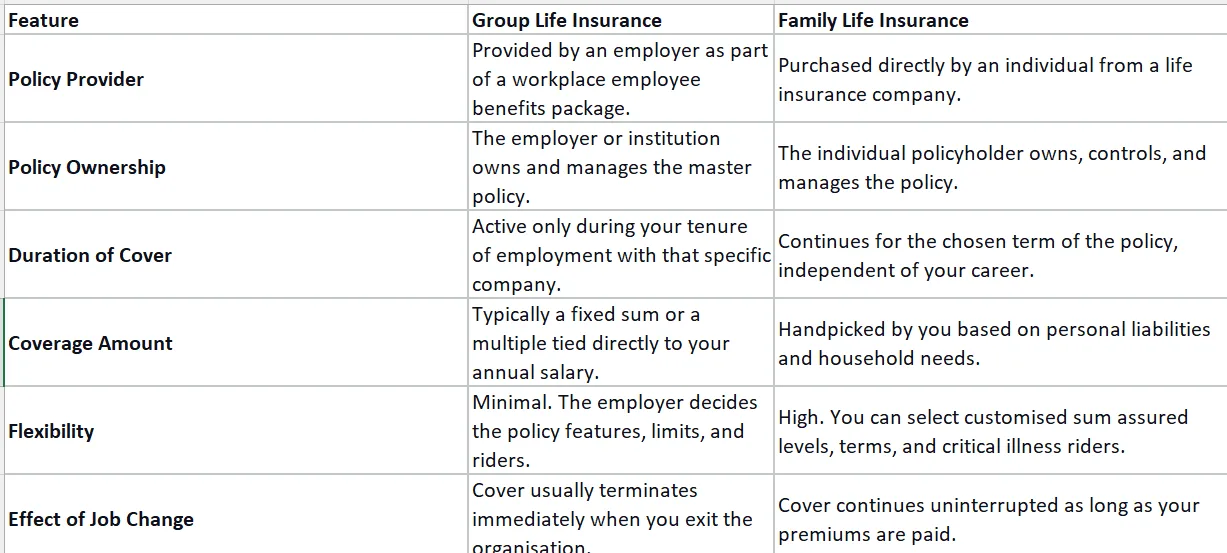
While both group and family life insurance provide financial support to beneficiaries, they serve entirely different purposes and offer different levels of control. The comparison below breaks down how each option works across key operational features:
Which Model Offers Better Protection?
Determining which type of insurance offers “better” protection depends heavily on your current life stage, outstanding financial liabilities, and long-term family milestones.
The Case for Group Life Insurance
Employer-sponsored insurance provides immediate financial protection without requiring you to research, apply for, or manage a separate policy. As employers usually subsidise or fully cover the premium, it acts as a highly valuable, zero-cost or low-cost workplace perk. Furthermore, group policies are often extended to employees with minimal or no medical screening, making it an excellent baseline protection tool for individuals who might otherwise face high premiums due to pre-existing health conditions.
The Case for Family Life Insurance
The primary limitation of group life insurance is its lack of portability. Financial commitments such as home loans, children’s higher education, and daily household expenses do not disappear when you change jobs, experience a corporate layoff, or retire. If your family relies solely on workplace insurance, an unexpected career transition could leave them entirely unprotected during a critical window.
Family life insurance offers complete control. As you own the policy, the coverage remains active regardless of your employment status. This allows you to lock in lower premium rates while you are young and healthy, creating a permanent shield that safeguards your family’s lifestyle through every career transition.
5 Critical Factors to Review Before Choosing
Before deciding if your current coverage is sufficient, review your household’s financial health against these five pillars:
- Number of Financial Dependants: Evaluate how many family members rely entirely on your monthly income. A larger household typically requires a more substantial, customised payout than a standard group policy provides.
- Outstanding Debt and Financial Commitments: Take inventory of major long-term liabilities, such as home loans, personal loans, or credit card debt. Your coverage should be large enough to clear these debts entirely so your family is not burdened with repayments.
- Income Replacement Timeline: Estimate how many years of your current salary your family would need to maintain their standard of living if your income suddenly stopped. Experts often recommend a sum assured that is at least 10 to 15 times your annual income.
- Future Milestones and Inflation: Factor in future, inflation-adjusted expenses such as your children’s higher education, weddings, or a spouse’s retirement fund. Fixed employer policies rarely account for these long-term individual goals.
- Existing Workplace Terms: Carefully read the fine print of your corporate policy. Understand the exact sum assured, whether it includes accidental disability benefits, and what happens to the coverage during extended medical leave or resignation.
Conclusion
Both employer-sponsored group insurance and personal family life insurance play vital roles in a comprehensive financial plan. Group cover offers convenient, cost-effective protection while you build your career with an organisation. However, it cannot replace the security, high sum assured customisation, and permanent nature of a dedicated personal policy.
When evaluating your personal protection gaps, exploring comprehensive solutions from established life insurers like Aviva can help you strike the right balance. Assessing your insurance portfolio regularly ensures that your coverage evolves alongside your family’s changing financial needs, keeping your loved ones truly secure for the long haul.
(Disclaimer: The views expressed by the author are personal and not of the publication)