Balochistan has once again drawn global attention after a self-proclaimed “Republic of Balochistan” declared independence from Pakistan and sought international recognition, reigniting focus on the region’s decades-old nationalist movement and uncertain political future. Against this backdrop, history recalls a little-known episode from 1948, when India was presented with a rare strategic opportunity in Balochistan, one that then-Prime Minister Jawaharlal Nehru ultimately chose to reject.
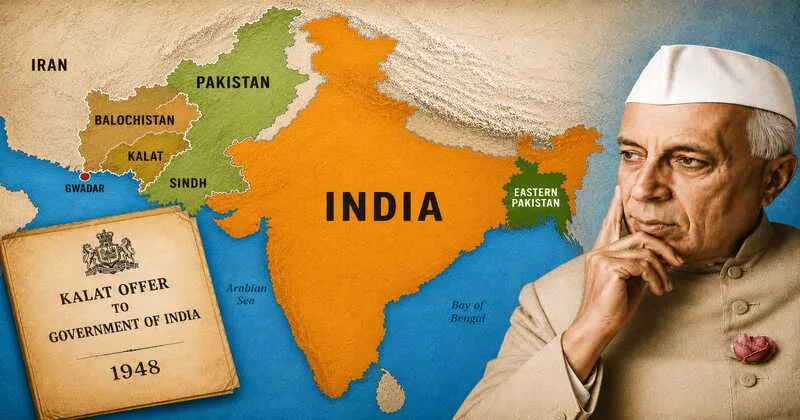
In the turbulent months following the Partition of the Indian subcontinent, when the political map of South Asia was still being redrawn, India was presented with one of the greatest geopolitical opportunities in its modern history. In March 1948, Mir Ahmed Yar Khan, the Khan of Kalat, ruler of the largest and most influential princely state in Balochistan, secretly approached New Delhi with an extraordinary proposal. Through confidential emissaries, he expressed his willingness to accede Kalat to India.
Had India accepted the offer, the geopolitical architecture of South Asia would have been dramatically different. India would have acquired a strategically invaluable presence on the Arabian Sea, sharing proximity with Iran and Afghanistan, while simultaneously denying Pakistan complete control over its western frontier. Instead, Prime Minister Jawaharlal Nehru rejected the proposal, a decision that remains one of the most controversial strategic choices in independent India’s history.
Located in present-day south-western Pakistan, Kalat lies about 150 kilometres south of Quetta in the heart of Balochistan. Historically, the Khanate of Kalat was the largest and most influential princely state in the region, occupying a strategic position between the Arabian Sea, Iran, Afghanistan and the Indian subcontinent. Its location at the crossroads of South Asia, West Asia and Central Asia made it a geopolitical prize with immense military, commercial and strategic significance.
The wider region also has deep civilisational links with ancient Bharat, with nearby areas traditionally associated with the kingdoms of Sivi (Shivi) and Sauvira mentioned in the Mahabharata, long before the emergence of the Khanate of Kalat.
Kalat’s appeal to India and Nehru’s refusal
Unlike most princely states that formed part of British India, the Khanate of Kalat occupied a unique constitutional position under the British Crown. The Khan consistently argued that Kalat was not merely another princely state but a sovereign political entity comparable to Nepal or Afghanistan. As British rule ended, this claim received temporary recognition.
On August 11, 1947, a separate agreement acknowledged Kalat’s independent status. However, the newly created state of Pakistan immediately began exerting sustained pressure on the Khan to join Pakistan. Seeking to preserve Kalat’s autonomy and counter Islamabad’s growing pressure, the Khan quietly turned towards New Delhi.
When the proposal reached the Indian leadership in March 1948, Nehru and his Cabinet examined its implications but ultimately declined. Their principal argument centred on geography. Kalat had no direct land border with India. It was separated from Indian territory by hundreds of kilometres of Pakistani territory, the deserts of Sindh and the Arabian Sea. According to Nehru, administering, defending and supplying such an isolated territory would be militarily and logistically impossible.
His government also argued that India was already overstretched. By early 1948, Indian forces were engaged in the first Indo-Pakistan war over Jammu and Kashmir, while simultaneously dealing with the integration of major princely states such as Hyderabad and Junagadh. Opening another military front thousands of kilometres away was viewed as an unacceptable strategic burden.
Nehru also feared the diplomatic consequences. He believed accepting Kalat’s accession would be portrayed internationally as territorial expansionism, provoking Pakistan into prolonged conflict, weakening India’s fragile economy and alienating Western powers whose diplomatic goodwill the new republic considered important.
Critics, however, argue that this reasoning reflected excessive caution rather than strategic vision. They point out that Nehru rejected the proposal primarily because Kalat lacked geographical continuity with India. Yet, the very creation of Pakistan in 1947 demonstrated that territorial discontinuity was not considered an insurmountable obstacle. Pakistan itself came into existence as two geographically separate wings, West Pakistan and East Pakistan (Bangladesh), divided by nearly 1,600 kilometres of Indian territory. Despite this lack of territorial continuity, Pakistan accepted and sought to govern both regions as a single sovereign state. Critics, therefore, argue that the geographical argument invoked to reject Kalat appears inconsistent when viewed against the political realities of Partition itself.
The disclosure that changed Balochistan’s fate
The confidential negotiations might have continued had secrecy been maintained. Instead, a remarkable diplomatic lapse altered the course of history. On March 27, 1948, during a press conference, V. P. Menon, Secretary of the Ministry of States, publicly disclosed that the Khan of Kalat had repeatedly requested accession to India but that New Delhi had rejected the proposal because of geographical constraints. The revelation was subsequently broadcast across the country by All India Radio.
The announcement destroyed the Khan’s diplomatic cover and eliminated any possibility of plausible deniability. Pakistan immediately interpreted the disclosure as evidence that Kalat was seeking external support against its demands.
The response was swift. On March 28, 1948, just one day after the public disclosure, Pakistani forces entered Kalat. Isolated, surrounded and facing military pressure without any prospect of Indian assistance, the Khan had little room for resistance. Under these circumstances, he signed the Instrument of Accession to Pakistan under duress. With that signature, India’s opportunity to establish a strategic presence on the western edge of the subcontinent disappeared permanently.
A strategic opportunity lost for generations
The consequences of Nehru’s decision continue to generate debate more than seven decades later. Had Kalat become part of India, the country would have possessed direct strategic access towards West Asia and Central Asia, while enjoying a commanding position along the Arabian Sea.
Pakistan would have been denied complete control over Balochistan’s vast coastline and its enormous natural resources. India’s western strategic depth would have expanded significantly, potentially transforming regional trade routes, energy corridors and military calculations.
Instead, New Delhi surrendered a historic geopolitical advantage without even testing whether long-term strategic arrangements could have made such an accession viable. The episode also raises difficult questions regarding India’s diplomatic handling of the matter.
The public disclosure of confidential negotiations by V. P. Menon not only embarrassed the Khan but arguably accelerated Pakistan’s military intervention. Within twenty-four hours of the revelation, Kalat lost the limited diplomatic space it still possessed.
Supporters of Nehru maintain that India in 1948 lacked the military capacity and economic resources to defend an isolated territory while simultaneously fighting in Kashmir and integrating hundreds of princely states. They argue that the decision reflected realism rather than weakness.
However, critics contend that the rejection represented a profound failure of geopolitical imagination. They argue that Nehru evaluated Kalat through the limitations of immediate logistics rather than through the lens of long-term strategic interests. From this perspective, Nehru forfeited what could have become its gateway to West Asia and Central Asia, while allowing Pakistan to consolidate complete control over Balochistan.
The annexation of Kalat also marked the beginning of a prolonged and unresolved conflict in Balochistan. Decades of insurgency, political unrest and demands for greater autonomy have continued to shape Pakistan’s internal security and the wider geopolitics of South Asia. For many observers, the events of March 1948 remain one of independent Nehru’s greatest strategic “what-ifs”, a moment when a single decision closed the door on a geopolitical opportunity whose consequences continue to reverberate across the region.