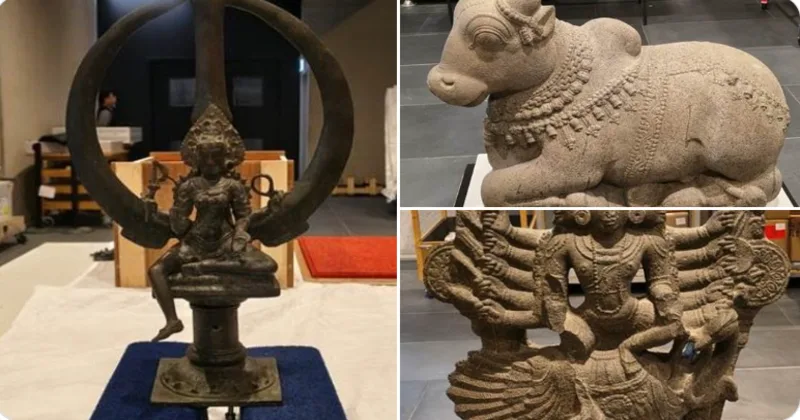
MELBOURNE: In a significant gesture of cultural cooperation and heritage restoration, Australia has announced the voluntary repatriation of three ancient Tamil Nadu temple artefacts to India during the 3rd India–Australia Annual Summit. The return of the centuries-old idols, which were smuggled out of the country and later traced through investigations by the Tamil Nadu Idol Wing-CID, marks another milestone in India’s global efforts to reclaim its stolen civilisational heritage under Prime Minister Narendra Modi’s leadership.
The artefacts include a ceremonial metal trident crowned with the image of Goddess Bhadrakali and a stone idol of Nandi, both belonging to the Shri Kashi Vishwanath Swamy Temple at Kullumangudi in Tamil Nadu’s Tiruvarur district, along with a rare six-faced stone idol of Lord Kartikeya (Shanmukha) from the Naganatha Swamy Temple at Manambadi near Kumbakonam. The idols were formally handed over during Prime Minister Narendra Modi’s visit to Melbourne, where he held bilateral talks with Australian Prime Minister Anthony Albanese.
According to officials, the antiquities had been housed at the National Gallery of Australia after being trafficked out of India. Their recovery was made possible through investigations by the Tamil Nadu Idol Wing-CID, which invoked the Mutual Legal Assistance Treaty (MLAT) mechanism to trace and secure their return.
The six-faced stone image of Shanmukha, also revered as Murugan, Skanda and Subramanya in different traditions, is believed to date back to the 12th century during the Chola period. Standing approximately 130 cm tall, the sculpture is valued by the Idol Wing at around Rs 4 crore, although historians say its cultural and historical significance is beyond monetary value. Originally carved for the Rajendra Chola-era Naganathaswamy Temple at Manambadi, the idol is now set to return to its rightful home after centuries.
"ஆஸ்திரேலியா, தமிழகத்தின் கொள்ளுமாங்குடியில் உள்ள ஸ்ரீ காசி விஸ்வநாதசுவாமி கோயிலுக்குச் சொந்தமான, பிற்கால சோழர் காலத்தைச் சேர்ந்த பத்திரகாளி அம்மன் உருவம் பொறிக்கப்பட்ட உலோகத் திரிசூலத்தை இந்தியாவிடம் மீள ஒப்படைக்க உள்ளது."🔱🙏🏻 https://t.co/rYBZS7M822 pic.twitter.com/TeM8kKk3AQ
— MR.Anil (@Saffron_Anil_) July 9, 2026
Historian T.S. Krishnan welcomed the development, describing it as a major victory for India’s heritage conservation efforts. He noted that the return of the Shanmukha idol could become a catalyst for the restoration of the historic Naganathaswamy Temple, which has suffered extensive damage over the years.
“Australia will repatriate the stone vigraha of Shanmuga from the Naganathaswamy Temple at Manambadi. This is especially significant because the temple was built during the reign of Rajendra Chola. Hopefully, the return of Murugan will become the catalyst for the restoration and revival of this historically important temple,” he wrote on X while appreciating the Government of India’s sustained efforts to bring back stolen antiquities.
In a significant development, Australia will repatriate the stone vigraha of Shanmuga from the Naganathaswamy Temple at Manambadi.
This is especially significant because the temple was built during the reign of Rajendra Chola. Sadly, it now lies in a dilapidated state after… pic.twitter.com/YCxCcljrg3
— 𑀓𑀺𑀭𑀼𑀱𑁆𑀡𑀷𑁆 🇮🇳 (@tskrishnan) July 9, 2026
The repatriation also reflects the growing cultural partnership between India and Australia. In a reciprocal humanitarian gesture, India agreed to return the ancestral remains of an Australian First Nations individual that had been preserved at the Government Museum in Chennai.
The latest development continues India’s broader campaign to recover stolen antiquities from across the world. Under the Ministry of Culture and the Archaeological Survey of India, hundreds of artefacts have been traced and repatriated in recent years through diplomatic engagement and international legal cooperation. Similar returns have taken place during Prime Minister Modi’s visits to the United States, the United Kingdom and the Netherlands, where the historic Anaimangalam copper plates were handed over earlier this year.
The return of the three Tamil Nadu idols not only restores priceless works of art to their original cultural setting but also represents another step in safeguarding India’s civilisational legacy for future generations.