India–Japan Cultural Diplomacy: Key highlights of Takaichi's visit
July 8, 2026
  • Read Ecopy
  • Circulation
  • Advertise
  • Careers
  • About Us
  • Contact Us
Android AppiPhone AppArattai
Organiser
  • ‌
  • Bharat
    • Assam
    • Bihar
    • Chhattisgarh
    • Jharkhand
    • Maharashtra
    • View All States
  • World
    • Asia
    • Europe
    • North America
    • South America
    • Africa
    • Australia
  • Editorial
  • International
  • Opinion
  • RSS @ 100
  • More
    • Op Sindoor
    • Analysis
    • Sports
    • Defence
    • Politics
    • Business
    • Economy
    • Culture
    • Special Report
    • Sci & Tech
    • Entertainment
    • G20
    • Azadi Ka Amrit Mahotsav
    • Vocal4Local
    • Web Stories
    • Education
    • Employment
    • Books
    • Interviews
    • Travel
    • Law
    • Health
    • Obituary
  • Subscribe
    • Subscribe Print Edition
    • Subscribe Ecopy
    • Read Ecopy
  • ‌
  • Bharat
    • Assam
    • Bihar
    • Chhattisgarh
    • Jharkhand
    • Maharashtra
    • View All States
  • World
    • Asia
    • Europe
    • North America
    • South America
    • Africa
    • Australia
  • Editorial
  • International
  • Opinion
  • RSS @ 100
  • More
    • Op Sindoor
    • Analysis
    • Sports
    • Defence
    • Politics
    • Business
    • Economy
    • Culture
    • Special Report
    • Sci & Tech
    • Entertainment
    • G20
    • Azadi Ka Amrit Mahotsav
    • Vocal4Local
    • Web Stories
    • Education
    • Employment
    • Books
    • Interviews
    • Travel
    • Law
    • Health
    • Obituary
  • Subscribe
    • Subscribe Print Edition
    • Subscribe Ecopy
    • Read Ecopy
Organiser
  • Home
  • Bharat
  • World
  • Operation Sindoor
  • Editorial
  • Analysis
  • Opinion
  • Culture
  • Defence
  • International Edition
  • RSS @ 100
  • Magazine
  • Read Ecopy
Home Bharat

Santoor, Buddhism and Shared Values: The cultural diplomacy of Japanese PM Takaichi’s India tour

Prime Minister Sanae Takaichi's visit to India highlighted the deep civilisational foundations of the India–Japan partnership, where shared cultural heritage and soft power complement strategic cooperation. The visit showcased how traditions, Buddhist links, cultural symbolism, and people-to-people ties continue to strengthen one of Asia's most trusted bilateral relationships

Prof Vivek MishraProf Vivek Mishra
Jul 8, 2026, 07:00 pm IST
in Bharat, World, East Asia, Asia, International Edition
Follow on Google News
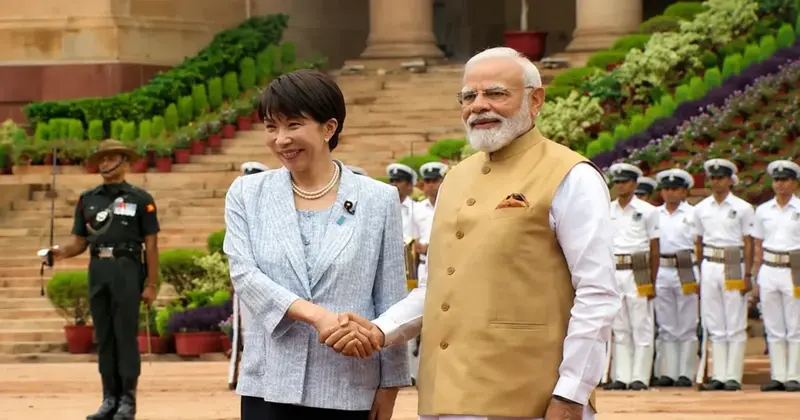
Japanese Prime Minister Sanae Takaichi and Prime Minister Narendra Modi

Japanese Prime Minister Sanae Takaichi and Prime Minister Narendra Modi

FacebookTwitterWhatsAppTelegramEmail

India and Japan share a unique civilisational partnership rooted in centuries of cultural exchange, Buddhist heritage, democratic values, and enduring people-to-people ties. While the relationship has expanded significantly across strategic, economic, and technological domains, its enduring strength lies in the shared cultural values, historical memories, and mutual trust that have evolved over generations. These civilisational linkages have also enabled both countries to harness culture as an important instrument of soft power and international engagement. The Japanese Prime Minister’s official visit to India reaffirmed that the India–Japan Special Strategic and Global Partnership is sustained not only by common interests but also by a deep sense of civilisational connectedness and cultural understanding. Through traditional ceremonies, symbolic gestures, references to shared heritage, and meaningful cultural interactions, the visit demonstrated how cultural diplomacy, as an important instrument of soft power, continues to strengthen bilateral relations, deepen people-to-people ties, and build a resilient partnership for the future.

Prime Minister Sanae Takaichi was accorded a ceremonial welcome at Rashtrapati Bhavan, reflecting India’s longstanding diplomatic traditions and the cultural ethos of Atithi Devo Bhava (“The guest is akin to God”). During the ceremony, she greeted her hosts with the traditional “Namaste”, a gesture widely regarded as conveying respect and cultural sensitivity. The exchange contributed to a cordial atmosphere that complemented the formal diplomatic proceedings and underscored the importance of cultural protocol in India–Japan engagement.

During the Annual Summit, Prime Minister Narendra Modi emphasised that India and Japan are connected not merely through economic cooperation or technological collaboration, but also through shared cultural values, mutual trust and a common developmental outlook. His observation underscored the idea that enduring international partnerships derive their resilience from common civilisational values and societal understanding rather than from transactional interests alone. An especially significant moment of the visit occurred during lunch at Hyderabad House, where Prime Minister Takaichi interacted with the Santoor, one of India’s classical musical instruments. Appreciated by Prime Minister Modi, this gesture symbolised the capacity of art and music to transcend political boundaries and foster genuine cultural dialogue. Such moments of artistic engagement represent important instruments of soft power, enabling states to cultivate emotional connectivity alongside formal diplomacy.

The visit further reflected the growing importance of personal diplomacy in international relations. Prime Minister Modi’s affectionate reference to Prime Minister Takaichi as his choti behen (“younger sister”) transcended diplomatic protocol and conveyed a sense of familiarity, trust, and emotional closeness.

Also Read: Ancient Shivling discovered at bottom of historic Amrit Kund at Trimbakeshwar Mandir in Nashik during ASI conservation

Such symbolic expressions humanise interstate relations and contribute to the development of long-term confidence between political leaders and their societies. A defining cultural dimension of the visit was the reaffirmation of the shared Buddhist heritage that has connected India and Japan for more than a millennium. Prime Minister Takaichi observed that her hometown, Nara, continues to preserve Buddhist traditions whose intellectual and spiritual origins lie in India. This acknowledgement highlighted the continuing relevance of Buddhism as a living civilisational bridge linking the two societies. Rather than being confined to history, this shared heritage continues to shape cultural exchanges, mutual perceptions, and contemporary diplomacy.

Prime Minister Takaichi also emphasised the importance of people-to-people exchanges, recognising cultural interaction, educational collaboration, tourism, youth mobility, and academic engagement as indispensable pillars of bilateral relations. She expressed confidence that the forthcoming 75th anniversary of diplomatic relations would provide renewed momentum to these exchanges, thereby strengthening societal partnerships beyond the governmental level.

One of the most intellectually significant cultural references during the visit was Prime Minister Takaichi’s invocation of former Japanese Prime Minister Shinzo Abe’s address to the Indian Parliament, in which he quoted Swami Vivekananda: “The different streams, having their sources in different places, all mingle their water in the sea.” This philosophical reflection represents India’s enduring civilisational vision of unity amidst diversity. By recalling Vivekananda’s words, Prime Minister Takaichi situated the contemporary India–Japan partnership within a broader framework of shared ethical values, cultural pluralism, and peaceful coexistence. The reference demonstrated that the bilateral relationship draws legitimacy not only from strategic convergence but also from a shared civilisational imagination that values dialogue, inclusiveness, and harmony.

Collectively, these cultural interactions illustrated that the India–Japan relationship is increasingly shaped by soft power, cultural symbolism, and societal engagement. Traditional greetings, artistic exchanges, Buddhist heritage, philosophical references, and interpersonal warmth transformed the visit from a routine diplomatic engagement into a meaningful expression of civilisational partnership. Such interactions strengthen mutual trust and foster a favourable social environment for expanding cooperation across strategic, economic, and technological domains.

Prime Minister Sanae Takaichi’s visit reaffirmed that the India–Japan relationship is fundamentally a civilisational partnership rooted in shared heritage, cultural values, democratic traditions, and enduring people-to-people ties. Symbolic moments such as the exchange of Namaste, the Santoor interaction, the reference to “Choti Behen,” recognition of India’s Buddhist legacy in Nara, and the invocation of Swami Vivekananda’s civilisational philosophy collectively highlighted the cultural foundations of bilateral relations.

The visit underscores an important principle of contemporary diplomacy: while strategic and economic interests define the scope of cooperation, it is shared cultural memory, mutual respect, and societal trust that sustain long-term international partnerships. From this perspective, India and Japan increasingly represent a model in which cultural diplomacy functions not merely as a supplement to foreign policy but as one of its core pillars.
Topics: Sanae TakaichiIndia Japan PartnershipIndia Japan Summitindia-japan relationsBuddhist heritage
ShareTweetSendShareSend
✮ Subscribe Organiser YouTube Channel. ✮
✮ Join Organiser's WhatsApp channel for Nationalist views beyond the news. ✮
Previous News

Karur Stampede Case: Supreme Court refuses DMK plea, says court not forum for political disputes

Next News

Ram Mandir donation row: ‘Exercise patience in times of crisis,’ says Champat Rai; will wait for final SIT report

Related News

Yamanashi Prefecture Governor Kotaro Nagasaki held discussions with Uttar Pradesh Chief Minister Yogi Adityanath

UP–Japan Partnership Strengthened: Yogi Adityanath signs historic green hydrogen MoU and boosts industrial ties

Devnimori relics of Buddha displayed in Colombo

Devnimori Relics: After Thailand, Mongolia, Vietnam, Buddhist relics makes historic journey to Sri Lanka

PM Modi is confident that Piprahwa relics will become a sacred pilgrimage centre

PM Modi is confident that Piprahwa relics will become a sacred pilgrimage centre for Buddhists globally

Archaeologists uncover a 1200-year-old Mandir in Swat Valley

Pakistan: Archaeologists uncover a 1200-year-old Mandir in Swat Valley, revealing centuries of religious history

Sanae Takaichi becomes Japan’s first female Prime Minister

The Dawn of a New Era: Sanae Takaichi becomes Japan’s first female Prime Minister

Lieutenant Governor of J&K Shri Manoj Sinha at the National Museum of Kalmykia, Russia

Padma Shri Vasudeo Kamath & Prof. Vinay Kumar Rao illuminate Buddha’s legacy in Kalmykia

Load More

Latest News

Prerna Park in Prayagraj: How Yogi Adityanath’s new memorial celebrates three pillars of India’s nationalist legacy

Champat Rai, former General Secretary of Shri Ram Janmabhoomi Teerth Kshetra Trust

Ram Mandir donation row: ‘Exercise patience in times of crisis,’ says Champat Rai; will wait for final SIT report

Japanese Prime Minister Sanae Takaichi and Prime Minister Narendra Modi

Santoor, Buddhism and Shared Values: The cultural diplomacy of Japanese PM Takaichi’s India tour

Karur Stampede Case: Supreme Court refuses DMK plea, says court not forum for political disputes

Why India needs a dedicated national award system to honour foreign heads of state and global leaders

NIA busts social media radicalisation network

Andhra Pradesh: NIA unmasks social media radicalisation network linked to ISIS and AQIS

No age, no barrier: 116-year-old Navaneethamma’s Thirumala trek reflects the Bharatiya spirit of devotion

Vice President to launch high seas fishing authorisation framework, Odisha Deep Sea Mission

Odisha: VP CP Radhakrishnan to launch letter of authorisation for sustainable high seas fishing

My Son Sanctuary, Vietnam

From Vietnam to Bahrain: Inside the Modi government’s mission to restore ancient Hindu Mandir across Asia

ADA approves renaming of under construction Ajmer multipurpose Stadium after Dr Shyama Prasad Mukherjee

Ajmer’s Panchsheel multipurpose stadium renamed to ‘Dr Shyama Prasad Mukherjee stadium’

Load More
  • Privacy
  • Terms
  • Cookie Policy
  • Refund and Cancellation
  • Delivery and Shipping

© Bharat Prakashan (Delhi) Limited.
Tech-enabled by Ananthapuri Technologies

  • Home
  • Search Organiser
  • Bharat
    • Assam
    • Bihar
    • Chhattisgarh
    • Jharkhand
    • Maharashtra
    • View All States
  • World
    • Asia
    • Africa
    • North America
    • South America
    • Europe
    • Australia
  • Editorial
  • Operation Sindoor
  • Opinion
  • Analysis
  • Defence
  • Culture
  • Sports
  • Business
  • RSS @ 100
  • Entertainment
  • More ..
    • Sci & Tech
    • Vocal4Local
    • Special Report
    • Education
    • Employment
    • Books
    • Interviews
    • Travel
    • Health
    • Politics
    • Law
    • Economy
    • Obituary
  • Subscribe Magazine
  • Read Ecopy
  • Advertise
  • Circulation
  • Careers
  • About Us
  • Contact Us
  • Policies & Terms
    • Privacy Policy
    • Cookie Policy
    • Refund and Cancellation
    • Terms of Use

© Bharat Prakashan (Delhi) Limited.
Tech-enabled by Ananthapuri Technologies