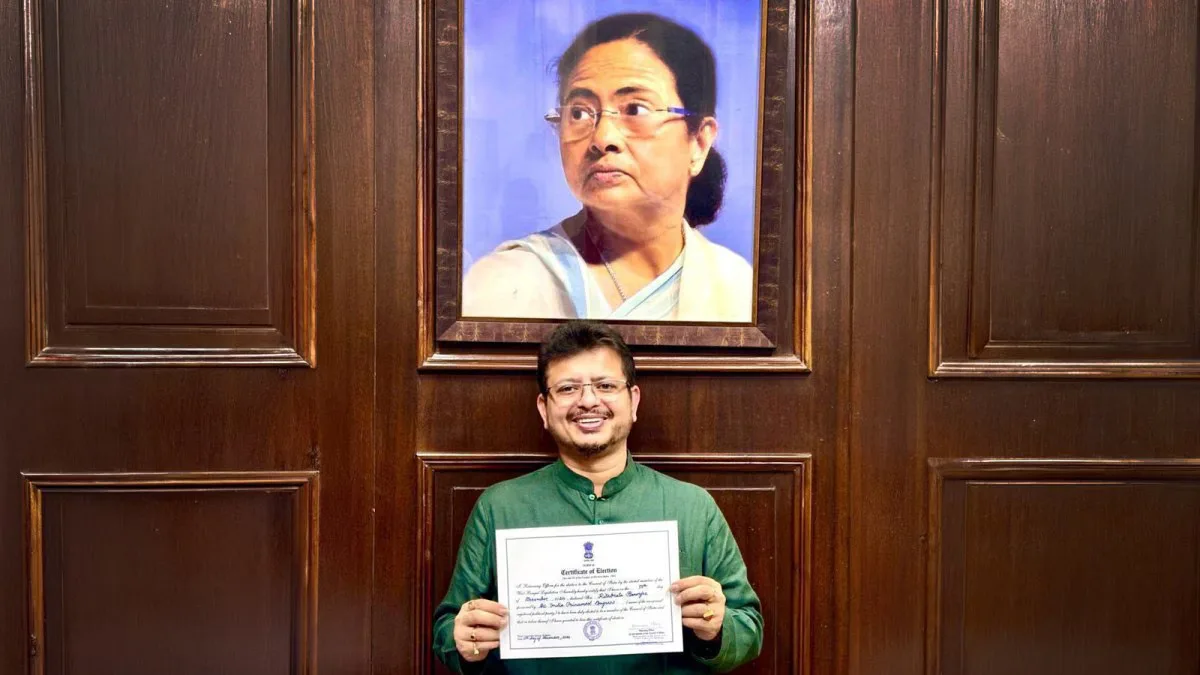
The political crisis engulfing the Trinamool Congress (TMC) took a dramatic turn this week after Ritabrata Banerjee, once expelled by Mamata Banerjee’s leadership, was recognised as the Leader of the Opposition (LoP) in the West Bengal Assembly. The development has not only triggered a legal and political confrontation between rival factions but has also highlighted the growing instability within a party that, until recently, appeared unchallenged in Bengal’s political landscape.
For years, the TMC functioned as a tightly controlled political machine under Mamata Banerjee’s leadership. However, recent months have witnessed an increasing number of public disagreements, factional rivalries, and organisational tensions. The recognition of a rival opposition leadership within the Assembly has now brought those simmering tensions into the open.
The controversy comes at a politically sensitive moment for the former ruling party. Since suffering a major electoral setback at the hands of the BJP, questions have emerged regarding leadership, organisational discipline, and the party’s ability to retain its traditional support base. The latest confrontation over the Leader of the Opposition post is being viewed by many political observers as the clearest indication yet that internal cohesion within the TMC is under strain.
At the centre of the controversy is the office of the Leader of the Opposition, a position that is often misunderstood as merely ceremonial. In reality, the post carries significant statutory authority and institutional influence. As rival camps within the TMC now battle for control of the office, the fight is no longer simply about prestige. It is about who gets to represent the opposition voice inside the Assembly, who gains institutional legitimacy, and who acquires leverage over future political developments.
The recognition of Ritabrata Banerjee has particularly angered the Mamata Banerjee camp because it elevates a former insider into a position that carries both political visibility and legal significance. TMC leaders have already indicated that they intend to challenge the recognition in court, arguing that the decision is legally untenable.
Behind the legal arguments, however, lies a much larger political struggle.
More importantly, the office holder becomes part of several crucial selection committees responsible for appointing senior officials to key oversight institutions. These may include bodies such as the Lokayukta, Human Rights Commission, Information Commission, and other statutory watchdogs.
Control over the LoP post therefore translates into influence beyond the Assembly floor. For any faction seeking to establish itself as the principal political alternative, securing the office provides direct access to important institutional processes.
This explains why the battle has become so intense.
For the rival camp led by Ritabrata Banerjee and his supporters, recognition as the Leader of the Opposition is more than a personal victory. It represents formal acknowledgement by the Assembly system that they constitute a legitimate political force. Such recognition can help attract legislators, local leaders, district-level organisers, and workers who may already be uncertain about the future direction of the TMC.
Political defections often accelerate when party workers begin to believe that a new centre of power is emerging. The LoP designation sends exactly that signal.
For Mamata Banerjee’s leadership, therefore, the issue extends far beyond one Assembly position. Losing control of the opposition narrative within the legislature risks creating the perception that the party’s authority is weakening.
That perception has become particularly damaging because it comes against the backdrop of growing dissatisfaction within sections of the party after recent electoral setbacks.
The BJP’s advances in Bengal have fundamentally altered the state’s political equation. For the first time in years, the TMC has faced sustained pressure from a well-organised opposition capable of challenging its dominance across multiple regions.
Many believe the current crisis reflects precisely such a moment.
Several leaders who once remained firmly aligned with the central leadership have begun expressing differences more openly. Disagreements that were previously managed internally are increasingly playing out in public. The emergence of competing power centres has further complicated matters.
The battle over the LoP position has become the most visible manifestation of this broader struggle.
Inside the Assembly, the office carries considerable operational authority. The Leader of the Opposition receives priority speaking opportunities during important debates, plays a central role during Question Hour, coordinates opposition floor strategy, and helps determine which issues receive sustained legislative attention.
Control over these mechanisms allows a political faction to shape public discourse and dominate media narratives emerging from the legislature.
For a breakaway group, this visibility is invaluable.
The importance of the post also extends into the legal arena. Under India’s anti-defection framework, legislative recognition can significantly strengthen a faction’s arguments when disputes reach constitutional authorities or courts.
While the final authority on disqualification matters rests with the Speaker, formal recognition as Leader of the Opposition can become a powerful political and legal asset during subsequent litigation.
Institutional recognition often allows rebel factions to argue that they represent a substantial legislative grouping rather than isolated defectors.
This is one of the reasons why the struggle has become so fierce.
The current confrontation has effectively transformed the West Bengal Assembly into a stage for a larger political conflict within the TMC itself. Rather than focusing solely on the BJP or other opposition parties, sections of the Trinamool Congress are now locked in a battle against former colleagues.
The optics are particularly damaging for a party that has traditionally projected itself as a disciplined and unified organisation under Mamata Banerjee’s leadership.
Every public disagreement, every legal challenge, and every competing claim to authority reinforces the impression of a party facing internal turbulence.
Whether the dispute ultimately ends in court or through political negotiations, the episode has already revealed a significant reality: the battle for the Leader of the Opposition post is, in many ways, a battle over the future direction of the Trinamool Congress itself.
For Mamata Banerjee, the challenge is no longer limited to confronting political opponents outside the party. The more immediate challenge may now be preserving unity within an organisation that increasingly appears divided between competing factions, ambitions, and visions for the future.