When the India Meteorological Department revised its 2026 southwest monsoon forecast on May 29 to 90 per cent of the Long Period Average with a 60 per cent probability of a deficient season. The revision tightened a cautious outlook, IMD’s first long-range forecast, issued on April 13, had pegged the season at 92 per cent of LPA with a 35 per cent deficiency risk, meaning the situation has worsened in the weeks since. It is the first below-normal monsoon forecast since 2023, driven by a developing El Niño over the Pacific, a warm-phase shift in ocean temperatures that weakens the Indian monsoon even as it brings wetter conditions elsewhere.
The IMD classifies anything between 90 and 95 per cent of the LPA as “below normal” and has separately flagged that the monsoon core zone, the rain-fed agricultural heartland of central, western and eastern India could see even less below 94 per cent of LPA. In an earlier era, such a forecast might have triggered only anxiety. In 2026, it lands on a country over the last seven years, it has been rebuilding its relationship with water, not through giant new dams alone, but by reviving what its grandmothers’generation always understood that India was never water-poor, only water-careless.
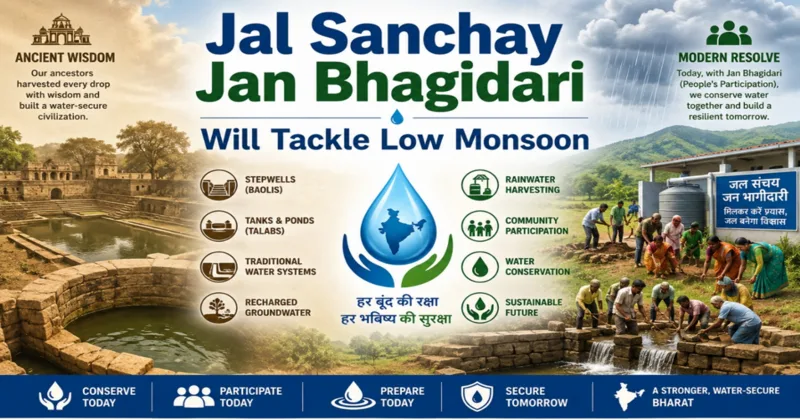
Jal Sanchay through wells and others
Long before pipelines and borewell pumps, Indian civilisation had already solved the puzzle of survival in a land where rain falls hard for four months and then vanishes for eight. In Rajasthan’s Thar desert, villagers built johads, a small earthen check-dams that caught monsoon runoff and let it soak slowly into the aquifer rather than rushing away as flood. Across Gujarat and Rajasthan, master builders carved baolis, also called vavs or bawdis, stepwells descending several storeys into the earth, doubling as architecture, temple and reservoir at once. In household courtyards across the arid west, tankas stored captured rooftop rain underground, keeping a family supplied through the dry months.
This was not folklore, it was hydrology refined over centuries and it had been allowed to decay through decades of neglect, when borewells and tankers seemed like easier substitutes than maintaining a living water heritage. The Ministry of Jal Shakti’s own documentation acknowledges this directly that among the named interventions of the Jal Shakti Abhiyan is the explicit renovation of johads, baolis, ahars and traditional tanks alongside the creation of new structures, a recognition that the answer to India’s water stress was buried in its own villages all along not imported from elsewhere.
The most celebrated proof that this model still works. In Gopalpura, in Rajasthan’s Alwar district, the community-led revival of johads spread to roughly 750 villages, reviving the traditional gram sabha council to plan and maintain the structures, raising water tables and drawing young men back from the cities as farming became viable again. The movement’s foot-soldiers came to be called jal yodhas, water warriors who carried the model from village to village on padyatras. It is in essence Jan Bhagidari before the phrase ever appeared in a government scheme’s name.
Jal Sanchay from folk memory to national mission
What the Modi government has done through Jal Sanchay abhiyan, it reflects the scattered, local genius and making of ancestors. The Jal Shakti Abhiyan, launched in 2019 across 256 water-stressed districts, evolved into the annual “Catch the Rain” campaign from 2021 onward, eventually covering every block in every district, rural and urban alike with a simple, memorable instruction: catch the rain, where it falls, when it falls.
The campaign acquired its present name and fresh energy in September 2024, when Prime Minister Modi launched the “Jal Sanchay Jan Bhagidari” initiative via video conference from Surat, a state whose own water turnaround, including the long-pending Sardar Sarovar Dam, is now held up as a template for the country. The Gujarat pilot alone targeted nearly 24,800 rainwater harvesting and recharge structures, built through a partnership between the Ministry of Jal Shakti, the state government, industry and citizens.
According to the Ministry’s own JSJB portal, more than 10.9 lakh groundwater recharge structures have been identified nationwide, of which over 9 lakh stand already completed, a conversion rate that speaks to execution. The initiative runs on what officials describe as a 3C formula: Community participation, leveraging Corporate Social Responsibility funding, and optimising Cost, a model designed to multiply government outlay with citizen and industry contribution rather than lean on the exchequer alone.
The mission does not stop at villages. Under Jal Shakti Abhiyan’s urban component, municipal bodies have been pushed to enforce rainwater harvesting through the Model Building By-Laws of 2016, set up dedicated RWH cells to track groundwater extraction, and promote reuse of treated wastewater in construction, horticulture and even fire-fighting extending the same johad and baoli logic of “catch it locally” to concrete and high-rises.
Women have been placed at the centre of this effort as the 2024 edition of Catch the Rain carried the theme “Nari Shakti se Jal Shakti” and on the ground this has translated into recognition for grassroots leaders such as a woman sarpanch from Rajnandgaon in Chhattisgarh, honoured by the Union Jal Shakti Ministry for her work in local water management proof that Jan Bhagidari is not a slogan confined to press releases.
Jal Sanchay Abhiyaan among states
In the first Jal Sanchay Jan Bhagidari Awards, Telangana topped the list with 5.2 lakh water conservation structures, followed by Chhattisgarh at 4.05 lakh and Rajasthan at 3.64 lakh. Chhattisgarh has since launched a second phase of its own campaign, targeting 10 lakh structures by May 31, 2026, with geo-tagging of every structure and water budgets now prepared at the Gram Panchayat level turning what was once an invisible resource into one local bodies can actually plan around. Over four lakh farmers with landholdings above ten acres are being encouraged to build dabris or farm ponds, serving irrigation and groundwater recharge together.
Madhya Pradesh has run a parallel push, the Jal Ganga Samvardhan Abhiyan, restoring traditional water bodies alongside new farm ponds, recharge pits and Amrit Sarovars. Dindori district has emerged as the state top performer and more than 3.97 lakh structures have been built across Madhya Pradesh so far, monitored through a real-time central dashboard. Union Jal Shakti Minister C.R. Patil has repeatedly framed this as the fulfilment of the Prime Minister call to make water conservation a genuine people’s movement rather than a department paperwork exercise, urging district collectors at events from Haryana to Chhattisgarh to deploy MGNREGA funds effectively toward these works.
Why this year matters more
None of this would carry the weight it does without the IMD’s warning hanging over the season. A below-normal monsoon does not merely mean less rain for four months, it threatens kharif sowing, rural incomes, drinking water security through next summer and the health of aquifers that took decades to deplete and will take years to refill. This is precisely the scenario the architects of the Jal Shakti Abhiyan anticipated when the campaign was first conceived, after a 2019 NITI Aayog assessment warned that 21 major Indian cities risked exhausting their groundwater. Recharge structures built in 2024 and 2025 cannot undo a weak monsoon, but they determine how much of whatever rain does fall actually stays in the ground rather than running off uselessly toward the sea.
That is the deeper argument worth taking from this moment Indian water security strategy under this government has never depended on hoping the monsoon behaves. It has depended on building and village structure with the same capacity to “catch the rain where it falls” that our ancestors mastered with johads and baolis now scaled with geo-tagging, CSR partnerships and a Prime Minister willing to treat water as a civilisational priority rather than a seasonal headline.
Over 9 lakh completed structures, district-wise dashboards and award rankings between states are not the trappings of a publicity exercise but of a programme designed to be audited. Whether 2026 delivers 90 per cent of normal rainfall or worse, the real test of Jal Sanchay Jan Bhagidari will show up in the water tables of villages that did the work. In the kharif fields that stay green a little longer and in the wells that do not run dry by April. In a year when the sky has chosen to give less, the measure of a self-reliant Bharat is how much of that less the nation still manages to keep.