
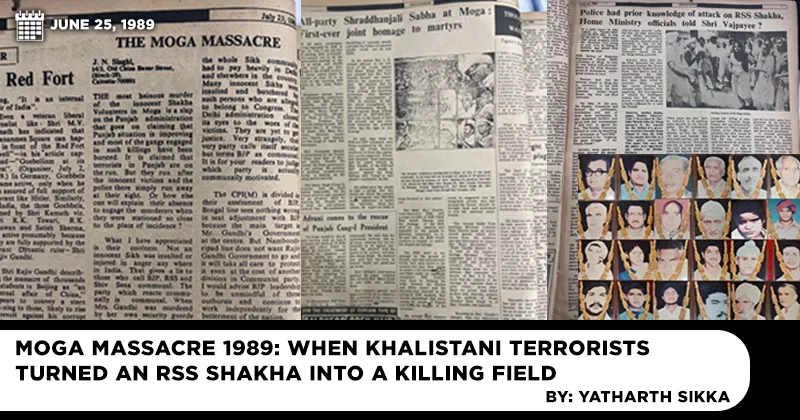
The morning of June 25, 1989, began like any other day in Punjab’s Moga town. In the Nehru Park, Rashtriya Swayamsevak Sangh (RSS) Swayamsevaks had assembled for their routine morning shakha. The gathering consisted of ordinary citizens, shopkeepers, students, professionals and elderly men participating in a daily activity that had become a part of their lives. Within minutes, however, the park became the site of one of the bloodiest terrorist attacks in Punjab’s history.
Armed Khalistani terrorists entered the park and opened indiscriminate fire on the gathering. Witnesses later recalled that the attackers first challenged the swayamsevaks and demanded that the Bhagwa Dhwaj be lowered. When the demand was rejected, bullets began raining down on the gathering. Twenty-five people were killed, dozens were injured, and an entire nation was left stunned by the brutality of the attack.
Yet the Moga massacre was not merely a tragic incident of terrorism. The attack raised serious questions regarding intelligence failures, administrative preparedness, the motives of the terrorists, and the broader strategy of separatist groups operating in Punjab in the late 1980s. Contemporary reports, intelligence assessments, political reactions, and archival records reveal that the massacre was part of a larger conflict between forces seeking to divide society and those attempting to preserve social harmony in the midst of one of India’s most difficult internal security crises.
Nearly four decades later, the Moga massacre deserves renewed examination.
The attack occurred at a time when the Punjab insurgency was entering a critical phase. Throughout the 1980s, terrorist organisations advocating Khalistan had targeted political leaders, security personnel, journalists, intellectuals, and ordinary civilians. The objective extended far beyond isolated acts of violence. Terrorist groups sought to create an atmosphere of fear, weaken public confidence in the state, provoke communal divisions, and ultimately advance their separatist agenda.
By 1989, official claims suggested that the security situation in Punjab was improving. Government representatives repeatedly stated that militant networks were being dismantled and that terrorists were on the defensive mode. However, the events at Moga shattered that perception.
The manner in which the attack was carried out indicates careful preparation. The terrorists possessed precise knowledge of the shakha’s location, timing, and routine. They arrived armed with automatic weapons and executed their operation within minutes. Their objective was not assassination but mass killings. Every individual present at the site became a target.
Eyewitnesses described scenes of unimaginable horror. Bullets struck RSS swayamsevaks sitting in formation. Panic spread across the park as people attempted to flee. Some collapsed where they stood. Others sought shelter behind trees. The terrorists continued firing without discrimination. The attack left bodies scattered across the ground and transformed a peaceful morning gathering into a battlefield.
Among the victims were RSS swayamsevaks and local residents who happened to be present in the area. Particularly moving was the story of Om Prakash and his wife Chhinder Kaur. As the terrorists attempted to escape, the unarmed couple reportedly confronted them in an effort to stop them. They paid for their courage with their lives. A one-and-a-half-year-old child named Dimple was also killed. The death of a toddler underscored the indiscriminate nature of the violence.
A powerful explosion followed the firing. A bomb planted by the attackers detonated shortly after the shooting, causing additional casualties. The use of explosives suggests that the operation was designed not only to kill but to maximise panic and destruction. In this a couple and two policemen were killed.
Archival reports from Organiser indicate that intelligence agencies had received information suggesting that terrorists were planning retaliatory attacks following the killing of the notorious militant Charanjit Singh Channi. Security agencies reportedly anticipated attempts to target Hindus in Punjab. According to contemporary accounts, district authorities were informed about the possibility of such attacks.
The issue gained greater significance when senior BJP leader Atal Bihari Vajpayee stated that Home Ministry officials had informed him those authorities possessed prior information regarding a possible attack on RSS shakhas.
Now, the question is, if security forces has prior information then, why was a public gathering allowed to proceed without additional protection?
Some officials reportedly suggested that security personnel were unable to respond immediately because they could not accurately identify the attackers within the crowd. Beyond questions of security and intelligence lies another issue: why was an RSS shakha chosen as the target?
The answer appears to lie in the role the organisation was playing in Punjab during that period.
Several contemporary reports linked the attack to the RSS’s involvement in supporting the distribution of newspapers belonging to the Hind Samachar group. Earlier in 1989, terrorist organisations had issued threats against Punjab Kesari, Jag Bani, and Hind Samachar. These newspapers had consistently opposed separatist violence and criticised extremist groups. As a result, they became targets of intimidation.
Terrorists sought to suppress circulation by threatening hawkers, distributors, and vendors. Fear spread rapidly, and circulation figures reportedly declined sharply. It was at this point that RSS swayamsevaks stepped forward to assist in newspaper distribution. According to intelligence assessments cited at the time, swayamsevaks helped ensure that thousands of copies continued reaching readers despite terrorist threats.
This intervention carried significance beyond newspaper sales. Control over information has always been central to extremist movements. By helping maintain circulation, RSS swayamsevaks made it clear that intimidation would not silence the voices.
Many observers therefore concluded that the Moga massacre may have been intended as retaliation against those efforts.
Another possible motive relates to the RSS campaign promoting Hindu-Sikh unity during one of Punjab’s most turbulent periods. Terrorist organisations depended heavily upon narratives of division. Their political project required the portrayal of Hindus and Sikhs as separate and opposing communities.
Past reports indicate that RSS swayamsevaks were actively engaged in initiatives promoting fraternity between communities. RSS swayamsevaks participated in relief efforts, assisted victims of terrorism, and supported families affected by violence. Particularly noteworthy were efforts to assist children orphaned by terrorist attacks, many of whom belonged to Sikh families.
RSS swayamsevaks showed that ordinary Hindus and Sikhs continued to share social bonds despite the efforts of terrorists to divide them.
In this context, the selection of an RSS shakha as a target acquires deeper significance. The attack was not simply directed against individuals. It was directed against an organisation that represented a united vision of Punjab, one based on coexistence rather than separation.
Throughout Punjab’s troubled decade, extremist groups repeatedly attempted to provoke communal reactions. The Moga massacre offered precisely such an opportunity. Twenty-five people had been killed in broad daylight. Emotions were running high. A communal backlash could easily have followed. Yet none occurred.
The response of RSS swayamsevaks and their families was particularly significant. Instead of retreating in fear, they returned to the same site on June 26, less than twenty-four hours after the massacre and conducted another shakha. Approximately one hundred swayamsevaks gathered where their fellow swayamsevaks had been murdered.
The swayamsevaks sang songs celebrating Hindu-Sikh unity, including, “Kaun Kahanda Hindu-Sikh Vakh Ne, Ae Bharat Maa Di Sajji-Khabbi Akh Ne” (Who says Hindus and Sikhs are different? They are the two eyes of Bharat Mata).
The aftermath of the massacre also witnessed an extraordinary expression of public solidarity. An all-party condolence meeting held in Moga attracted tens of thousands of participants. Political leaders representing diverse ideological backgrounds joined in condemning the attack.
Speakers repeatedly emphasised that terrorism represented a threat not merely to one community but to the entire nation. Calls were made for broader cooperation against separatist violence and for stronger measures to address the security situation in Punjab.
The Rashtriya Swayamsevak Sangh also moved quickly to commemorate the victims. Nehru Park was eventually renamed Shahidi Park. A memorial committee was formed to support bereaved families and preserve the memory of those who had lost their lives. The foundation stone of Shahidi Smarak was laid on July 9, 1989, by Bhaurao Deoras, and the memorial was later inaugurated by Rajju Bhaiya, then Sarsanghchalak of RSS. Annual commemorations till date continue to honour the victims and remind future generations of the sacrifices made during Punjab’s years of terror.
Beyond Moga: A continuing pattern of targeted violence
The Moga massacre was not the first nor the last instance in which RSS swayamsevaks became targets of extremist violence in Punjab. While the 1989 attack remains one of the deadliest assaults on the Sangh, subsequent decades witnessed a series of targeted attacks.
On January 18, 2016, two motorcycle-borne assailants wearing monkey caps opened fire at New Kidwai Nagar Park in Ludhiana. The location was scheduled to host an RSS shakha later in the day. Fortunately, the ground was vacant at the time of the attack and no casualties were reported. The incident nevertheless raised serious concerns about attempts to target RSS activities even decades after the peak of Punjab’s insurgency.
On the very same day, RSS swayamsevak Naresh Kumar was shot and injured by masked motorcycle-borne attackers near Shaheedi Park in Ludhiana.
Among the other victims was Brigadier (Retd.) Jagdish Gagneja, the then Sah-Sanghchalak of RSS Punjab, who was shot by motorcycle-borne assailants in Jalandhar on August 6, 2016. After battling for life for nearly seven weeks, he succumbed to his injuries on September 22. Investigations later revealed that his assassination was allegedly part of a larger conspiracy linked to Khalistan Liberation Force (KLF) operatives operating across multiple countries.
According to NIA investigations, the conspiracy extended beyond India’s borders, involving operatives and financial networks based in Pakistan, the United Kingdom, Italy, Australia, France, and the UAE. The agency has maintained that the objective was to destabilise Punjab and revive terrorism.
The threat turned deadly again on October 17, 2017, when RSS Swayamsevak Ravinder Gosai was assassinated outside his residence in Ludhiana. Gosai, an RSS functionary, was shot by two motorcycle-borne assailants in a chilling attack that bore similarities to earlier targeted killings carried out by radical elements in Punjab.
Years later, on November 15, 2025 another tragedy struck. Naveen Arora, a 40-year-old RSS swayamsevak from Firozpur, was shot dead while returning home after closing his shop. According to police, the attackers opened fire near Budhwara Wala Mohalla, killing him on the spot. The murder sent shockwaves through the region. Naveen belonged to a family deeply associated with the Sangh; his grandfather, Dina Nath, had served as Firozpur’s Sanghchalak, while his father too remained an active swayamsevak.
Viewed together, these incidents reveal a disturbing continuity. From the massacre at Nehru Park in Moga to targeted assassinations in Ludhiana and Firozpur, RSS swayamsevaks have repeatedly faced violence for their commitment to social harmony, and resistance to separatist ideologies.
The story of Moga and other violent attacks is therefore not only the story of a massacre. It is the story of an attempted assault on the very idea of national unity.