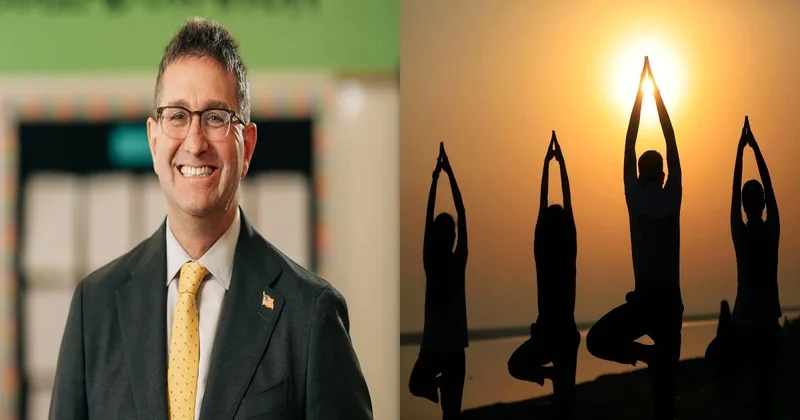
In a notable gesture from an office of importance in the United States of America that resonates deeply with India’s cultural heritage, Delaware Governor Matthew Meyer has officially proclaimed June 21, 2026, as International Day of Yoga in the state.
A proclamation rooted in civilizational respect
The proclamation, issued from the Office of the Governor, stands out for its unambiguous recognition of yoga as “a 5,000-year-old ancient practice from India that integrates the mind, body and spirit to enhance overall health and well-being”.
This clear, upfront acknowledgment of yoga’s Indian origins is profoundly appreciated at a time when attempts to appropriate or dilute ancient Indian knowledge systems have become increasingly common across the world.
United States of America | Delaware Governor Matthew Meyer declares June 21, 2026, as International Day of Yoga in the state of Delaware, and encouraged all residents of the state to "explore this practice for a healthier lifestyle." pic.twitter.com/RoB2YHQKMV
— ANI (@ANI) June 20, 2026
The Indian embassy in the US (New York, to be specific) was quick to revert with a ‘thank you’ acknowledgement.
The Consulate General of India, New York is sincerely grateful to Hon’ble Governor Matthew Meyer @MattMeyerDE for the proclamation declaring June 21, 2026 as International Day of Yoga in the State of Delaware.
This gracious recognition reaffirms the growing resonance of yoga as… pic.twitter.com/qyxL9S6Lae
— India in New York (@IndiainNewYork) June 20, 2026
Calling out cultural appropriation with clarity
Governor Meyer’s words carry special weight. By leading with yoga’s civilizational depth and its Indian cradle, the proclamation cuts through the noise of cultural appropriation that often seeks to detach such practices from their historical and philosophical foundations.
In many global discourses, there is a subtle but persistent race to rebrand elements of ancient Indian wisdom, be it yoga, meditation, Ayurveda or broader scientific temper rooted in India’s oldest continuous civilization, as generic “wellness trends” or universal discoveries detached from their source. You may
Meyer’s proclamation, by contrast, offers refreshing intellectual honesty and respect. It honours not just the practice but the civilization that gifted it to humanity.
Yoga Beyond Wellness: A civilizational gift from India
The full text of the proclamation elaborates beautifully on yoga’s multifaceted benefits: fostering “physical strength, flexibility, mental clarity, and emotional balance,” while providing “valuable tools for managing stress and improving community health.”.
The United Nations and India’s diplomatic milestone
It further notes the United Nations’ decision to designate June 21 as International Day of Yoga to raise global awareness of its benefits, a landmark achievement that traces directly back to India’s diplomatic initiative in 2014.
Prime Minister Narendra Modi’s visionary push at the UN General Assembly led to the unanimous adoption of the resolution, with 177 countries co-sponsoring it, marking one of the fastest recognitions of any international day in UN history.
Delaware’s recognition and the role of the Indian diaspora
Delaware’s move is particularly significant because it highlights the collaborative spirit between the Indian American community and Indian diplomatic outreach. The proclamation specifically commends the Indian American Community Delaware working in association with the Consulate General of India in New York to organize local events that bring citizens together around wellness, peace, and unity.
These grassroots efforts transform International Day of Yoga from a symbolic observance into lived community experiences, mass yoga sessions in parks, wellness workshops, and educational programs that introduce Americans to yoga’s holistic philosophy.
Strengthening India–US cultural ties through Yoga
From an Indian perspective, such state-level proclamations represent more than ceremonial recognition. They signify the growing soft power of India’s cultural heritage in the United States.
Yoga is not merely exercise; it is a profound darshana, a way of seeing and being, that has sustained Indian civilization through millennia. Rooted in the Vedas, Upanishads, Patanjali’s Yoga Sutras, and various classical texts, yoga embodies India’s ancient emphasis on harmony between individual well-being and cosmic order. Its global spread is a testament to the universality of this wisdom, yet preserving its authenticity remains crucial.
Governor Meyer’s explicit mention of its Indian origins helps counter narratives that attempt to minimize or erase this civilizational credit.
This proclamation adds Delaware to the growing list of U.S. states and cities that formally observe International Day of Yoga. Across America, Indian diplomatic missions and vibrant diaspora organizations have steadily expanded public events, turning June 21 into a vibrant celebration of India’s contribution to global wellness.
These observances serve dual purposes: promoting public health and strengthening people-to-people ties between India and the United States. In an era of strategic partnerships, from defence and technology to clean energy and space, cultural bonds like these provide a warm, humanistic foundation.
The Indian American community’s role deserves special applause. As one of the most successful diaspora groups in the U.S., Indian Americans have leveraged their professional achievements in medicine, technology, academia, and entrepreneurship to also champion cultural causes.
Their advocacy for yoga proclamations reflects quiet confidence and effective civic engagement. It demonstrates how diaspora communities can serve as cultural ambassadors, fostering greater appreciation for India’s ancient contributions while building bridges in their adopted homeland.
All things Sanatani Hindu and Bharatiya
All things Hindu. Yoga, meditation, pranayama, Ayurveda, chakras, mantras, festivals like Holi and Diwali and related practices originate from Hinduism (Sanatan Dharma), rooted in Vedic, Upanishadic, and classical Hindu traditions (Patanjali’s Yoga Sutras, Samkhya philosophy, etc.).
They are civilizational heritage of Bharat.
The Hindu American Foundation (HAF) has led the pushback through its “Take Back Yoga” campaign, highlighting systematic efforts to erase or downplay the explicit Hindu roots while commercializing and profiting from these traditions.
HAF insists on honest acknowledgment: these are Hindu practices being reframed as “ancient Indian,” “secular” or “universal” to make them palatable or marketable.
Here is a short list of Key Appropriations:
Christian Yoga/Holy Yoga/Gospel Yoga: Bible verses, Jesus-focused meditation, and church classes that repackage asanas as “Christ-centered movement,” stripping Hindu philosophy.
Muslim/Islamic Yoga: Practitioners blend postures with salah, dhikr, or Quran, framing it as health practice or compatible with tawhid, often avoiding Hindu origins.
Secular/Fitness Yoga: Dominant Western version, power yoga, hot yoga, apps, and gyms, reduced to exercise and wellness, deliberately removing Om, deities, Sanskrit, and spiritual context.
Mindfulness & Ayurveda: Buddhist-derived mindfulness (e.g., MBSR) and Ayurvedic herbs repackaged as neutral science or lifestyle products.
Festivals & Symbols: Holi turned into colour parties; Diwali into generic lights; Om, mandalas, Ganesha icons used as fashion or decor without Hindu meaning.
The pattern is clear: Global commodification dissociates these practices from Hinduism/Sanatan Dharma to avoid “religious” baggage, enable broader appeal, or sidestep ownership claims, while profiting from their Hindu essence. Cultural exchange is natural; systematic de-Hinduization for profit or conversion is appropriation. India promotes Yoga internationally as its civilizational gift, not a rootless commodity. Acknowledge the source.
Countering narratives that erase India’s legacy
Critically, in a world witnessing rising attempts to appropriate or challenge the antiquity and continuity of Indian civilization, Delaware’s proclamation serves as a timely counter-narrative.
India’s civilization is indeed one of the oldest continuous living traditions, with an unbroken thread of philosophical, scientific and spiritual inquiry stretching back thousands of years. Yoga exemplifies this living heritage, evolving through rigorous experimentation (as seen in texts like the Hatha Yoga Pradipika) yet remaining rooted in timeless principles.
Official acknowledgments like Governor Meyer’s affirm that genuine cross-cultural exchange thrives on respect for origins, not erasure.
As Governor Meyer encouraged Delaware residents to “explore this practice for a healthier lifestyle,” the message extends far beyond one state. It invites Americans to experience yoga not as a fleeting fitness fad but as a time-tested science of well-being.
For India, each such proclamation is a source of pride and a reminder of the responsibility to preserve, promote, and share its heritage authentically.
Yoga as a living, evolving tradition
On June 21, 2026, as yogis gather across Delaware and the world, this proclamation will stand as a beacon of mutual respect. It underscores that yoga’s journey from the banks of the ancient Saraswati and the Ganga to American statehouses is one of shared human aspiration for health, harmony, and higher consciousness. India warmly appreciates Governor Matthew Meyer’s leadership and looks forward to deeper cultural collaboration in the years ahead.
In celebrating Delaware’s initiative, we celebrate not just yoga’s global appeal but the enduring civilizational confidence of Bharat, a confidence that generously shares its treasures while proudly owning their roots.