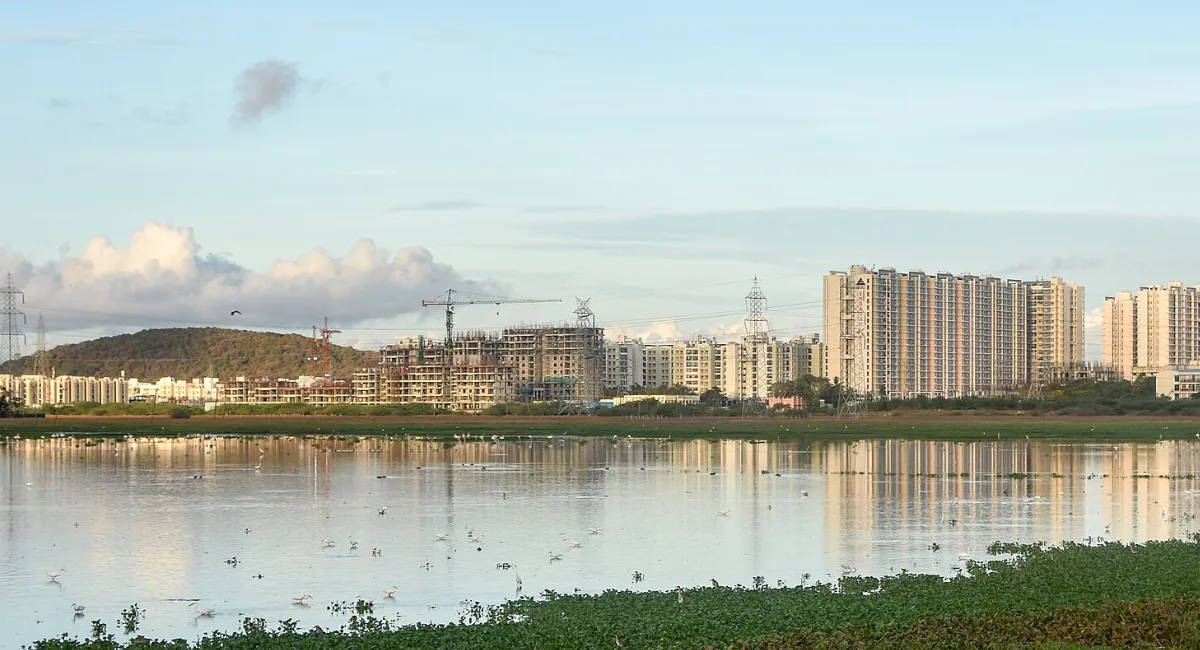
In a significant decision, the Joseph Vijay-led TVK government has revoked the environmental clearance granted during the previous DMK rule to a proposed Rs 2,000-crore residential project in the ecologically sensitive Pallikaranai marshland area near Chennai. The construction company said it will legally challenge the Tamil Nadu government’s order revoking the environmental clearance, besides publishing advertisements in newspapers.
The project, promoted by Brigade Group, comprises a 1,250-unit large multi-storey residential complex spread across 14.7 acres in Perumbakkam. It is alleged to fall within the ecologically sensitive Pallikaranai Ramsar Wetland site.
The environmental clearance was cancelled by the State Level Environment Impact Assessment Authority (SEIAA), which found that the developer had allegedly violated a key condition attached to the approval.
According to SEIAA, construction-related activities were initiated without first obtaining a mandatory no objection certificate from the Tamil Nadu Wetland Authority. The absence of the required clearance from the wetland regulator prompted SEIAA to withdraw the project’s environmental approval.
Arappor Iyakkam, an NGO that spearheaded the campaign demanding the cancellation of permission for the project, has now hailed the government’s decision.
The NGO complained last October that the site fell within the Ramsar area. It had submitted a petition to CM Vijay on June 14.
Big News: Environmental Clearance cancelled for Rs 2000 Crore Brigade Morgan Heights given within Pallikaranai Ramsar Marsh
Brigade Heights – சுற்றுச்சூழல் அனுமதி ரத்து!
பாதுகாக்கப்பட்ட பள்ளிக்கரணை ராம்சார் சதுப்பு நிலத்தை அரசாங்கத்திடம் இருந்து பாதுகாக்க அறப்போர் இயக்கத்துடன்… pic.twitter.com/fhBwieRmPs— Arappor Iyakkam (@Arappor) June 18, 2026
Parts of the wetland system are associated with the internationally recognised Ramsar Convention network of protected wetlands, making conservation concerns particularly sensitive.
YouTuber Savukku Shankar, in a post on X, said, “Lot of skeletons will come out. Former Chief Secretary will have a lot of answering to do.”
Excellent decision @CMOTamilnadu. Excellent. And also please order a probe as to how permission was given. Lot of skeletons will come out. Former CS will have a lot of answering to do. https://t.co/leONc34oBB
— Savukku Shankar (@SavukkuOfficial) June 18, 2026
It is being alleged that a former influential DMK minister and some DMK bigwigs were involved in the scam.
Just reiterating: The order was passed on May 8, two days before Chief Minister Vijay was sworn in.
The member secretary of the TN state wetland authority wrote the letter on April 16, when the Model Code of Conduct was in force. https://t.co/sFYX4ZbOsV— Siddharth Prabhakar (@Sidprabhakar7) June 18, 2026
TN BJP chief spokesperson Narayanan Thirupathi said, “I welcome the cancellation by the State Environmental Impact Assessment Authority (SEIAA) of the illegal approval granted by the DMK government to the Brigade Morgan Heights project — which planned to construct 1,250 multi-storey residential apartments worth ₹2,000 crore in the Pallikaranai Ramsar Wetland.”
I welcome the cancellation by the State Environmental Impact Assessment Authority (SEIAA) of the illegal approval granted by the DMK government to the Brigade Morgan Heights project — which planned to construct 1,250 multi-storey residential apartments worth ₹2,000 crore in the…
— Narayanan Thirupathy (@narayanantbjp) June 18, 2026
He said, “The Authority has also ordered the cancellation of the Encumbrance Certificate (EC) issued for the said land. Beyond this, all approvals given by the Chennai Metropolitan Development Authority (CMDA) for this project should also be cancelled, and strict action must be taken against everyone responsible for this scam. I extend my appreciation to Arappor Iyakkam for their relentless efforts in preventing the destruction and exploitation of nature. When I had earlier raised this irregularity, strongly condemned it, and urged the previous DMK government to take severe action against those involved, a few politicians and individuals connected to the project exerted various forms of pressure on me.”
Meanwhile, the Brigade Group said it will legally challenge the Tamil Nadu government’s order revoking the environmental clearance, describing the move as arbitrary and legally unsustainable. The group said that the project is on private patta land and that neither the government authorities nor the Madras High Court had conclusively designated the site as wetland. It also alleged that the environmental clearance was cancelled without prior notice or a hearing.
The Brigade Group said, “We have begun returning the booking amounts to the purchasers in light of the ongoing issues.”
In another move, the new government has strictly frozen ₹1,800 crore in pending dues for Chennai Corporation works carried out during the previous DMK regime. There are severe complaints that up to a 25% ‘commission’ was taken and poor-quality work was carried out without any care.
🚨 BREAKING: The TVK government has strictly frozen ₹1,800 Crores in pending dues for Chennai Corporation works done during the previous DMK regime.
Severe complaints that up to 25% 'commission' was taken and poor-quality work was done without any care.
CM Joseph Vijay has… pic.twitter.com/5LUSiqVjZG
— George (@georgeviews) June 19, 2026
CM Joseph Vijay has ordered a full quality review of all past and ongoing works. New tenders have been completely banned for now. Any contractor who carried out low-quality work will be permanently blacklisted from future projects.
What are Ramsar Sites?
Ramsar Sites are wetlands recognised as being of international importance under the Ramsar Convention, an international treaty adopted in 1971 in the Iranian city of Ramsar for the conservation and sustainable use of wetlands. A Ramsar designation does not transfer ownership or control to any international body; instead, it commits the country to conserving the wetland’s ecological character while allowing sustainable community use.
India’s Ramsar network
India became a signatory to the Ramsar Convention in 1982. The country now has 100 Ramsar Sites, covering over 13.8 lakh hectares, making India the nation with the highest number of Ramsar Sites in Asia and among the top three globally. Of these, 74 sites have been added since 2014, reflecting a significant expansion in wetland conservation. Tamil Nadu has the highest number of Ramsar Sites (20), followed by Uttar Pradesh.
Governance and protection
Wetland conservation in India is primarily governed by the Wetlands (Conservation and Management) Rules, 2017, which mandate State Wetland Authorities to identify, notify and manage wetlands. These rules prohibit activities such as reclamation, conversion for non-wetland use, dumping of waste and discharge of untreated effluents in notified wetlands, while promoting sustainable management through state-specific conservation plans.