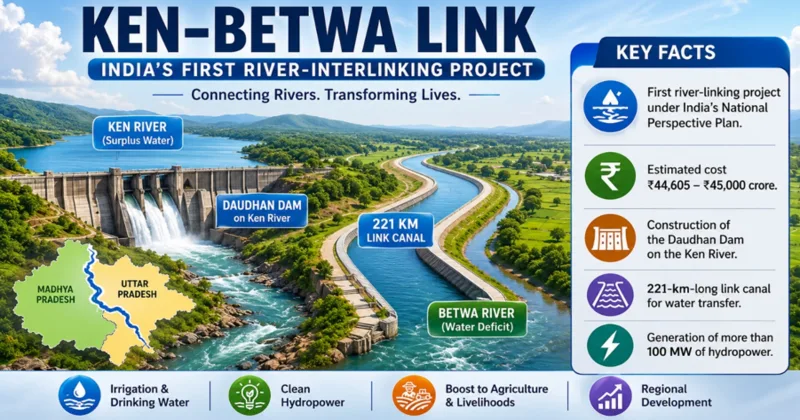
For more than four decades, the idea of interlinking Indian rivers together remained a blueprint on paper, a vision of late Atal Bihari Vajpayee and reaching back to the National Perspective Plan formulated in 1980. Today that idea is finally on ground. The Ken-Betwa Link Project (KBLP) is the first scheme to take physical form under that plan and its progress is being watched closely as a test case for whether river interlinking can move from political ambition to engineering reality.
The logic of the project was simple. The Ken River in Madhya Pradesh carries more water than its basin can use, the Betwa basin in Uttar Pradesh uses lower part. Both are tributaries of the Yamuna. The KBLP proposes to transfer the Ken surplus to the parched Betwa basin by substitution, a hydrological balancing act intended to even out the fortunes of two neighbouring river systems. The principal beneficiary is Bundelkhand, the semi-arid belt straddling 13 districts of the two states that has long been synonymous with drought, crop failure and distress migration.
The water-sharing dispute that stalled the project for years, MP and UP could not agree on how much water would flow when, finally resolved with a memorandum of agreement signed on March 22, 2021, between the Union Jal Shakti Ministry and the two state governments. The Union Cabinet had cleared the project in December 2021 and Prime Minister Narendra Modi laid the foundation stone at Khajuraho on December 25, 2024.
The Numbers that reflect why it matters
The KBLP carries an estimated cost of Rs 44,605 crore, with central support of Rs 39,317 crore. It is being executed through a Special Purpose Vehicle, the Ken-Betwa Link Project Authority (KBLPA) with the National Water Development Agency spearheading implementation.
At the heart of the engineering is the Daudhan Dam, a 77-metre-high roughly 2.1-kilometre-long structure being raised on the Ken in Chhatarpur district, inside the Panna Tiger Reserve. The dam will hold a gross storage capacity of 2,853 million cubic metres water. From there the Ken-Betwa Link Canal runs around 221 kilometres long including a 2-kilometre tunnel section, alongside a separate set of high-level and low-level tunnels and two powerhouses.
The project is designed to provide annual irrigation to 10.62 lakh hectares, of which the larger share, 8.11 lakh hectares, lies in Madhya Pradesh and 2.51 lakh hectares in Uttar Pradesh. It is expected to supply drinking water to about 62 lakh people, generate 103 MW of hydropower and adds 27 MW of solar power. Of the total 4,543.52 MCM drawn from the Daudhan reservoir, Madhya Pradesh is allocated 2,350 MCM and Uttar Pradesh 1,700 MCM for irrigation, drinking and industrial use.
The project is divided in two phases with different funding patterns. Phase I covers the Daudhan Dam complex, the tunnels, the link canal and the powerhouses, which is funded 90 per cent by central grant and 10% by the states. Phase II, comprises the Lower Orr Dam, the Bina Complex Project and the Kotha Barrage, follows a 60 per cent grant, 30 per cent central loan and 10% state share formula. The full project is slated for completion within eight years.
How the SP-BSP Government’s Neglect and the Inter-State Dispute Delayed the Project
The National Perspective Plan of 1980s was pushed by Atal Bihari Vajpayee, the Ken-Betwa Link languished for decades and the years of Samajwadi Party rule in Uttar Pradesh saw little decisive movement toward resolution. The central obstacle was an unresolved inter-state water-sharing disagreement between Uttar Pradesh and Madhya Pradesh. While neither state objected to its broad allocation, Uttar Pradesh pressed for a larger share, around 935 MCM, during the lean pre-monsoon months to support its rabi crop, precisely when Madhya Pradesh, as the upstream state was least willing to release water from a basin already running low. This seasonal deadlock, each state guarding its own interest, stalled any binding agreement and kept the project frozen on paper. Critics argue the period reflected a broader pattern of treating Bundelkhand’s water crisis as an emergency to be managed through drought relief and tanker funding rather than a structural problem to be engineered away. During the severe 2016 drought, the state government response centred on seeking thousands of crores for water tankers, even declining a central water-train offer, rather than driving the permanent inter-state settlement the link project required. The result was years of avoidable delay while the region’s distress deepened.
Where the Work Stands
After the December 2024 foundation stone, site preparation got under way through 2025, with civil work scaling up from around September 2025 onward. The dam construction contract has been awarded to NCC Limited. Through late 2025 and into 2026, work has continued on the Daudhan Dam in Chhatarpur, the most visible marker of the project moving from paperwork to concrete. For a scheme that spent decades in file, the steady progress on the dam is itself the headline.
Why Bundelkhand Is the Centre
It is impossible to understand the political and emotional weight of the KBLP without understanding Bundelkhand. This region water scarcity is not an occasional misfortune but a structural condition, recurring drought has historically driven its young people to migrate outward in search of work and the sight of villagers depending on water tankers has long defined the area in the national imagination. Assured irrigation and drinking water, if delivered, it would change the basic arithmetic of life there, making it possible to farm reliably. The project is the water spine of a broader regional revival that also includes expressways and an emerging industrial corridor, but the dam and canal are the foundation on which the rest depends.
Economic Revival of Bundelkhand After the Project
The Ken-Betwa Link promises to overturn the economic logic that has held Bundelkhand back for generations. Assured irrigation for 10.62 lakh hectares converts a single crop, rain-dependent agrarian economy into one capable of multiple cropping cycles, lifting farm incomes and stabilising the rural base that employs most of the region. Reliable drinking water for 62 lakh people removes the recurring crisis that drove distress migration, allowing working-age youth to stay rather than leave. The 103 MW of hydropower and 27 MW of solar capacity feed an energy starved belt, making it viable to site agro-processing, dairy and small manufacturing units locally. The water security underpins the wider industrial push now layered onto the region, the Bundelkhand Expressway, the new industrial development authority near Jhansi and the defence corridor nodes, none of which can function without assured supply. Land long written off as arid acquires fresh value as irrigated farmland or investable industrial plots. The cumulative effect is a shift in identity defined by drought relief to an emerging investment destination competing on cheaper land and labour. The transformation remains unfinished, but for the first time the foundations of a self-sustaining regional economy are being laid.
Addressing Environmental Concerns
The KBLP is among the most contested infrastructure projects in the country and for substantive reasons. The most serious problem is ecological. The Daudhan Dam sits in the core of the Panna Tiger Reserve and its reservoir is expected to submerge a large tract, estimates of the affected forest area run to roughly 98 square kilometres, threatening tiger habitat as well as gharials in the Ken Gharial Sanctuary and the nesting sites of vultures. Scientists also raised concerns the underlying hydrology, warning that the assumption of a reliable surplus in the Ken may be overstated and that the diversion could disrupt downstream flows. The government is doing best to tackle the problem.
The stakes extend well beyond Bundelkhand. The KBLP is the first of dozens of proposed links under the National Perspective Plan, a programme to interlink rivers across the country whose total cost runs into lakhs of crores. If the Ken-Betwa link delivers on its promises without the ecological and social damage, it will become the case study that unlocks the rest. If it stumbles, on the cost of health of Panna forests, it will harden opposition to the entire interlinking vision.
That is what makes this single dam in Chhatarpur so consequential. It is not only a regional irrigation scheme but a proof of concept for one of the most ambitious India’s water geography ever attempted.