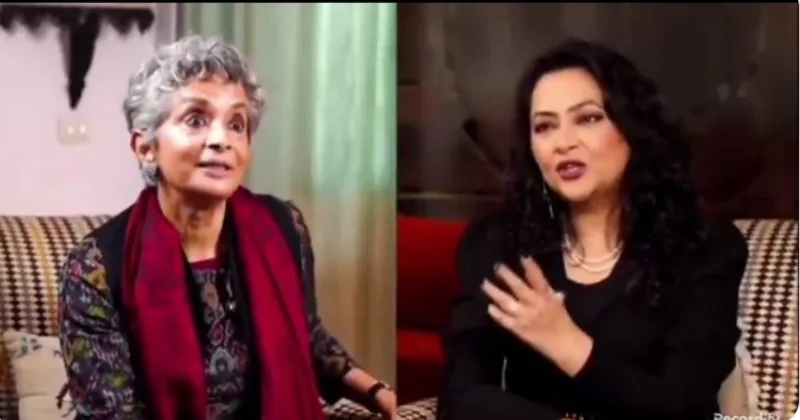
(Left) Nivedita Menon (Right) Arfa Khanum
In a widely circulated podcast clip, retired JNU professor Nivedita Menon and journalist Arfa Khanum Sherwani engaged in a gleeful, mocking exchange about interfaith relationships, especially targeting and insulting Hindu men for objecting to the relationships of Hindu girls with Muslim men.
“Hindu ladkiyon ko Muslim ladke hi kyun pasand aate hain?” Why do Hindu women swoon over Muslim men?
“Hindu mardon se nahi hota, Muslim mard attractive hote hain.” Hindu men are incapable (of sexual prowess) and Muslim men are more attractive.
This is what Arfa Khanum Sherwani and JNU’s Nivedita Menon are discussing.
Dismissing the fact that the Hindu men’s perspective stems from civilizational experience of the Islamic culture, through invaders and also as seen in the bloody Partition of India, treating non-Muslim women as easy prey, legitimate loot, trophies of war, etc.
The two women can be seen indulging in smirks and rude giggles bordering on pornographic delight while dismissing concerns around “Love Jihad” as Hindu male insecurity, with remarks reducing the issue to Muslim men’s supposed superior attractiveness, charisma, bikes, surma (kohl)-lined eyes, and cultural appeal like chewing paan.
Menon framed the phenomenon as evidence of Hindu men’s “bebasi” (helplessness), while the tone suggested Hindu women were simply drawn to more desirable Muslim men. This casual flippancy, treating documented victim testimonies as punchlines, sparked outrage for trivializing coercion, deception, and violence.
Such elite dismissals evade structural realities such as doctrinal asymmetries in Islam that treat non-Muslim women differently, combined with patterns of identity concealment followed by pressure.
“A podcast conversation between Arfa Khanum Sherwani and Nivedita Menon saw Hindu victims belittled and insulted as the duo laughed off concerns about Love Jihad and attributed such fears to Hindu male insecurity,” called out OpIndia. “Instead of examining allegations of religiously motivated grooming, deception, and conversion, the duo chose to speculate on why Hindu women are supposedly attracted to Muslim men,” it stated boldly.
Islamic jurisprudence permits Muslim men to marry chaste Christian or Jewish women (Quran 5:5) but generally prohibits Muslim women from marrying non-Muslim men, viewing it as invalid and risking apostasy consequences.
This one-way permeability, paired with norms around izzat (honor), hijab enforcement, and guardianship, restricts Muslim women’s choices far more than men’s.
Historical permissions for relations with “those whom your right hands possess” (captive women) further embed othering of non-Muslim women in classical texts.
Madrassas and certain networks have faced accusations of reinforcing supremacist attitudes that incentivize pursuit of non-Muslim women as conquest or demographic strategy.
Numerous cases involve Muslim youths allegedly hiding their religious identity, wooing Hindu women (often posing as Hindu), securing relationships or marriage, and then revealing Islamic roots with pressure to convert, adopt customs, abort, or isolate from family.
Victims report love-bombing followed by control, threats, or violence. While consensual relationships occur, courts and police have recorded clusters involving deception, precisely what the podcast mocked. Families and organizations document these as eroding agency, not exercising it.
Shraddha Walkar’s murder exemplified the tragic endpoint: a Hindu woman in a live-in relationship with Aaftab Poonawala was strangled, dismembered into 35 pieces, and disposed of piecemeal.
The Chhangur Baba (Jalaluddin) racket in Uttar Pradesh allegedly involved mass conversions, targeting thousands (including over 4,000 Hindu women per some claims), with foreign funding probes by ED. It operated through fronts, counselling women, and organized events, highlighting networked exploitation beyond isolated romance.
The 2026 TCS Nashik “Corporate Jihad” case involved multiple FIRs at a TCS BPO unit alleging sexual harassment, mental abuse, and religious coercion/conversion pressure by Muslim colleagues/supervisors on Hindu women employees. Undercover probes and arrests followed, with public discourse framing it as workplace grooming and forced Islamization patterns.
AIMIM leader Asaduddin Owaisi has made inflammatory remarks, including boasts invoking Muslim male prowess (echoing “palangtod” tropes of bed-breaking virility and dominance in cultural banter). Watch this eight-year-old clip where he mocks Vishwa Hindu Parishad’s call to Hindus to have 3-4 children to keep the demographic balance.
Asaduddin makes bedroom eyes expressions while smiling and saying that his Muslim brethren are so virile that they can make babies without any help from booster medicines but that the Hindus who cannot sire more ids should eat the Rs 5000 worth Tara paan from a Muslim vendor’s shop named Tara in Chhatrapati Sambhajinagar (previously Aurangabad).
What the Arfas, Niveditas, and Owaisis of the world do not get is that Hindu culture is based on the concept of maryada – control. The various stages in life marked for celibacy and scholarship, then for artharjan and grihasthi, then the veteran phase when one’s wisdom guides and imbibes cultural values in the younger generations. Unlike any other continuous and existing religion and civilisation, Hinduism or Sanatan Hindu culture has allotted place of worship to female deities as well. God is not just male. There is a balance between Shiv and Shakti.
From the Rajputs to the Marathas, from the Sikhs to the time of Partition of undivided India in 1947, through the ages, when Muslim forces were seen invading or gaining an upper hand, Hindu women preferred dying by johar or sword amongst their own instead of courting the danger of being carted away as sex-slaves or trophies of war in the slave markets of the Islamic world.
This is not India-specific. UK inquiries (Rotherham Jay Report: ~1,400 victims, mostly White British girls as young as 11; similar in Rochdale, Telford, Oxford) documented organized group-based child sexual exploitation predominantly by British-Pakistani Muslim men. Perpetrators viewed non-Muslim girls as “easy meat” or lesser (kafir). Police and authorities failed for years, paralyzed by racism fears, political correctness enabled the horror. Convictions and reports (Quilliam, independent reviews) confirmed ethnic/religious skew in these networks.
Mocking concerns as “male insecurity” or cultural tropes while ignoring doctrinal male authority, grooming data, victim testimonies, and cases like Shraddha, Chhangur Baba, TCS Nashik, and UK scandals is not feminism or secularism.
After being called out, Arfa Khanum Sherwani came out with another video saying that with all the state machineries having been hijacked by the Hindu majority and the state, they have only this route available.
It is selective narrative protection. Adult consensual relationships deserve respect for agency. But flattening coercion, identity fraud, post-relationship pressure, and organized patterns into “attraction” erases victims’ voices, often Hindu, Sikh, or Christian women, and discourages scrutiny.
Serious discourse demands evidence over flippancy: address asymmetries, enforce uniform laws against deception and forced conversion, protect women across communities, and reject supremacist incentives. Easy mockery entrenches divisions; facing facts might reduce them.
