The most commonly used saying regarding Adhik Maasa is that whatever is done during Adhik Maasa yields greater results. The original name of Adhik Maasa is Purushottam Maasa. Purushottam means “the best among men,” thus the name.
The system of time calculation in Bharat is extremely scientific. Measuring time is equivalent to measuring life force (prana shakti). It is from Bhagavan Bhuwan Bhaskar Surya (the Sun) that we receive life force, and our entire life is pervaded by it. Therefore, our daily routine, as well as the five limbs of the Panchang — Yoga, Karana, Muhurta, Nakshatra and Tithi — are all determined according to the Sun. The seven days of the week are also based on the movements of the Sun.
On the other hand, the Moon is also important because its gravitational attraction and its relationship with the Earth affect the human mind. Therefore, the Moon is essential for mental well-being. The tithis from Pratipada to Purnima, and from Pratipada to Amavasya, are based on the phases of the Moon. As the Moon’s visible portion increases, it reaches Purnima (Full Moon), and as it decreases, it moves towards Amavasya (New Moon). On Amavasya, the Moon is not visible because its dark side faces the Earth. Therefore, tithi is also important and is determined by the lunar cycle.
According to solar calculations, the solar year also begins with the Sun’s entry into Aries (Mesha Sankranti), which generally falls on April 14 or 15, marking the beginning of Vaishakhi. Thus, both systems of time calculation have existed and remained important in Bharat since ancient times. Solar months are determined by Sankranti. Sankranti occurs when the Sun enters the next zodiac sign, and from that transition a new movement begins.
When the process of creating the National Calendar was undertaken under the leadership of scientist Meghnad Saha, the date of the Sun’s entry into Aries was fixed as March 22. This was an effort to align solar calculations with the present Gregorian calendar. During the period of Islamic invasions in Bharat, Kumbh Melas remained suspended for about 400 years. As a result, the work of Panchang correction and systematic refinement of time calculation did not take place.
Because of this, although the longest night occurs on the Capricorn equinox ie December 22 and the Sun begins its northward journey (Uttarayana), we still celebrate Makar Sankranti only on January 14. Some degree of change occurred over time. Meghnad Saha corrected this and established Chaitra 1 as beginning on March 22 in the National Calendar. The lunar month is based on the Moon’s movement. The Moon’s cycle is about 27.3 days.
Because of the difference between the Moon’s orbit around the Earth and the Earth’s orbit around the Sun, the solar month is about 30 days while the lunar month is about 27 days. Therefore, while the solar year consists of 365 days in the Gregorian calendar and 360 days in traditional Bharatiya calculations, the lunar year may sometimes be around 330 or 340 days.
People often say that Adhik Maasa exists to reconcile this difference, just as the Gregorian calendar introduces a leap year every four years by making February 29 days, thereby adjusting the annual count. However, Adhik Maasa is not merely an adjustment between two systems of time calculation. Behind it lies a significant pranic and scientific principle. It is called Purushottam Maasa because no Sankranti occurs between two Amavasyas. Therefore, in regions north of the Tropic of Cancer, where lunar months begin after Amavasya, that lunar month is called Adhik Maasa because the Sun does not enter any new zodiac sign during that period. Thus, Adhik Maasa is not merely an adjustment; it is the result of an astronomical phenomenon. Because the Sun does not enter a new zodiac sign during this period and no transition takes place, auspicious ceremonial activities are generally not performed. However, for spiritual practices, Purushottam Maasa is extremely important. Since it arrives without a Sankranti, it is called Adhik Maasa. Whatever spiritual practice or sattvic action is performed during this period yields greater results.
Understanding The Debt of Life
In the Bhagavad Gita, three paths of spiritual practice are described: Yajna (sacrifice), Daana (donation), and Tapa (austerity).
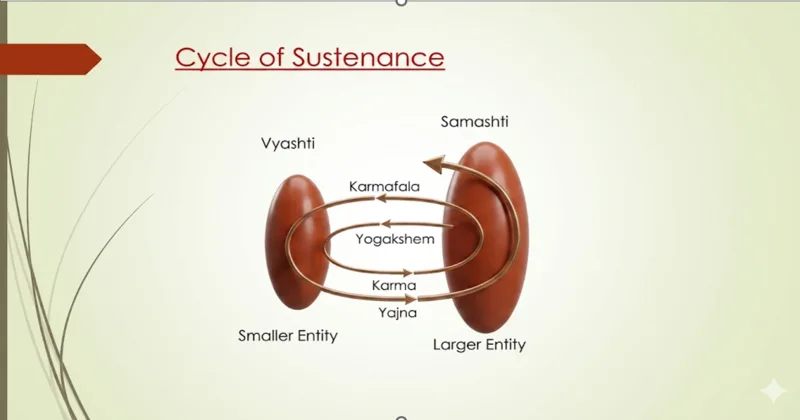
In individual life, enduring discipline and refinement at the physical, mental, and material levels is called Tapas. Tapasya means subjecting oneself to discipline and hardship. It is an important aspect of Raja Yoga and Hatha Yoga, and through Tapas one advances spiritually, awakens Kundalini, and activates life force. In life, we receive more than we give. To repay this debt, we must recognise that from birth we have received everything from our parents and society. Culture, values, language, traditions, customs, and the art and science of life have all been given to us by society.
Parents have given us this body itself. Our DNA, genetics, and chromosomes come from our parents. They provided food and care through which the body developed. The qualities we possess also came through them. Education too was provided for by them. Thus, life itself has been given by parents and teachers. When we become capable and perform actions in life, we give back to society through our vocation. However, in return we receive the fruits of our actions. Because we receive these results, the debt of the support and welfare provided by society and family remains unpaid.
Whether through business, profession, employment, service, or any other work, we receive some form of compensation. Even those who work selflessly for society, such as monks or pracharaks who live a life of Karma Yoga, receive affection, respect, and honour from society. Therefore, we continue to receive more than we give. If we wish to correct this situation, we must act without expectation of reward. Such action is called Yajna, an offering.
The oblations offered into the sacred fire are also offerings because they are given back to nature. The type of substances offered and the materials used nourish nature through the smoke and air that emerge from the ritual. Thus, giving back what we have received, without any expectation of return, is Yajna.
In Sattvic Yajna, nothing is sought in return. Rajasic Yajna is performed with the desire to obtain something. Tamasic Yajna is performed to cause harm to others. The same applies to Tapas. When austerity is pursued with tamasic tendencies, it aims at overpowering or harming others. When pursued with rajasic tendencies, it is aimed at personal gain. When it is sattvic, it is performed selflessly for the welfare of all, with the prayer that all beings may be happy.
The third and simplest path in Kaliyuga is Daana — giving. When donation is given to a worthy recipient, it purifies one’s actions. Even here, one should not act with the desire to gain punya (virtue). It should be done solely with the spirit of giving. This is a way of becoming free from debt. Therefore, during this Adhik Maasa, in which no Sankranti occurs, the Sun is showering its grace upon us completely.
Making use of that life force, we should undertake as much Tapas as possible in our lives. This may include chanting, spiritual practices, worship, or maintaining some period of silence each day. In the modern age, one may even observe digital silence by switching off mobile phones and digital devices for two or four hours daily. If one can do this for an entire day each week, it is even better. One should undertake some form of discipline that challenges the mind, body, or intellect, enabling the attainment of greater sattvic strength.
The Higher Purpose of Yajna
One should perform some Yajna and, most simply, engage in the act of offering. Keeping in mind that greater effort yields greater results in this period, one should donate for the welfare of society. Providing food to the hungry, clothing to those without garments, and shelter to those without homes is one form of Daana. But greater than that is the donation of knowledge. Swami Vivekananda used to quote a Japanese saying: if you give a hungry person a fish, you feed him for a day; if you teach him how to catch fish, you feed him for life. Therefore, the gift of knowledge is greater than the gift of food.
Greater still is the gift of self-knowledge and spiritual wisdom. Today, many Gurukuls are functioning across the country where true knowledge is imparted. Through this education, students receive livelihood skills, become self-reliant, and progress spiritually. They gain instruction in Sanskrit, the Vedas, arts, agriculture, yoga, science, and other branches of knowledge. As a result, they become self-reliant and capable of serving society. Therefore, during this Purushottam Maasa, it is befitting to find a Gurukul and make a donation.
Our tradition prescribes donating one-tenth of one’s income. Out of everything earned during the year, ten per cent (Dashaansh) should be donated for a Dharmik cause. Donating one month’s income would amount to one-twelfth of annual earnings and would be close to one-tenth.
This Adhik Maasa ends on June 15. So, donate as much as possible. Perform some form of Yajna — verbal, mental, or physical. And take a daily resolve to improve yourself. For example, resolve to perform Surya Namaskar daily, observe silence, or engage in chanting. In this way, through Tapas, Yajna, and Daana, during this Purushottam Maasa, we too may become better than we are today. May we continue to progress and become greater in every way every day.