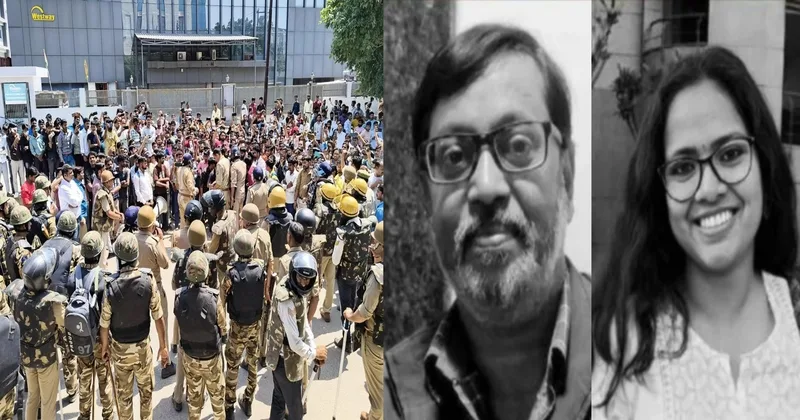
Noida: In a significant escalation of action following the recent labour unrest in Noida, police have invoked the stringent National Security Act (NSA) against accused of playing a key role in the violence that broke out during workers’ protests in April. The move has triggered a sharp debate, with civil liberties groups alleging misuse of the law to suppress dissent.
The two accused, Satyam Verma and Aakriti Choudhary, have been charged under the NSA for their alleged involvement in inciting violence during protests demanding higher minimum wages.
Satyam Verma, 62, a veteran journalist who previously worked in Lucknow and Delhi, is associated with the labour publication Mazdoor Bigul. Police claim that the group Mazdoor Bigul Dasta, which they say was central to the April 13 violence, draws its name and ideological direction from his work. He was arrested in Lucknow on April 17.
Aakriti Choudhary, a Delhi-based student and theatre artist, is also linked to the same organisation. She completed her master’s degree in history from Daulat Ram College, Delhi University, and is currently preparing for a PhD.
According to police officials, both Verma and Choudhary were instrumental in mobilising workers and allegedly encouraged sections of the crowd to turn aggressive. Authorities have cited CCTV footage, social media posts, and intelligence inputs as evidence suggesting their involvement in spreading provocative messages that contributed to the outbreak of violence.
A senior police officer stated that the decision to invoke the NSA was based on the assessment that the actions of the accused posed a serious threat to public order. The law allows preventive detention without formal charges for extended periods in cases involving national security or public safety.
Investigators have alleged that inflammatory content and rumours were disseminated through social media platforms to incite workers against the government. They further claim that certain groups attempted to exploit the labour movement to deliberately trigger unrest and destabilise law and order in the industrial hub.
Police added that efforts are ongoing to identify other individuals who may have played a role in instigating violence or spreading misinformation during the protests.
Sequence of Events: From Protest to Violence
The workers’ agitation in Noida began on April 10, following a decision by the Haryana government to implement a 35 per cent increase in wages for unskilled, semi-skilled, and skilled workers. Inspired by this development, factory workers in Noida’s industrial areas launched demonstrations demanding similar wage hikes and improved working conditions.
Officials noted that the protests remained peaceful for the first three days, from April 10 to April 12. However, the situation escalated dramatically on April 13, when violence broke out across several industrial sectors.
During the unrest, multiple factories reportedly suffered damage, vehicles were set ablaze, and incidents of vandalism were recorded. Police subsequently registered several FIRs across different police stations, including Phase II and Sector 63.
At least seven individuals, including three women, were arrested as key accused in connection with orchestrating the violence. As the legal proceedings unfold, the case is likely to remain under close scrutiny, with implications for both labour movements and the broader discourse on civil liberties in India.